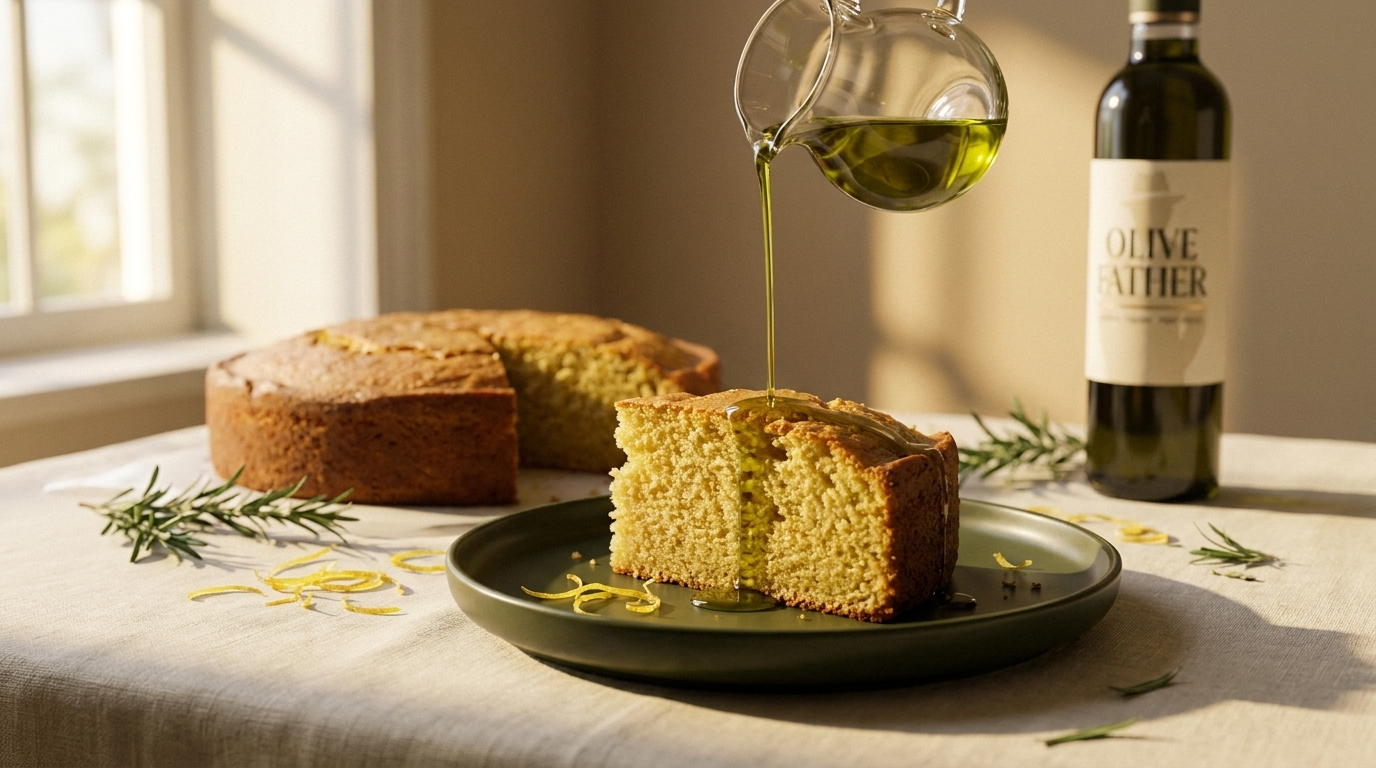
Somewhere along the way, olive oil cake stopped being a curiosity on American menus and became the dessert everyone orders — the one that arrives looking humble and disappears first. Italians find the fuss charming, because in the olive-growing south, baking with oil was never a trend. It was simply what you did with the ingredient you had in abundance and trusted most. Here is why the cake works, what the oil actually does to the crumb, and how to make one that tastes like it came from a grove rather than a mix.
Why oil makes a better crumb than butter
The difference is physical, not sentimental. Butter is roughly one-sixth water; when a butter cake cools, that water helps the starches firm up, which is why yesterday’s pound cake feels dry. Olive oil is pure fat. It coats the flour’s proteins more completely, limits gluten development, and stays liquid at room temperature — so an olive oil cake is tender the day it is baked and often better on day two and three, when the flavors have settled into the crumb. That famous plush, springy, almost damp texture is not a baker’s trick. It is chemistry you can taste.
Then there is the flavor itself. Butter gives a cake richness; a real extra virgin gives it a point of view — green, faintly bitter at the edges, with that peppery finish that oleocanthal leaves at the back of the throat. Sugar softens it, lemon sharpens it, and the result is a dessert that tastes like an ingredient rather than a technique.
The one decision that makes or breaks it
An olive oil cake has five or six ingredients, and the oil is a third of the batter’s character. This is not the place for the anonymous supermarket bottle — a vague blend that tastes of nothing will bake into a cake that tastes of sugar and regret. But it is also not a myth that you “can’t bake with good oil.” Heat mellows an oil’s sharpest edges but keeps its fruit; a fresh, genuinely extra virgin oil bakes into something floral and gently grassy. We wrote about the broader smoke-point misunderstanding in Can You Cook With Extra Virgin Olive Oil? — the short version is that a moderate oven is well within a real EVOO’s comfort zone.
A useful rule from our own kitchen: bake with an oil you would happily eat on bread. If it has a harvest date, a named place, and a little pepper on the finish, it belongs in the batter. Our Organic Extra Virgin — pressed from a single Calabrian grove — is the bottle we reach for.
A simple method that always works
The proportions
For one 9-inch cake: 3 eggs, 200 g sugar, 150 ml extra virgin olive oil, 120 ml whole milk, the zest of two lemons, 250 g flour, 2 teaspoons baking powder, a good pinch of salt. No mixer needed — a whisk and a bowl.
The method
Whisk the eggs and sugar until pale and slightly thickened — two patient minutes. Stream in the oil, whisking as you pour, until the batter turns glossy; this is a loose emulsion, and it is where the crumb’s silkiness is decided. Whisk in the milk and zest, then fold in the dry ingredients just until no flour shows. Into a parchment-lined tin, 45–50 minutes at 170°C (340°F), until deep gold and a skewer comes out clean. Cool it in the tin — an olive oil cake is fragile warm and magnificent at room temperature.
Serve it the Italian way: a dusting of powdered sugar, nothing else — or go where the restaurants go and add a pinch of flaky salt and a fresh thread of the same oil you baked with, poured at the table. That final raw drizzle is where a truly fresh oil — the kind we describe in our tasting notes — earns its keep, aroma fully intact.
A cake that keeps
Wrapped at room temperature, the cake stays moist for four days — it genuinely improves overnight, which makes it the rare dessert you should bake ahead on purpose. It wants espresso in the afternoon, vin santo after dinner, and no occasion at all.
Bake it with the real thing. Olive Father is single-source Italian extra virgin — one grove, one harvest date on every bottle, pressed by a family that has done this for six generations. Explore the range and taste what the cake has been trying to tell you.
Leave a Reply