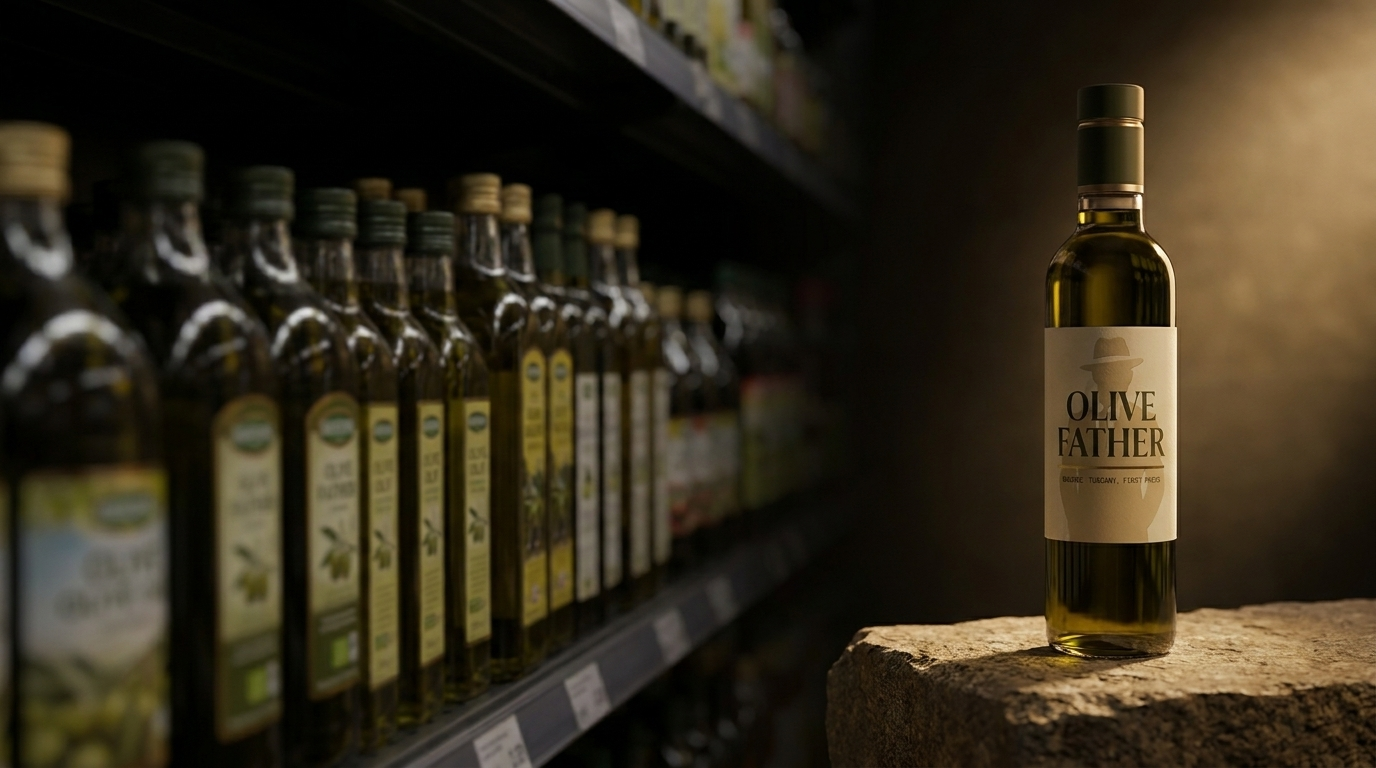
Turn over almost any supermarket bottle of olive oil and, in small print near the barcode, you will find one of the most revealing sentences in the food world: “Blend of olive oils of European Union origin” — or its even vaguer cousin, “of EU and non-EU origin.” Most people never read it. They should. That one phrase tells you more about what is in the bottle than the Tuscan farmhouse on the front label ever will.
What the phrase legally means
Under EU labelling rules, when an olive oil is made from oils of more than one country, the producer does not have to name the countries. They only have to state the broad category: EU origin, non-EU origin, or a mix of both. So “blend of EU and non-EU olive oils” can mean oil from Spain, Greece, Tunisia and Turkey, pooled in a tank and bottled in Italy — legally, and with an Italian flag on the front. “Bottled in Italy” is a statement about geography of the bottling plant, not the olives. If the origin of the fruit were a selling point, the label would say so. When it is hidden behind a category, that is a choice.
What blending does to the oil
Blending is not automatically fraud — it is a business model. Large bottlers buy oils on the commodity market from whichever region is cheapest that season, then blend them to hit a consistent, inoffensive flavour target and a price point. The result is engineered to taste the same in March and November, year after year.
But that consistency has a cost, and it is the oil’s character. The peppery bite, the green tomato-leaf aroma, the taste of an actual place and harvest — those are exactly the edges a blend is designed to sand off. And because bulk oils are bought, shipped, stored and re-stored before bottling, they are often already months old when they are blended. Freshness is the first casualty. A well-known University of California, Davis study found that a large share of imported oils labelled extra virgin failed international sensory standards — many of them tired, oxidised blends. We break down what the grade is supposed to guarantee in what makes quality olive oil.
The traceability problem
Here is the deeper issue: once oils are pooled, no honest answer exists to the most basic questions. Which grove? Which harvest? What acidity was the fruit pressed at? A blender cannot tell you, because the answer is different for every tanker in the tank. That is why blended-oil labels talk about lifestyle and heritage instead of facts — the facts were averaged away. It is the exact opposite of the standard we hold ourselves to on single source & traceability, where every lot traces back to one named grove.
How to read a label in ten seconds
Flip the bottle. If you see “blend of EU olive oils” (or EU/non-EU), you are holding a commodity product — fine for a fryer, not what you want raw on your table. If you see a named estate or village, a harvest date, and a stated free-acidity figure, you are holding oil from someone willing to be checked. Producers hide what embarrasses them and print what makes them proud. The back label is where they tell you which kind they are. For the full picture of what sits on those shelves, read why not supermarket oil.
One grove, no tank farm
Olive Father exists because we think the opposite model makes better oil: one family grove in Calabria, picked at the green moment, milled within hours, bottled under the name of the place it came from — with the harvest, acidity and lot printed on every batch. No pooling, no averaging, nothing to hide. See the range and taste what a bottle says when it doesn’t have to mumble.
Leave a Reply