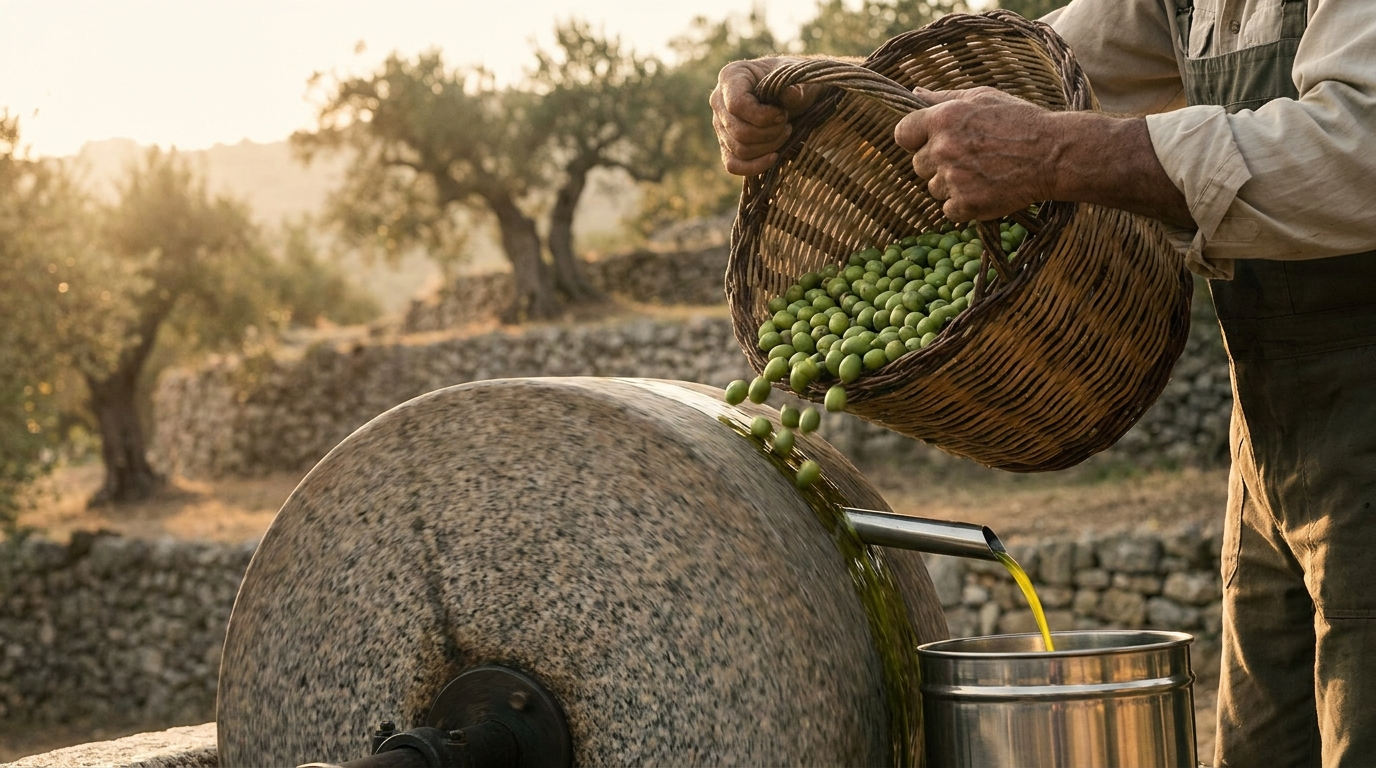
Great olive oil is not manufactured. It is caught — inside a narrow window, by people paying fierce attention. The moment an olive leaves the branch it begins to come apart: its own enzymes wake up, oxygen goes to work on the fruit’s flesh, and the bright, peppery compounds that define a serious oil start counting down. Free acidity climbs. Aroma leaks away. Nothing downstream can put either back.
So everything between the tree and the sealed bottle is a race against one clock, and every decision along the way is the same decision in a different costume: more oil, or better oil. Here is the whole journey as it happens on our estate above San Procopio in Calabria — no stage outsourced, no stage hurried, all of it under one family’s eyes.
1. Harvest — the decision that costs us money
We pick early, while the fruit is still green and firm and the skin has only just begun to turn. Left another three or four weeks, those same olives would swell with oil and hand us a materially larger yield. They would also hand us a softer, sweeter, duller oil, because the phenolic compounds that give a great extra virgin its bitterness, its peppery finish and its shelf life are at their peak in green fruit and fall steadily as the olive ripens. We choose flavour and polyphenols over volume, knowingly, every single year.
How the fruit is handled matters as much as when. Olives go into shallow slatted crates, never heaped into sacks or trailers, because weight bruises fruit and a bruised olive begins fermenting long before it reaches the mill — a fault you can taste in the finished oil as a flat, winey, vaguely muddy note. The whole tense fortnight is set out on our Harvest & Cold Pressing page. It is where the character of the vintage is decided, and its date is the one we later stamp on every label. If you have never thought to look for one, here is why the harvest date is the single most useful number on a bottle.
2. Crushing — measured in hours, not days
Picked fruit goes straight to the mill, minutes down the hill rather than a truck journey away, and is washed, de-leafed and crushed whole — stones and all — into a dense, grassy-smelling paste within hours of leaving the tree. The stone is not an inconvenience to be removed: crushing it releases natural antioxidants that help protect the paste during the minutes that follow.
This is the stage where industrial supply chains quietly lose the plot. Fruit that sits in bins overnight, or travels for a day in warm trailers, arrives at the mill already fermenting, already climbing in free acidity. The oil that results may still be legally sellable. It will never be exceptional. We treat every hour between branch and crusher as flavour walking out of the door, because that is precisely what it is.
3. Malaxation — the most delicate half hour of the year
The paste is then folded slowly in the malaxer, a long trough of gentle steel paddles, so that microscopic droplets of oil trapped in the fruit’s cells can find one another and merge into pools large enough to separate out. Thirty to forty minutes of patient turning is where an oil’s aroma is either built or burned off.
It is also where the phrase “cold extraction” is either honoured or quietly betrayed, because the temptation here is enormous. Warm the paste past 27°C and it will give up noticeably more oil — and surrender the volatile green aromatics and much of the peppery oleocanthal along with it. Malaxe longer and warmer still and you gain yield while oxidation eats the very compounds you were farming for. We hold the line below 27°C, accept the smaller number at the end of the day, and keep the fire in the oil. That trade is the entire philosophy of this house compressed into one temperature.
4. Extraction — physics only
To separate oil from water and solids we use a modern cold decanter centrifuge. No heat, no solvents, no chemical assistance, no second pass over exhausted pomace. The paste spins at a controlled temperature and density does the work: a clean, vivid green ribbon of oil separates from the vegetal water and the spent fruit, and runs out bright.
One quiet detail decides a great deal here — water. Polyphenols are water-soluble, so every litre added to the paste to make it flow more easily washes antioxidants out of the oil and into the waste stream. The discipline is to add as little as the fruit will allow. This is what “mechanically extracted” means when it is done honestly, and it is the discipline behind the laboratory numbers that define genuine extra virgin quality: free acidity a fraction of the legal ceiling, peroxides low, polyphenols intact and measurable.
5. Filtration — clarity bought with a little body
A cloudy, unfiltered bottle looks romantic and photographs beautifully. It is also a slow fuse. Those suspended fruit particles carry moisture and sugars; given a few months in a warm kitchen they ferment, and fermentation is exactly how a gorgeous young oil turns musty and stale on a shelf.
So the new oil is gently filtered while it is still at its most vivid. We give up a trace of texture and buy the oil months of additional life — brilliant, stable, and still tasting of the week it was pressed when it reaches a table four thousand miles away. For an oil that crosses an ocean to reach you, that is not a close call.
6. Storage and bottling — protecting it from the obvious enemies
Finished oil rests in sealed, temperature-controlled stainless steel, shielded from the three things that destroy olive oil: heat, light and oxygen. It is bottled only as it is needed — dark glass, filled and closed tight, then stamped with its harvest, its acidity and its lot number so that any bottle can be traced back to the fortnight and the grove that produced it.
Every one of these stages happens in Italy, on and around the family’s own land. Nothing is shipped off in bulk tankers to be blended by strangers in a port warehouse, which is the ordinary fate of most oil sold as Italian. That unbroken chain is the whole point of our single-source guarantee — and the reason the supermarket bottle is a different product, not merely a cheaper one.
What arrives in your kitchen
What you pour is exactly what the Olive Father made: one grove, one harvest, one pressing, one unbroken chain of attention, with a date on the label to prove how recently it happened. Meet the six generations behind it in our story, or go straight to the finished result on the products page.