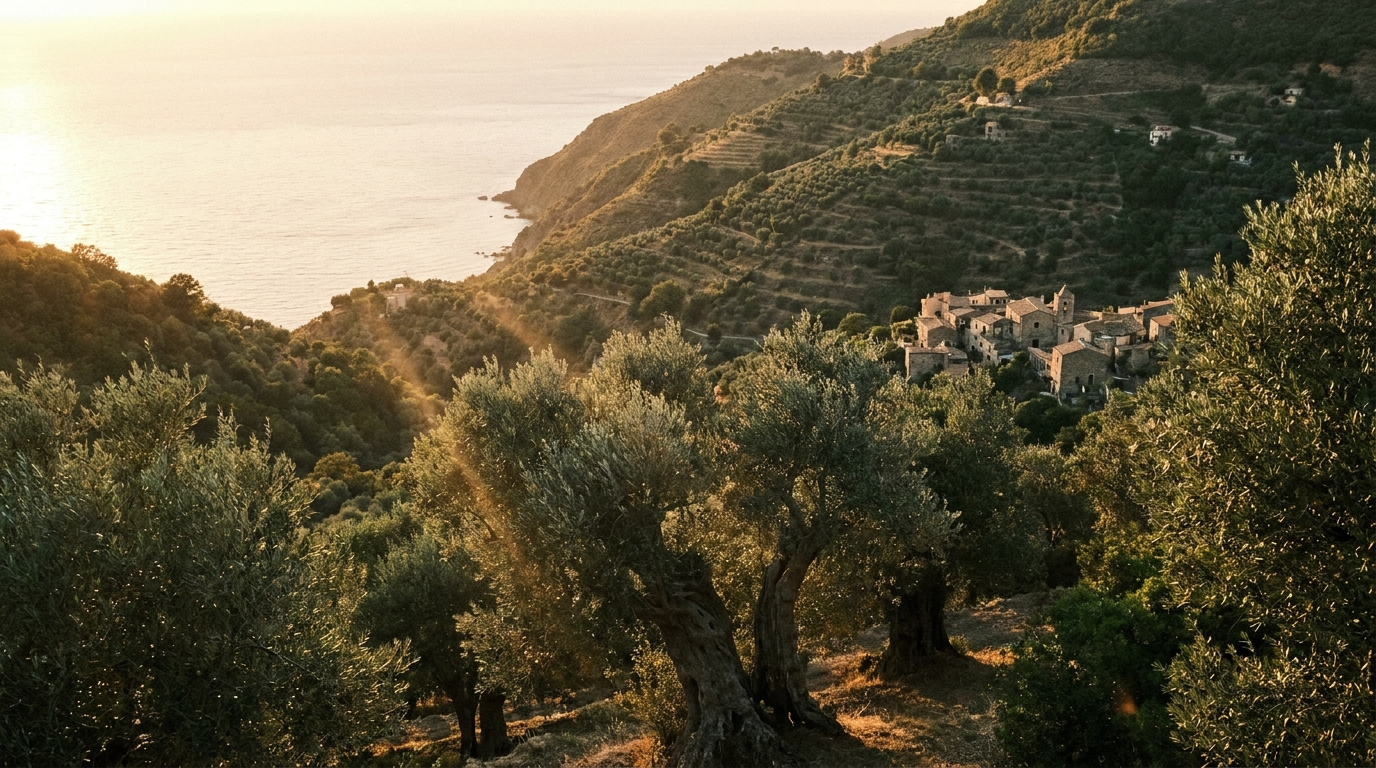
Ask someone to picture Italian olive oil and they will describe Tuscany. Ask an Italian miller where much of the country’s oil actually comes from, and the answer moves south — a long way south, to the sun-hammered hills of Calabria, the region that forms the toe of the boot. It is one of Italy’s great olive-growing heartlands, and one of its least famous. That gap between how much Calabria grows and how little credit it gets is not an accident. It is the story of how the olive oil business works — and why we chose to build Olive Father around a single Calabrian grove.
The region that feeds the blends
Calabria is consistently one of Italy’s largest olive oil producing regions, second only to neighbouring Puglia in most harvests. Olives are not a crop here; they are the landscape. Groves climb from the Tyrrhenian and Ionian coasts up into the foothills of the Aspromonte, and many of the trees are centuries old — planted by great-great-grandparents and still bearing fruit.
So why have you never seen “Calabria” on a bottle? Because for generations, much of the region’s oil has been sold in bulk — shipped north in tankers to bottlers who blend it with oils from other regions and countries, then sell it under brand names that mention Italy in general and Calabria not at all. The region’s growers did the farming; someone else’s label got the glory. It is the same anonymising machinery we describe in why we say no to supermarket oil: when oil is pooled, its origin simply disappears.
What Calabrian oil actually tastes like
Calabria’s native cultivars — names like Ottobratica, Sinopolese and Carolea that rarely make it onto a label — produce oils with a character of their own: golden-green, round and fruity, with notes of fresh almond, tomato leaf and cut grass, and a peppery finish that arrives late and stays. It is a warmer, more generous profile than the famously fierce green Tuscan style we wrote about in our guide to Tuscan olive oil — less of a punch, more of an embrace. Neither is better; they are two different expressions of the same craft. But you can only taste the difference when the oil is allowed to stay itself, unblended.
One village, six generations
Our oil comes from San Procopio, a small village folded into the Calabrian hills, where the same family has tended the same groves for six generations. The trees are picked at the green-ripe moment and milled within hours — the discipline we describe in harvest & cold pressing — and the oil goes into the bottle carrying the name of the place it came from. No tankers, no pooling, no anonymity. That is what single-source means in practice: the grove on the label is the grove in the glass.
How to buy real Calabrian olive oil
If this article sends you looking, three checks will keep you safe. First, look for a named place — a village, an estate, a grove — not just “product of Italy.” Second, look for a harvest date; fresh oil is better oil, and producers proud of their harvest print it. Third, look for a stated free-acidity figure well below the 0.8% extra-virgin ceiling. Any producer who controls their chain from tree to bottle can give you all three. Most brands on a supermarket shelf can give you none.
Taste the toe of the boot
Calabria has spent a century making other people’s olive oil great. We think it is time the region got the label to itself. Our organic and classic extra virgin oils are pressed from that one grove in San Procopio and traced lot by lot from tree to bottle. Explore the range — and taste what Calabria sounds like when it speaks in its own name.
Leave a Reply