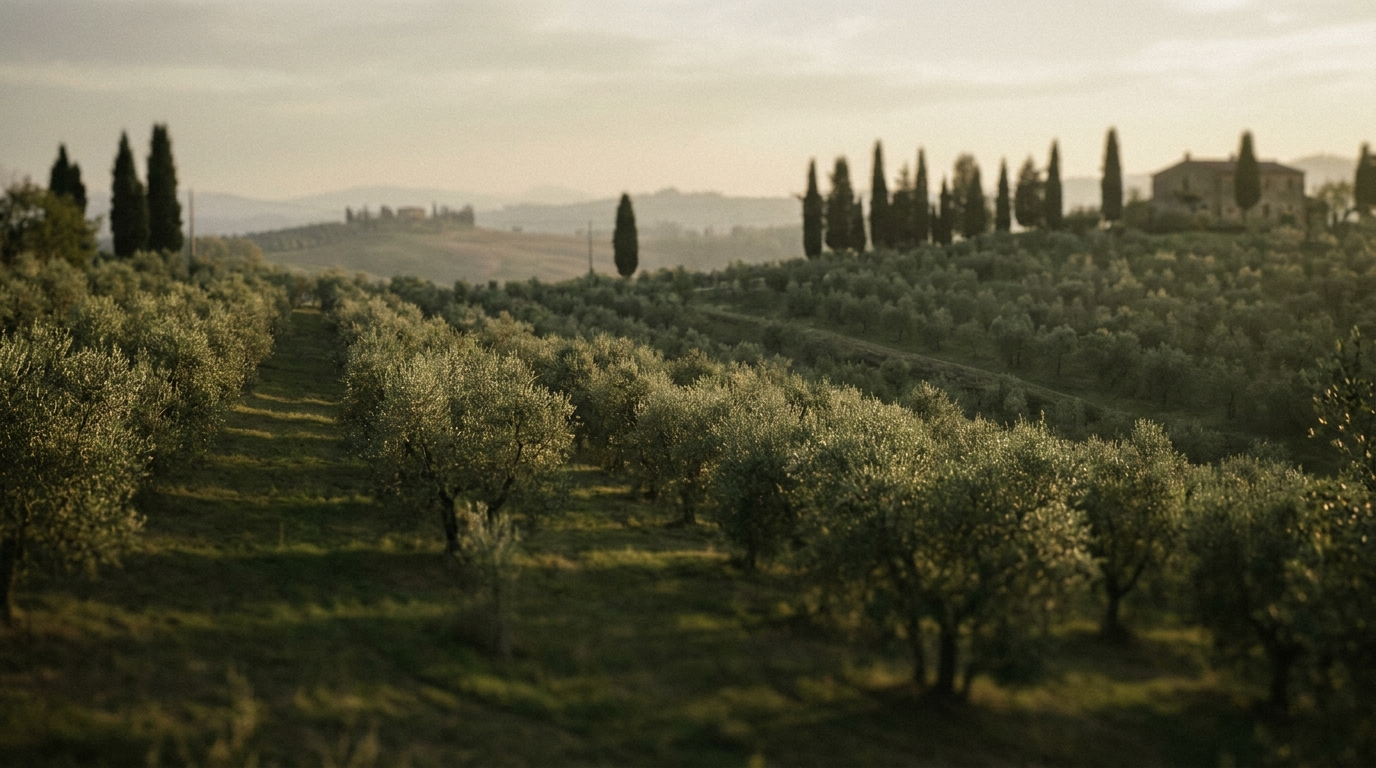
Say “olive oil” and most people picture Tuscany: silver groves on rolling hills, cypress trees against a gold evening sky. The picture is earned. Tuscan olive oil has a character no other region quite matches — but the region’s fame has also made its name one of the most borrowed in the business. Here is what actually makes a Tuscan oil Tuscan, and how to make sure the bottle in your hand deserves the word.
Why Tuscan oil tastes the way it does
Tuscany is, by olive-growing standards, a hard place. The groves sit further north than most of the Mediterranean’s oil country, on hillsides where winters bite and the fruit ripens slowly. Growers there harvest early — often while the olives are still defiantly green — because waiting for a fat, ripe crop risks losing it to the first frost.
That constraint became a style. Early-picked fruit from cultivars like Frantoio, Leccino, Moraiolo and Pendolino gives up less oil, but what it gives is intense: deep green in the glass, aromas of cut grass and artichoke, a firm bitterness and the famous peppery finish that catches the back of your throat. That sting is not a flaw — it is the signature of the polyphenols that early harvesting preserves, the same compounds behind much of olive oil’s health reputation.
What the IGP seal actually guarantees
Because “Tuscan” sells, European law stepped in. Toscano IGP (Indicazione Geografica Protetta) is a protected designation: to carry it, an oil must be grown, pressed and bottled within the defined Tuscan territory, from approved cultivars, and pass chemical and sensory checks stricter than the baseline for extra virgin. A consortium verifies each lot, and every certified bottle carries a numbered seal.
In other words, IGP turns a romantic word into a verifiable claim. It is the difference between a label that gestures at Tuscany and one that is legally accountable to it. Our own Tuscan oil, ETRURIUM, is bottled under exactly this mark — and also comes as a certified organic IGP for those who want both assurances in one bottle.
The “Tuscan style” trap
Borrowed scenery, blended oil
Walk a supermarket aisle and you will find bottles wearing cypress trees, Renaissance fonts and Italian flags — with fine print reading “packed in Italy” or “blend of EU olive oils.” A bottle can be filled in Tuscany with oil that never saw a Tuscan tree. The imagery is legal; the implication is not honest. If a label leans hard on scenery but goes quiet about origin, that silence is the answer.
Four things to check on the label
First, look for the Toscano IGP seal — not the word “Tuscan” in the brand name. Second, find a harvest date; a producer proud of the year says so. Third, look for a named estate or mill, because oil that can be traced to one place has nowhere to hide — the whole argument for single-source oil. Fourth, expect a serious price. Early harvests and hillside hand-picking yield little oil per tree; a genuine Toscano IGP simply cannot be cheap.
How to use it (don’t save it)
Tuscan oil is a finishing oil of the first order: over ribollita and bean soups, on grilled bread with nothing but salt, across a bistecca straight off the fire, or poured raw over burrata and winter greens. Its bitterness is a seasoning in its own right — it does for a dish what acidity does for a wine. And despite the old myth, a well-made extra virgin handles the pan perfectly well; the real sin is leaving a living oil to age in the cupboard until it fades.
Taste Tuscany with the seal on the bottle
ETRURIUM is our Tuscan chapter: estate-grown fruit, pressed cold within the IGP’s borders and rules, green and peppery the way the region intended. If you have only ever had “Tuscan style,” the certified original is a different experience entirely. Meet ETRURIUM, or explore the full Olive Father range and taste what a protected name actually protects.
Leave a Reply