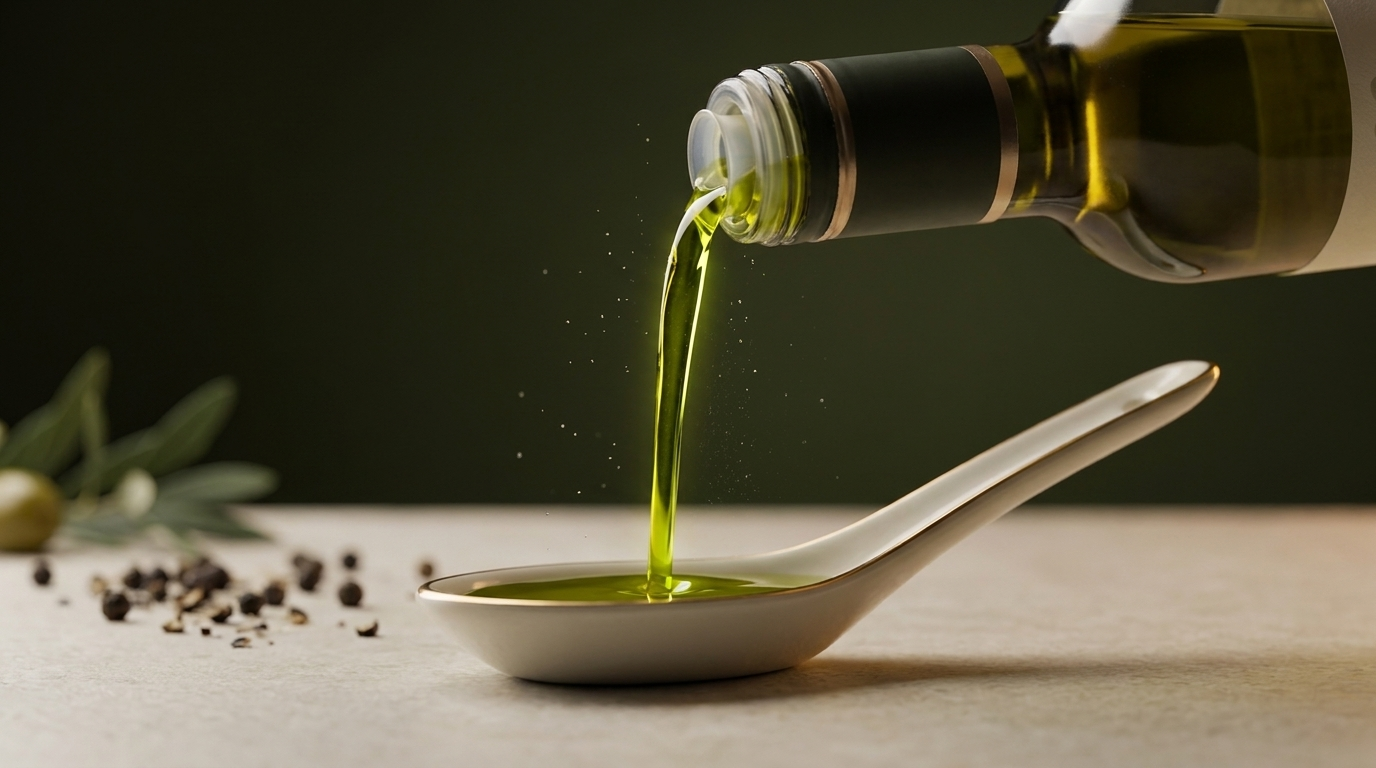
The first time someone tastes a serious extra virgin olive oil, there is almost always a moment of alarm. The oil goes down smoothly, green and fruity — and then, a second later, a peppery sting flares at the back of the throat, sharp enough to make you cough. Many people assume something is wrong with the oil. In fact, the opposite is true. That burn has a name, a fascinating piece of science behind it, and a very practical use: it is one of the most honest quality signals you will ever get from a food.
The compound behind the cough
The sting comes from oleocanthal, a natural phenolic compound found in fresh, well-made extra virgin olive oil and essentially nowhere else in the human diet. Researchers formally identified and named it in 2005, after noticing that the throat sting of fresh olive oil felt strangely similar to the sting of liquid ibuprofen. That was not a coincidence of flavor; the two act on the same sensory pathway, and oleocanthal has been studied ever since for its naturally occurring anti-inflammatory properties. Olive oil is a food, not a medicine — but the fact that scientists keep returning to this one compound tells you how unusual it is.
Why the throat, and only the throat?
Here is the part that surprises even seasoned cooks. Oleocanthal does not burn your tongue or lips the way chili does. It fires a specific irritant receptor — one that, in humans, happens to be concentrated in the tissue at the back of the throat. That is why the sensation waits until you swallow, and why it lands in exactly the same spot every time. Italian tasters have known the effect for generations: a robust oil is affectionately graded by the cough it provokes. A one-cough oil is good. A due tosse — two-cough — oil is something to talk about.
The burn is a freshness meter
Oleocanthal belongs to the same family of compounds as the polyphenols we go to great lengths to protect — the antioxidants that make a great oil taste alive and help it resist rancidity. We wrote a full guide to polyphenols and why they matter, but the short version is this: they are abundant in olives picked early and milled within hours, and they fade with time, heat, light and neglect.
That is what makes the throat sting so useful. It cannot be faked and it cannot be added back. An oil made from overripe fruit, or milled days after picking, or blended from tired tanker oil, arrives on your palate smooth, flat and buttery — pleasant, perhaps, but silent where the pepper should be. A refined or heavily processed oil has lost the compound almost entirely. The burn survives only in oil that was made the hard way: picked green and cold-pressed fast, then protected in dark glass. In other words, when your throat catches, it is telling you the truth about the harvest.
Bitter, peppery, alive: how to taste for it
Professional panels judge every oil on three qualities: fruitiness, bitterness and pungency. Oleocanthal is the pungency. To find it, take a spoonful of oil on its own — no bread — warm it briefly in your mouth, then swallow and wait. Count the seconds before the pepper arrives and notice where it lands. A fresh, high-polyphenol oil announces itself within moments. If you want to build the skill properly, our guide to tasting olive oil walks through the full ritual, and our deeper dive into the science of extra virgin olive oil explains what each sensation maps to chemically.
What the supermarket shelf is missing
Once you know the burn, a quiet test becomes available to you in every kitchen. Taste a mass-market “extra virgin” blend and you will very often find it does not sting at all. Nothing about that is illegal — but it tells you the polyphenols, and much of the point of extra virgin oil, left the building long before the bottle reached you. Freshness, early harvest and careful milling cost money, and oil engineered to a price point is the first place those costs get cut.
Our oil comes from a single named grove in Calabria, harvested green and milled within hours, precisely because that is the only way the pepper survives the journey. Pour a spoonful of our Organic Extra Virgin Olive Oil, swallow, and count your coughs. We are confident you will get at least one — and we mean that as the highest compliment an olive oil can pay you.
Leave a Reply