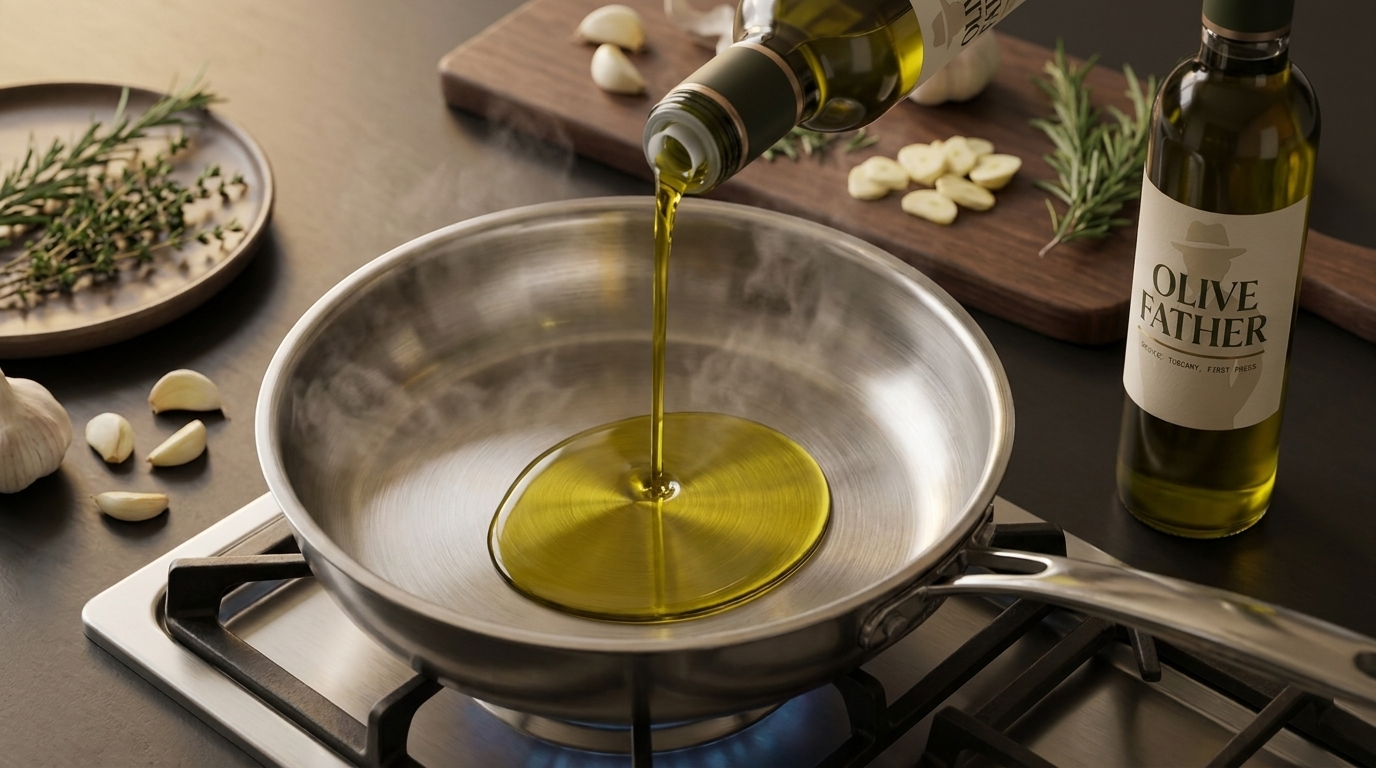
It is one of the most stubborn myths in the kitchen: that extra virgin olive oil is too delicate to cook with, that heat ruins it, that you should save the good bottle for salads and reach for something “neutral” when the pan gets hot. It sounds sensible. It is also mostly wrong. The people who make the best oil in the world have been frying, roasting and searing in it for thousands of years — and modern lab work backs them up.
Going deeper on the chemistry? Read our full guide to the olive oil smoke point — what the number measures, how hot your pan really gets, and why oxidative stability matters more than smoke.
What “smoke point” actually means
The smoke point is simply the temperature at which an oil begins to visibly smoke and break down. It became shorthand for “how safe an oil is to cook with,” but on its own it is a crude measure. An oil’s real behavior in a hot pan depends far more on what is in it — its fatty-acid makeup and its natural antioxidants — than on a single smoke-point number printed on a chart.
The real smoke point of extra virgin olive oil
Good extra virgin olive oil generally smokes somewhere around 375–410°F (190–210°C). Fresh oil with low free acidity sits at the higher end; tired, poorly made or high-acidity oil at the lower end. Now compare that to how you actually cook at home. Sautéing lands around 250–320°F. Pan-frying and most roasting sit near 350–375°F. Even a lot of deep-frying happens at 350–375°F. In other words, the temperatures of everyday cooking sit comfortably below the smoke point of a quality EVOO.
Why great olive oil is more heat-stable, not less
Here is the part the myth misses. Extra virgin olive oil is dominated by monounsaturated fat, which is far more resistant to heat damage than the polyunsaturated fats that fill many cheap “vegetable” and seed oils. On top of that, real EVOO is loaded with natural antioxidants — the same polyphenols that give a good oil its peppery finish. Those compounds actively slow oxidation when the oil is heated. Independent testing, including a widely cited 2018 Australian study that heated common cooking oils, found extra virgin olive oil to be one of the most stable oils under heat, producing fewer harmful breakdown compounds than several oils with higher smoke points. Stability, it turns out, is about chemistry — not just the smoke number.
So why does the myth survive?
Partly because most people’s experience of “olive oil” is a dull, months-old supermarket blend that was never very fresh to begin with. Oil like that does break down faster, because it has already lost the antioxidants that protect it and may carry a higher free-acidity level that drops its smoke point. Judging all olive oil by that bottle is like judging all coffee by a jar of instant. The fix is not a different oil — it is a better one.
How to cook with extra virgin olive oil
Do
- Sauté vegetables, sear fish and chicken, roast potatoes, build a soffritto — EVOO handles all of it, and it seasons the food while it cooks.
- Heat the oil with the pan rather than blasting an empty pan to screaming heat first.
- Finish the dish with a raw drizzle of the same oil to bring back its fresh, green aromatics.
Don’t
- Don’t heat any oil until it is smoking — that is the real line to avoid, for every fat, not just olive oil.
- Don’t reuse the same frying oil over and over.
- Don’t assume a “high smoke point” refined oil is automatically the healthier choice; the breakdown products matter more than the number.
Quality beats the number every time
The oil that cooks well is the oil that was made well: harvested early, cold-pressed quickly, low in acidity and rich in antioxidants. That is exactly how Olive Father oil is produced — single-source, from a six-generation Calabrian family grove, pressed within hours of harvest. It is delicious raw over burrata, and it will hold its own in a hot pan without a second thought.
Stop saving your best oil for special occasions. Explore the Olive Father range and cook with an oil that was built to be used.
Leave a Reply