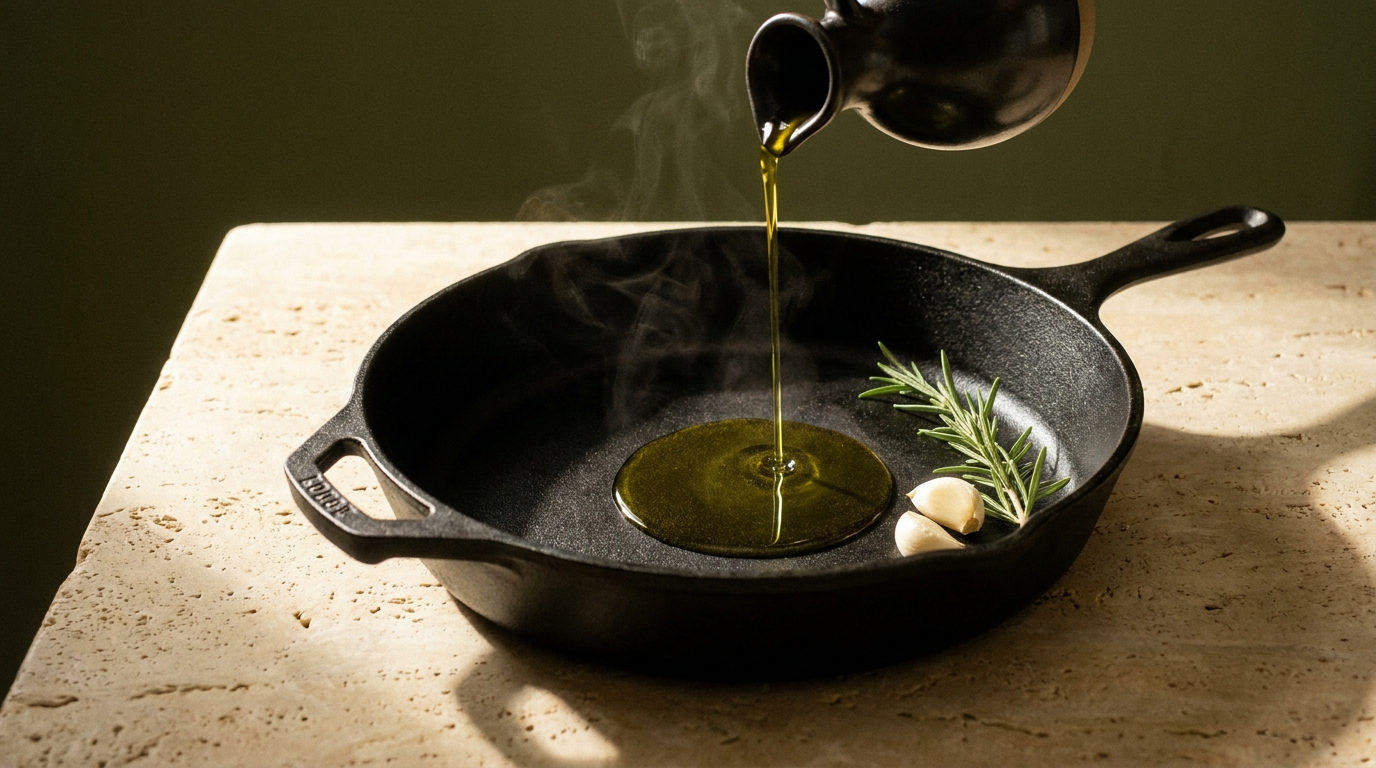
Somewhere in the last twenty years, a rumour hardened into common knowledge: extra virgin olive oil is too delicate to cook with. Save it for salads. Use something neutral for the pan. Every Italian kitchen we have ever stood in would find this baffling — and so, it turns out, does the chemistry.
The confusion comes down to a single number that has been asked to do far more work than it can bear: the smoke point. Here is what it actually measures, why it is a poor guide to how an oil behaves in your pan, and how to cook with the good bottle without wasting a drop of what makes it good.
What the Smoke Point Actually Is
The smoke point is the temperature at which an oil, heated in still air, first gives off a continuous wisp of blue smoke. That is the entire definition. It is a visual threshold, not a safety line and not a nutritional one.
For genuine extra virgin olive oil, that threshold generally falls somewhere around 375°F to 410°F (190–210°C), with fresher, lower-acidity oils sitting at the higher end of the range. The reason is worth understanding, because it flatters good oil: what smokes first is not the fat itself but the small stuff suspended in it — free fatty acids, water, fruit solids. An oil with very low free acidity has less of that material to burn off, so it holds its composure longer.
This is one of the quiet advantages of oil pressed within hours of picking. The harvest and cold-pressing decisions that give an oil its low acidity also give it a higher, steadier smoke point. Freshness is not just a flavour argument. It is a performance one.
How Hot Does Your Pan Really Get?
Now put that range next to the way people actually cook. Sauteing onions and garlic happens between roughly 250°F and 320°F. A hard sear in a heavy pan lands around 350°F to 400°F. Even deep frying is conventionally done at 350°F to 375°F. Roasting at 425°F sounds alarming until you remember that the oven air is at 425°F, not the oil in the tray, which is cooled continuously by the moisture coming out of the food.
In other words: almost everything you do on a domestic stove sits at or below the smoke point of a good extra virgin. The oil is not the fragile party in this arrangement.
The Number That Matters More: Oxidative Stability
Here is the part the smoke-point chart never tells you. Smoking is a cosmetic event. What you actually care about when you heat a fat is oxidation — the formation of polar compounds and breakdown products as the oil is stressed. Those two things are not the same, and they do not rank oils in the same order.
Extra virgin olive oil is unusually well armoured against oxidation for two reasons. It is dominated by oleic acid, a monounsaturated fat with only one double bond to attack — far more stable under heat than the polyunsaturated fats that make up most seed oils. And it arrives carrying its own antioxidants: the polyphenols and vitamin E that refining strips out of every other bottle on the shelf. A 2018 laboratory study out of Australia heated a range of common cooking oils and found that extra virgin olive oil generated lower levels of polar compounds and oxidation byproducts than several oils with substantially higher smoke points.
Why “Light” Olive Oil Is Not the Answer
You will be told that refined or “light” olive oil is the sensible choice for high heat, because its smoke point is higher — often quoted around 465°F. That is true, and it is true for an unflattering reason. Refining removes the free fatty acids, the aromatics, the pigments and the polyphenols. Nothing is left to smoke because nothing is left at all. You have bought a higher number by deleting everything the oil had to offer, including the antioxidants that were protecting it. We explain the full grade ladder on our what makes quality olive oil page, and why the cheapest bottles in the supermarket aisle are so often the most refined.
How We Cook With It
None of this means every drop should go in the pan. It means the decision is about flavour, not fear.
- Cook freely with good oil. Soffritto, roasting vegetables, searing fish, confit garlic — extra virgin is the right fat, and it seasons the dish as it goes.
- Warm the pan, then the oil, then the food. Do not preheat oil alone in an empty pan for minutes on end. There is nothing to absorb the heat.
- If it smokes, it is too hot for the food anyway. Pull the pan off, let it settle, start again. This is a cooking correction, not a catastrophe.
- Keep the best bottle for the last thirty seconds. Heat does soften aroma and pepper. A raw finishing pour restores everything the pan mellowed.
The honest summary is this: a real extra virgin will not fail you at any temperature you are likely to reach at home, and it will hold up better than the neutral oil you were told to reach for instead. What actually decides the outcome is not the smoke point printed on a chart — it is whether the oil in your hand is genuinely fresh, genuinely extra virgin, and genuinely traceable to a grove.
Cook With Oil Worth Cooking With
Olive Father is single-source extra virgin from one family grove in Calabria and one estate in Tuscany — harvested early, milled cold, and bottled with the harvest on the label so you know exactly how fresh it is. Low acidity, high polyphenols, nothing blended in. Explore the range and put a bottle next to the stove where it belongs.
Leave a Reply