Author: radjmover

  • The Olive Oil Gift Set Worth Giving: What Food People Actually Want in the Box

    An open deep-olive gift box holding an Olive Father bottle, a small tin of olive oil, a bundle of bronze-cut pasta and an olive branch

    There is a particular kind of gift that says the giver was paying attention. Olive oil can be that gift — it is beautiful, it is consumed, it lives on the counter for months as a daily reminder of the person who chose it. And yet most “olive oil gift sets” fail the test completely: a decorative box, a clear bottle of anonymous blended oil, a bottle of sweetened balsamic, and a little dish. A gesture, not a gift. As people who press the oil ourselves, here is what we would actually want to unwrap — and how to tell the difference before you buy.

    Rule one: the oil has to be good, or nothing else matters

    Packaging is where gift sets spend their money, and the oil is where they save it. Turn the set over and apply the same four checks you would use on any bottle. Is it labeled extra virgin, with a harvest date — not just a “best by”? Is it in dark glass or tin, not a clear bottle that has been sitting under shop lights? Does it name a single origin, a region or better still an estate, rather than “packed in Italy” or “blend of EU olive oils”? Is it from the most recent harvest? We explain each of these in how to choose olive oil. If a gift set fails two of the four, the ribbon is the most valuable thing in the box.

    What belongs in the box

    One serious bottle, not three small novelties

    Sets of three or four miniature flavored oils — lemon, chili, garlic, truffle — look generous and disappoint in practice. Infused oils are usually built on a cheap base, and “truffle oil” in particular has often never met a truffle. A single full-size bottle of a genuine single-estate extra virgin, one the recipient will reach for every day, is a far better gift than four bottles that end up at the back of the cupboard. If you want variety, give two real oils with different characters: a robust one and a gentler one.

    A robust oil and a delicate oil

    This is the pairing we would choose. A peppery, bitter, green oil — the kind that makes you cough once — for bread, beans, grilled meat and bitter greens. And a rounder, softer oil for fish, fresh cheese, raw tomatoes and anything delicate. Together they teach the recipient something about olive oil, which is the best kind of gift: it keeps giving after the bottle is empty. Our ETRURIUM Tuscan IGP is the assertive one; our Organic Calabrian Extra Virgin is the daily oil that does everything else.

    Something to put the oil on

    An oil on its own is a bottle. An oil with a bag of bronze-drawn pasta and a note that says “aglio e olio, tonight” is dinner. Bronze-cut pasta has a rough, porous surface that holds oil the way industrial pasta cannot, which makes the pairing more than decorative. Good sea salt, a jar of Calabrian chili, a tin of anchovies — any of these turns the box into a meal rather than a display.

    Not balsamic, unless it is the real thing

    The ubiquitous oil-and-vinegar set pairs a mediocre oil with “balsamic” that is mostly wine vinegar, caramel color and sugar. Italians do not dip bread in it, and the acidity flattens a fine oil. Skip it — or, if you want vinegar in the box, give a proper aged one and let it stand on its own.

    The details that make it a gift

    What separates a thoughtful olive oil gift from a hurried one is usually a piece of paper. A card that explains where the oil comes from, when it was harvested, which olives went into it and how to taste it. The tasting method takes two minutes to describe: warm the glass in your palm, smell for green things, sip, then pull a little air across it and wait for the pepper. Give someone that ritual along with the bottle and you have given them a way to enjoy every olive oil they will ever buy.

    Timing matters too. Olive oil is a fresh product with a life of about eighteen months from harvest, and it is at its most alive in the months just after pressing. A bottle from the new autumn harvest, given in the same winter, is the best olive oil gift there is — olio nuovo is what Italians themselves give one another.

    Who to give it to

    The obvious answer is the person who cooks. The better answer is the person who does not yet know how good olive oil can be — the friend who still buys the clear supermarket bottle, the relative who thinks olive oil is for salads, the new homeowner with an empty pantry. For them, a single genuine bottle is not a luxury; it is a small correction to the way they eat, and it tends to stick.

    Our approach

    Everything in the Olive Father range is single-source, harvest-dated and bottled in dark glass or tin, because those are the standards we hold ourselves to before anyone wraps anything. Pair a bottle with our bronze-drawn pasta and you have the gift we would give. For corporate or larger quantities, our wholesale team can help with allocations from the new harvest.

    Build your gift from the Olive Father range →

  • Light Olive Oil: What “Light” Actually Means — and Why It Is Not What You Think

    A pale, colorless bottle of light olive oil beside a dark bottle of Olive Father extra virgin olive oil and a dish of vivid green-gold oil

    Walk down the oil aisle and you will find a bottle that seems to solve a problem: “light olive oil.” It sounds like the sensible choice — olive oil, but easier on the waistline. Here is the first thing to know, from people who press olives for a living: light olive oil has exactly the same calories and the same fat as extra virgin. About 120 calories and 14 grams of fat per tablespoon, for every grade of olive oil that exists. The word “light” has never referred to nutrition. It refers to what has been taken out.

    What “light” legally means

    In the United States the term is a marketing description, not a grade. The International Olive Council recognizes categories such as extra virgin, virgin, refined olive oil and “olive oil” (a blend of refined and virgin). “Light” — sometimes “extra light” or “light tasting” — is simply the name manufacturers give to a refined olive oil, usually with a small percentage of virgin oil stirred back in for a hint of color and flavor. The word is describing the taste: light in flavor, light in aroma, light in color. Nothing about it is light in the sense a dieter hopes for.

    If you have read our guide to what refined olive oil actually is, you already know the rest. Light olive oil is refined olive oil under a friendlier name.

    How light olive oil is made

    Extra virgin olive oil is made one way: healthy fruit is crushed, the paste is gently worked, and the oil is separated mechanically below 27°C. Nothing is added and nothing is removed. It is, quite literally, fruit juice.

    Light olive oil starts where extra virgin fails. Oils that are too defective to be sold as virgin — too high in free acidity, oxidized, fusty, or musty — are sent to a refinery. There they are treated with alkali to neutralize the free fatty acids, bleached with absorbent clays to strip color and remaining impurities, and deodorized with steam at temperatures well above 200°C to remove the smells that made the oil unsellable in the first place. What comes out is a clean, neutral, nearly colorless fat. It is safe. It is stable. And it has had almost everything that made it olive oil removed.

    What refining takes out

    The polyphenols

    The peppery catch at the back of the throat, the clean bitterness, the green aroma — these come from polyphenols such as oleocanthal and hydroxytyrosol. They are also the compounds behind the only olive oil health claim the European Food Safety Authority has authorized, which requires at least 5 mg of hydroxytyrosol and its derivatives per 20 g of oil. Refining removes most of them. A light olive oil may carry a fraction of the polyphenols of a fresh extra virgin, which is why it tastes of nothing and why the health research on olive oil — almost all of it conducted with extra virgin — does not straightforwardly apply to it.

    The flavor

    Taste a light olive oil from a spoon and you will notice the absence before anything else. No grass, no artichoke, no tomato leaf, no pepper. That is by design: the refinery’s job is to make an oil that tastes of nothing, because the oil it started with tasted of something unpleasant.

    The honesty of the label

    Light olive oil almost never carries a harvest date, a named grove, or a cultivar. It cannot. It is assembled from batches sourced across countries and seasons, then blended to a consistent neutral profile. Our page on single-source traceability explains why a harvest date is the most honest thing an olive oil label can show you — and why refined oils leave it off.

    The one argument for light olive oil — examined

    The case usually made for light olive oil is its higher smoke point, often quoted around 240°C (465°F), versus roughly 190–210°C for extra virgin. It is true that refining raises the smoke point. It is also true that smoke point is a poor predictor of how an oil behaves when heated. What protects an oil under heat is its oxidative stability — its resistance to breaking down — and that is driven largely by monounsaturated fat and by antioxidants. Extra virgin has the same oleic acid as light oil plus the polyphenols the refinery removed. In published frying studies, fresh extra virgin olive oil has repeatedly proven among the most stable common cooking oils, forming fewer polar compounds than refined seed oils at typical cooking temperatures.

    Practically: a home sauté runs at 150–180°C. A deep fry sits at 175–190°C. Extra virgin is comfortably within range for both, as we lay out in can you fry with olive oil? The only time light olive oil’s higher smoke point matters is at the extreme searing end — and at that point a neutral oil of any kind will do, and you should not be paying an olive oil premium for it.

    When light olive oil is a reasonable choice

    We are not going to pretend it has no use. If you are baking something where you want no olive flavor at all and you happen to have a bottle, it works. If you need a neutral fat for a very hot wok, it works. But in both cases it is competing with cheaper neutral oils, not with extra virgin — and it is winning only on the name printed on the bottle.

    What to buy instead

    If you reached for “light” hoping for a gentler flavor, the honest answer is a mild extra virgin, not a refined one. Riper-harvest oils and softer cultivars produce extra virgins that are buttery and delicate, with the polyphenols and the harvest date intact. If you reached for it hoping for fewer calories, no olive oil can help you — but a good one will make you use less, because a teaspoon of a fresh, peppery extra virgin does the work of a tablespoon of something that tastes of nothing.

    Our Classic Extra Virgin is pressed from a single Calabrian grove, bottled with its harvest date, and made to be the one oil that lives beside your stove — for the sauté, the roasting tray and the final pour. It costs more than a bottle labeled “light.” It is also actually olive oil.

    Explore the Olive Father range →

  • Olive Oil Brands to Avoid: 8 Red Flags That Matter More Than the Name on the Label

    A row of anonymous clear-glass supermarket olive oil bottles under fluorescent light beside one dark-glass Olive Father extra virgin olive oil bottle in warm window light

    People search for “olive oil brands to avoid” expecting a list of villains. We are not going to give you one, for two reasons. First, a brand’s quality changes from harvest to harvest and from product line to product line — the same company can bottle an honest oil and a dreadful one. Second, a blacklist teaches you nothing you can use next year, in a different store, in front of a bottle you have never seen. What actually protects you is the ability to read a label like a buyer. So here are the eight red flags that, in our experience pressing and selling olive oil, tell you far more than any name ever will.

    Why the label lies more often than you think

    The most cited study on this subject came from the UC Davis Olive Center, which in 2010 tested imported extra virgin olive oils sold in California and found that a majority of the samples failed to meet the international standard for the extra virgin grade — most often because the oil was oxidised, of poor quality, or adulterated with cheaper refined oil. The exact proportion varied by test and by brand, and the industry disputed the methodology, but the underlying point has been confirmed repeatedly since: the words “extra virgin” on a bottle are a claim, not a guarantee. The red flags below are the ways that claim tends to unravel.

    The eight red flags

    1. No harvest date

    Olive oil is a fruit juice. It peaks in the months after pressing and declines steadily from there. A “best by” date is usually set eighteen to twenty-four months after bottling — and bottling can happen a year or more after harvest. A producer who is proud of the freshness prints the harvest date. A producer who is not, prints nothing. This is the single most useful check on the shelf.

    2. “Blend of EU and non-EU olive oils”

    Turn the bottle around. If the fine print says the oil is a blend of olive oils from several countries, you are buying a commodity assembled in a tank from whatever was cheapest that season. It may be legally extra virgin; it cannot be traceable, consistent, or fresh in any meaningful sense. An oil with a single named estate, region or mill is answerable for what is inside. A blend is not.

    3. Clear glass or plastic

    Light is one of the three things that destroy olive oil, along with heat and oxygen. A clear bottle under supermarket lighting is being slowly cooked from the outside. Producers choose clear glass because the golden colour sells. Serious producers choose dark glass or tin because it preserves the oil. When the packaging is designed for the shelf rather than for the oil, that tells you where the priorities are.

    4. “Light,” “pure,” “extra light” or simply “olive oil”

    These are not lesser grades of extra virgin. They are refined olive oil — oil that failed the extra virgin standard, was chemically and thermally stripped of its flavour and defects, then blended with a small amount of virgin oil for colour and taste. “Light” refers to flavour, not calories. Anything on the label that is not “extra virgin” is, by definition, an oil that has been through a refinery.

    5. A price that does not add up

    It takes roughly five to seven kilograms of olives, hand-harvested in a window of a few weeks and milled within hours, to make a litre of good extra virgin. There is a floor below which that is simply not possible. A very cheap “extra virgin” is not a bargain — it is a signal that the oil is old, blended, refined, or all three. We have written about where the money in olive oil actually goes; the short version is that a bottle costing less than a cup of coffee did not come from a grove anyone cares about.

    6. A flag with no address behind it

    “Imported from Italy,” a tricolore on the cap, an Italian-sounding name — none of it means the olives grew in Italy. It often means the oil was bottled there. Look for the specific origin of the olives, the name of the mill, and ideally a DOP or IGP seal, which are legally enforced guarantees of place. Vague nationalism on the front and silence on the back is a classic pattern.

    7. No mention of acidity, polyphenols or the cultivar

    Not every honest oil prints its lab numbers, but the presence of them is a strong positive signal and their absence across an entire product line is a mild negative one. Free acidity well below the 0.8% legal ceiling, a polyphenol figure, and the name of the olive variety are things a producer includes when they have something to show. A label that says only “extra virgin” and “Mediterranean” is a label with nothing to say.

    8. It tastes of nothing

    The final test is the one you run at home. Real extra virgin is fruity, bitter and pungent — it should smell of something green and catch in the throat when you swallow. If the oil is flat, greasy, waxy, or smells faintly of crayons or stale nuts, it is rancid or refined regardless of what the label promised. Our guide on how to taste olive oil walks you through it in five minutes.

    What to look for instead

    Flip every red flag and you have the buying rule: a harvest date within the last twelve to eighteen months, a single named source, dark glass or tin, the words “extra virgin” and nothing softer, a price that reflects real farming, a specific place rather than a flag, some numbers on the label, and a taste that bites back. Any brand — large or small, famous or not — that meets those conditions is worth your money. Any brand that fails most of them is not, whatever the name.

    We built Olive Father to pass every one of those checks in the open: one grove in Calabria and one estate in Tuscany, harvest date and acidity on every bottle, dark glass and tin, no blending, ever. See how we trace every bottle to its source, or explore the oils and judge them by the same eight tests.

  • Cacio e Pepe: The Real Roman Recipe — and the One Ingredient Everyone Argues About

    A bowl of authentic cacio e pepe with bronze-cut tonnarelli, grated pecorino romano and a pepper mill, with an Olive Father extra virgin olive oil bottle in the background

    Cacio e pepe is the dish Roman cooks use to find out whether you can actually cook. Three ingredients — pasta, pecorino romano, black pepper — and nothing to hide behind. No cream, no butter, no garlic, no parmesan. When it works, the cheese and the starchy pasta water fuse into a glossy sauce that clings to every strand. When it doesn’t, you get a clump of rubbery cheese sulking at the bottom of the bowl. The difference is not the recipe. It is the technique, and the quality of the very few things you put in the pot.

    What cacio e pepe actually is

    The name is Roman dialect for “cheese and pepper,” and the dish belongs to the same family as gricia, carbonara and amatriciana — the four pastas of Rome, each one a variation on pecorino, pepper and pork fat. Cacio e pepe is the ancestor: the version shepherds could carry into the hills of Lazio, because aged pecorino and peppercorns keep for months without a cellar. It was never a restaurant dish. It was fuel, made in one pot, with water that had already cooked the pasta doing the job of a sauce.

    That history matters because it explains what the dish is trying to be. It is meant to taste sharp, salty and peppery, with the pasta itself as the main event. Anything that softens or sweetens it — cream, butter, a milder cheese — is not a variation. It is a different dish wearing the name.

    The three ingredients, chosen properly

    The pasta

    Rome uses tonnarelli — a square-cut, egg-enriched fresh pasta — or dried spaghetti and rigatoni. Whatever the shape, the surface is what decides the dish. The sauce in cacio e pepe is an emulsion of cheese, fat and starch, and it needs something to grip. Bronze-drawn pasta, extruded through a bronze die rather than a Teflon one, has a rough, matte surface that holds the emulsion and releases far more starch into the cooking water. Smooth industrial pasta releases less starch and lets the sauce slide off. If you have ever wondered why your cacio e pepe is thinner than the one you ate in Trastevere, the die is usually the answer.

    The cheese

    Pecorino Romano DOP, and only that. It is a hard sheep’s-milk cheese aged at least five months, intensely salty, with a sharp lactic tang that parmesan does not have. Buy a wedge and grate it yourself on the finest side of the grater, as close to a powder as you can manage — a fine grate melts evenly, a coarse one seizes into strings. Pre-grated cheese is dusted with anti-caking starch and will never emulsify properly.

    The pepper

    Whole black peppercorns, toasted in a dry pan until fragrant, then crushed coarsely in a mortar or under the flat of a knife. Pre-ground pepper has already lost the volatile oils that give the dish its perfume. Toasting wakes them up; crushing rather than grinding gives you both heat and crunch.

    The recipe (serves 2)

    • 200 g bronze-cut spaghetti or tonnarelli
    • 100 g Pecorino Romano DOP, finely grated
    • 2 teaspoons whole black peppercorns
    • Salt for the water — less than usual, the cheese is salty
    1. Use less water than you think. Cook the pasta in about a litre and a half, not four. Less water means starchier water, and the starch is your emulsifier. Salt it lightly.
    2. Toast and crush the pepper. Dry pan, medium heat, one minute until it smells like a spice market. Crush coarsely. Put two-thirds in a wide skillet with a ladle of pasta water and let it simmer gently.
    3. Make the cheese paste. In a bowl, mix the grated pecorino with a few spoonfuls of pasta water — warm, not boiling — stirring until you have a thick, smooth cream the texture of yoghurt. This step is the whole secret. Cheese hits boiling water and seizes; cheese hits warm water and melts.
    4. Pull the pasta early. Two minutes before al dente, transfer it to the skillet with the pepper water. Finish cooking there, tossing constantly, adding splashes of pasta water as it absorbs. The pasta should look wet and glossy.
    5. Off the heat. Take the pan off the burner, wait fifteen seconds, then add the cheese cream and toss hard — lifting and dropping the pasta so the sauce coats everything. If it tightens, a spoon of water loosens it. Finish with the remaining pepper. Serve immediately, in warm bowls.

    Does olive oil belong in cacio e pepe?

    We press olive oil for a living, so you would expect us to say yes. The honest answer is: not in the classic, and yes in one specific place. The traditional Roman dish contains no fat except what is in the cheese. Many trattorias, though, bloom the pepper in a spoonful of extra virgin olive oil before adding the pasta water, and a good number finish the plate with a thread of raw oil. Both are reasonable: the oil carries the pepper’s aromatics and gives the emulsion a little more body and insurance against splitting.

    If you do it, the oil has to be worth tasting, because there is nothing to hide it. A refined or tired supermarket oil adds greasiness and nothing else — it is one of the reasons we wrote about why supermarket olive oil disappoints. A fresh, peppery, high-polyphenol extra virgin adds a green bitterness that sits beautifully against the salt of the pecorino. Use a small amount, add it at the end, and taste before you commit. What you should never do is use oil, butter or cream as a crutch for a sauce that split because the cheese went in too hot.

    Why it splits, and how to fix it

    Pecorino’s proteins tighten and squeeze out fat above roughly 70°C, which is why a sauce made in a pan over the flame turns to strings. The fixes are all about temperature: make the cheese paste separately, take the pan off the heat before the cheese goes in, and keep pasta water in reserve. If it has already clumped, a splash of warm water and vigorous tossing will usually bring it back. If it is hopelessly grainy, the cheese was too coarse or too hot, and the only cure is to start again — it takes eleven minutes.

    The dish tells the truth

    Like aglio e olio, cacio e pepe is a dish of nothing but ingredients and attention. It cannot be rescued by a sauce, so every element has to be right: pasta with a surface, cheese with a name, pepper with its oils still in it. That is the Italian idea of cooking in one bowl — buy fewer things, buy them properly, and let them speak.

    Our bronze-drawn pasta is cut on traditional dies in Calabria and dried slowly, exactly for dishes like this; and for the finishing thread, our single-source extra virgin olive oil is pressed within hours of harvest so the pepper you taste in the oil matches the pepper in the bowl. Explore the range — or browse more of our recipes built to show off what real ingredients can do.

  • Olive Oil Mayonnaise: The Real Recipe — and Why Most “Olive Oil Mayo” Isn’t

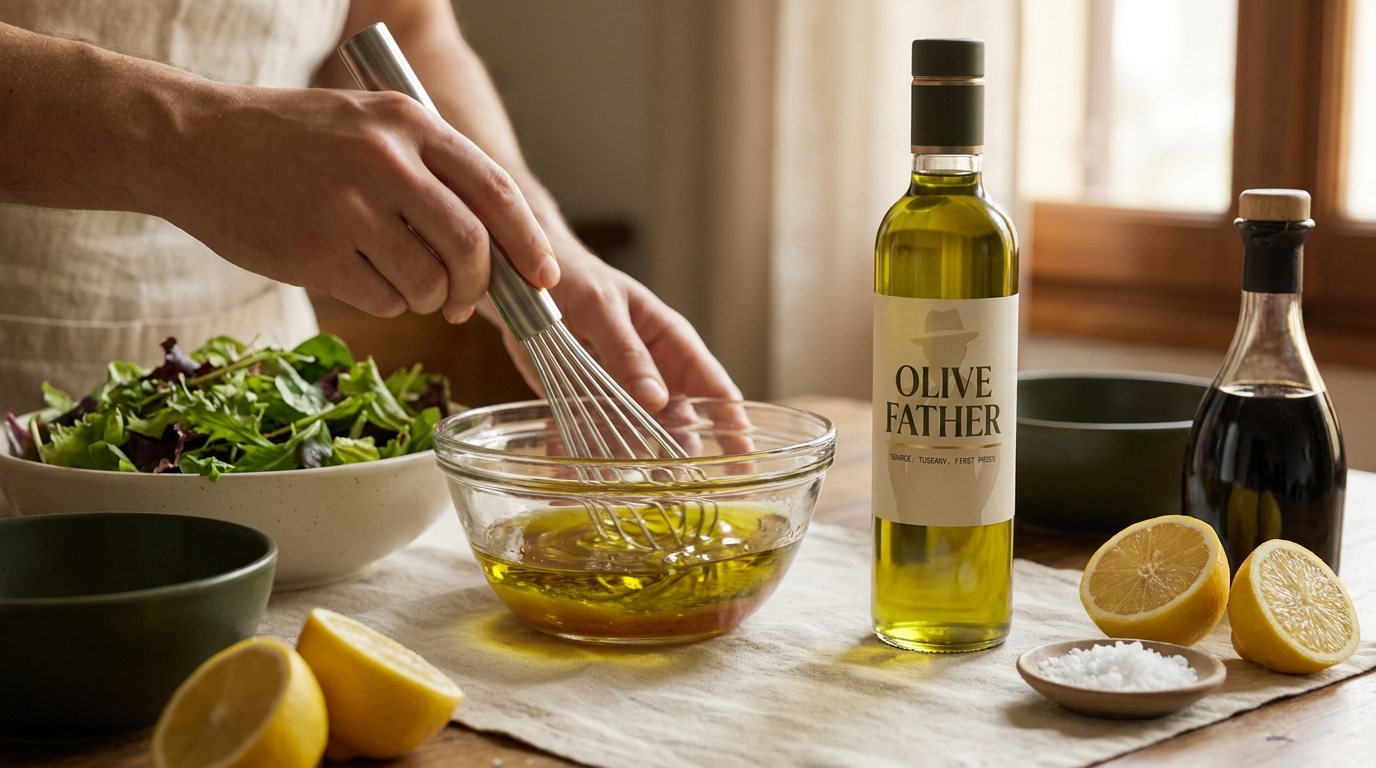
    Whisking an emulsion by hand in a rustic Italian kitchen beside a bottle of Olive Father extra virgin olive oil
    Mayonnaise is roughly four-fifths oil. Whatever you pour is what you will taste.

    Mayonnaise is one of the great kitchen magic tricks: a single egg yolk persuading a cup of oil to become something thick, pale and spoonable. It is also, by weight, about eighty percent oil — which makes it one of the most revealing things you can do with a bottle. Made with a fresh extra virgin olive oil it tastes green, rich and faintly peppery, and turns a plate of boiled potatoes or a piece of poached fish into a meal. Made with a tired one, it tastes exactly like a tired one, only more so.

    Here is how we make it at home in Calabria, the two mistakes that make people swear off olive oil mayonnaise forever, and a short, unsentimental look at what is actually inside the supermarket jar with the olive branch on the label.

    What mayonnaise actually is

    An emulsion: millions of tiny oil droplets suspended in a small amount of water, held apart by the lecithin in egg yolk. The yolk is the emulsifier, the acid — lemon juice or vinegar — supplies the water phase and the brightness, and the oil supplies almost everything else: body, richness and flavor. One yolk can comfortably hold 150 to 200 milliliters of oil. Push far past that and the emulsion runs out of yolk and breaks.

    Because there is so much oil and nothing is cooked, the oil’s character arrives on the spoon intact — bitterness, pepper, grass and all. That is the whole promise of olive oil mayonnaise, and it is also the trap.

    The recipe, by hand

    Makes about a cup. Everything should be at room temperature — a cold yolk and cold oil are the most common reason a mayonnaise refuses to come together.

    • 1 large egg yolk, as fresh as you can find (or from a pasteurized egg)
    • 1 teaspoon fresh lemon juice, plus more to finish
    • A generous pinch of fine sea salt
    • 175 ml (about ¾ cup) extra virgin olive oil — see the note on choosing it below
    • Optional: ½ teaspoon Dijon mustard, which helps the emulsion hold but is not Italian

    Set a bowl on a damp cloth so it does not skate around. Whisk the yolk with the salt and lemon juice for thirty seconds until it lightens slightly. Now add the oil drop by drop — truly drop by drop for the first two tablespoons — whisking without pause. This is the stage where the emulsion is born, and hurrying it is the second most common reason for failure. Once the mixture visibly thickens and turns glossy, you can move to a thin, steady stream, still whisking. When all the oil is in, it should stand in soft peaks. Taste, and adjust with lemon and salt. It will taste of the oil; that is correct.

    Keep it refrigerated and use it within two days. It contains raw egg, so it is not for the very young, the elderly, the pregnant or the immunocompromised unless you have used pasteurized eggs.

    If it breaks

    Do not throw it away. Put a fresh yolk, or a teaspoon of warm water, in a clean bowl and whisk the broken mixture into it a spoonful at a time. It will come back.

    Why olive oil mayonnaise turns bitter — and how to stop it

    This is the complaint we hear most, and the reason many people conclude that olive oil is “wrong” for mayonnaise. It is not wrong; it is being handled wrong.

    Extra virgin olive oil carries polyphenols — the compounds responsible for its bitterness and peppery finish, and for most of the health research around the oil. In a dressing they are a virtue. In an emulsion, two things can push them from pleasant to harsh:

    • The blender. A food processor or immersion blender shears the oil into far smaller droplets than a whisk does and exposes vastly more of its surface to the water phase. The result is a mayonnaise that tastes noticeably more bitter than the oil that went into it. Whisk by hand and the same oil is rounder and gentler. If you must use a machine, use a mild oil, and keep the running time short.
    • The wrong oil for the job. A fierce, early-harvest, high-polyphenol oil — glorious on grilled bread — makes an aggressive mayonnaise. Reach instead for a medium-fruity oil, or a slightly later-harvest one, and let it carry the dish rather than dominate it. Our tasting notes explain how to tell the two apart in the glass.

    Some cooks split the difference and use half extra virgin, half a neutral oil. It works, and we will not pretend otherwise. But once the ratio slides much past that, you no longer have olive oil mayonnaise; you have plain mayonnaise with a memory of olives.

    Aioli is not garlic mayonnaise

    Worth saying, because American menus have blurred the two. True aioli — allioli in Catalonia, aioli in Provence — is an emulsion of garlic and olive oil only, pounded in a mortar with salt until the crushed garlic itself holds the oil. No egg. It is fiercely garlicky, pale gold, and difficult to make in any quantity, which is why most restaurant “aioli” is simply mayonnaise with garlic stirred in. That version is perfectly good. It just is not aioli, and it is worth knowing the difference when you order it.

    What is really in the jar labeled “with olive oil”

    Read the first ingredient

    Walk down the condiment aisle and you will find several mayonnaises whose labels lean heavily on the words “olive oil,” often with a sprig of olives on the front. Turn the jar around. Ingredients are listed by weight, and in many of these products the first oil named is a refined seed oil — soybean or canola — with olive oil appearing further down the list, sometimes well behind water and vinegar. The phrase “made with olive oil” is true in the way that a room is “made with” a single brick.

    Even where the olive oil is genuine, it is almost never extra virgin, for the simple reason that refined and blended oils are cheaper and blander and keep for a year on a shelf. Which means the thing you were paying extra for — the flavor and the polyphenols of a real extra virgin — is exactly the thing that was left out. We go through the same sleight of hand on the oil shelf on our page on why supermarket olive oil usually disappoints.

    Choosing the oil

    The rules are the ones we apply at our own mill. A stated harvest date within the last year. A named place and producer rather than a “blend of EU oils.” Dark glass or tin. And when you taste it on its own, a clean fruitiness with some bitterness and pepper — an oil that is still alive, but a medium rather than a monster. Our Classic extra virgin was pressed for exactly this kind of everyday work: round, fresh and honest, single-source from one Calabrian grove, and gentle enough to whisk into a mayonnaise that tastes of olives rather than argues with them.

    Five minutes, one yolk, one decision

    You do not need the jar. You need a bowl, a whisk, a fresh egg and an oil worth being four-fifths of the result. Choose it the way you would choose the main ingredient, because in this recipe it is. Explore our single-estate extra virgin olive oils — one harvest, dated, nothing blended — and make the mayonnaise the supermarket only promised.

  • Coconut Oil vs Olive Oil: An Honest Comparison From People Who Press Olives

    An Olive Father extra virgin olive oil bottle on a marble counter beside small dishes of other cooking fats
    Two fats, two completely different origins — and only one of them is still a fruit juice when it reaches the bottle.

    A decade ago coconut oil was the darling of every wellness shelf in America. It went into coffee, onto skin, into cake batter and stir-fries, and it was sold as a kind of tropical miracle. Then the cardiologists weighed in, and the story got more complicated. Meanwhile olive oil simply kept doing what it has done for several thousand years.

    We press olives for a living, so you should read what follows knowing we have a favorite. But the comparison below is built on how each oil is made, what it is made of, and what the research actually found — not on which one we sell. Coconut oil has real uses. It also has a marketing halo it never earned.

    How each oil is made

    Start with the process, because it explains almost everything downstream.

    Extra virgin olive oil is a fruit juice. Olives are crushed into a paste, the paste is gently stirred, and the oil is spun free by centrifuge — mechanically, below 27°C, with no solvents, no heat treatment and no refining. What comes out of the separator is what goes into the bottle. That constraint is the entire reason the oil still carries its polyphenols, its aroma and its peppery bite. We walk through every step on our page on how olive oil goes from grove to bottle.

    Coconut oil comes in two very different forms. Virgin coconut oil is pressed from fresh coconut meat and keeps a distinct coconut aroma. Refined coconut oil — the great majority of what is sold for cooking — is made from copra, dried coconut flesh, and is typically bleached and deodorized to remove off-flavors and the smell of the drying process. It is flavorless and white, and it is closer in spirit to a refined seed oil than to anything you would call a juice.

    What is actually in the jar

    Here the two oils part ways completely.

    • Coconut oil is roughly 80–90% saturated fat. The single largest component is lauric acid, at around half the total. That is why it is solid at room temperature and melts at about 24°C (76°F). It contains essentially no polyphenols and no meaningful vitamin E.
    • Extra virgin olive oil is roughly 70–80% monounsaturated fat, almost all of it oleic acid, with about 14% saturated fat and a small share of polyunsaturates. On top of that fat base sits a minor fraction — one or two percent by weight — of polyphenols, tocopherols and aromatic compounds that give the oil its flavor, its shelf life and most of its health research. Our science of olive oil page goes through that chemistry in detail.

    Calorie for calorie, they are the same: about 120 calories per tablespoon. Everything else is different.

    The health question, answered honestly

    Coconut oil’s reputation rested on two arguments: that its medium-chain fats are burned quickly for energy, and that it raises HDL, the so-called good cholesterol. Both contain a grain of truth and neither survives close reading.

    The medium-chain argument leans on lauric acid, which is technically a 12-carbon fat but is metabolized in the body far more like a long-chain saturated fat than like the shorter chains used in clinical MCT products. And while coconut oil does raise HDL, it raises LDL — the cholesterol fraction most strongly linked to cardiovascular disease — at the same time. In 2017 the American Heart Association issued a presidential advisory that specifically recommended against using coconut oil, on the grounds that it raises LDL cholesterol with no known offsetting benefit. A 2020 meta-analysis of controlled trials published in Circulation found the same thing: compared with non-tropical vegetable oils, coconut oil significantly raised LDL cholesterol.

    Olive oil’s evidence runs in the other direction and is considerably deeper. The large Spanish PREDIMED trial found that a Mediterranean diet supplemented with extra virgin olive oil reduced major cardiovascular events compared with a control diet. Both the U.S. Food and Drug Administration and the European Food Safety Authority permit specific, dose-defined health claims tied to olive oil: the FDA’s qualified claim concerns replacing saturated fat with olive oil’s oleic acid, and the EFSA claim concerns the protection of blood lipids by the oil’s polyphenols. We keep all of this carefully hedged on our page on olive oil and health, because a producer should. But the honest summary is short: one of these oils has a body of research behind it, and the other has a trend.

    In the pan: smoke point versus stability

    Heat

    Refined coconut oil smokes at around 230°C (450°F); virgin coconut oil, closer to 175°C (350°F). A fresh, low-acidity extra virgin olive oil typically smokes somewhere between 190 and 210°C (375–410°F) — comfortably above the temperature of ordinary sautéing, roasting and shallow frying. The smoke point, though, is a poor guide to how a fat actually holds up. What matters is oxidative stability: how much a fat degrades over time at cooking heat. Olive oil’s high oleic content, low polyunsaturates and antioxidant load make it one of the more stable oils under heat, and cooking studies have consistently shown it producing fewer harmful oxidation products than seed oils with higher nominal smoke points. Coconut oil is also very stable — saturated fats are hard to oxidize — so in this one respect the two are closer than the marketing on either side suggests.

    Flavor

    Virgin coconut oil tastes of coconut, which is wonderful in a Thai curry and a disaster in a Tuscan bean soup. Refined coconut oil tastes of nothing. Extra virgin olive oil tastes of the fruit it came from — grass, artichoke, green almond, pepper — and that flavor is the point: it seasons the dish as it cooks. Only one of the three can be poured raw over bread, a tomato or a finished plate and improve it.

    Where each one belongs

    • Reach for coconut oil when a recipe wants a solid fat and a tropical note — Southeast Asian curries, certain vegan baking, granola. Treat it as an occasional saturated fat, the way you would treat butter.
    • Reach for extra virgin olive oil for nearly everything else: sautéing, roasting, dressings, marinades, cakes, and every dish that is finished with a pour. It is the fat the Mediterranean diet is built on, and the one the research is about.

    The comparison that actually matters

    The bigger risk in most American kitchens is not choosing coconut oil over olive oil. It is buying an olive oil that no longer has anything olive oil is prized for. A landmark University of California, Davis study found that a majority of imported oils sampled from retail shelves and sold as “extra virgin” failed the sensory standards for the grade. Old, blended, light-struck or quietly refined oil has lost most of its polyphenols — and with them, most of the argument for choosing it at all. We explain how that happens on our page on why supermarket olive oil is usually a false economy.

    So compare fats by all means. Then make sure the olive oil you land on is real: a harvest date, a named grove, dark glass, and the bitterness and pepper of an oil that is still alive.

    One grove, one harvest, nothing blended

    Olive Father is single-source extra virgin olive oil from one family’s groves in Calabria — picked early, milled cold within hours, and bottled with the harvest date on every label. It is the oil we cook with and the oil we finish with, and it has never been near a refinery. See the range and taste what a fruit juice is supposed to do in a pan.

  • Can You Fry With Olive Oil? Yes — Here Is What Actually Happens in the Pan

    Eggs frying in golden extra virgin olive oil in a steel pan, with a bottle of Olive Father extra virgin olive oil beside the stove

    Ask this question in an American kitchen and you will get a lecture about smoke points. Ask it in Calabria and you will get a plate of fried peppers and a puzzled look, because the question does not exist there. People who live surrounded by olive trees have fried in olive oil — shallow-fried, deep-fried, fried daily — for as long as anyone has written recipes down. Spanish churros, Roman carciofi alla giudia, Neapolitan frittura di paranza, every fried artichoke and anchovy in the Mediterranean: all of it, olive oil.

    So the short answer is yes — you can fry with olive oil, including extra virgin. The longer answer is more interesting, because it explains why the myth survives and what actually decides how an oil behaves under heat.

    The temperatures, honestly stated

    Frying is not as hot as people imagine. Shallow frying happens around 120–160°C (250–320°F). Proper deep frying happens at 160–190°C (320–375°F). A good extra virgin olive oil smokes somewhere around 190–215°C (375–420°F), with fresh, low-acidity oils at the top of that range — the free fatty acids that drag a smoke point down are exactly what the extra virgin grade limits. Refined olive oil sits higher still, around 240°C.

    Put those numbers side by side and the myth collapses: every normal frying task in a home kitchen happens below the smoke point of a decent extra virgin oil. You would have to be actively burning the oil — an empty pan, a forgotten burner — to get there. We go deeper into the number itself in our post on what the smoke point really means.

    Smoke point was never the right question

    Here is what the smoke-point argument misses: the temperature at which an oil visibly smokes tells you almost nothing about how it degrades below that temperature. What matters for both flavor and health is oxidative stability — how fast the oil breaks down into unwanted compounds while it cooks. That is decided by two things: the fat structure and the antioxidants.

    Olive oil scores well on both. It is built mostly of monounsaturated oleic acid, which has far fewer of the fragile double bonds that make polyunsaturated seed oils quick to oxidise. And extra virgin oil, uniquely, carries its own defence system: the polyphenols and vitamin E that survive from the fruit, which keep protecting the oil as it is heated. When an Australian laboratory heated ten common cooking oils side by side in 2018, extra virgin olive oil proved the most stable of all of them — producing fewer breakdown products than oils with nominally higher smoke points, including canola. Stability, not smoke point, is the property you actually cook with. The chemistry behind this is laid out on our page on free acidity, rancidity and freshness.

    Deep frying, since you asked

    Yes — the Mediterranean deep-fries in olive oil and always has. At 170–180°C, a fresh extra virgin handles multiple frying cycles gracefully; its phenolics slow the degradation that forces seed oils out of the fryer. Two honest caveats. First, heat does gradually consume the delicate aromatics and some of the polyphenols — frying in a great oil is not the way to taste its full character, which is why Italians also finish plates with a raw pour. Second, cost: filling a fryer with single-estate oil is a luxury. Our own answer is the practical Italian one — cook generously with a trusted everyday extra virgin, and keep the raw pour for the finished plate. The full argument lives in our guide to what quality actually means.

    The one distinction that changes the answer

    If there is a version of this question worth worrying about, it is not “can you fry with olive oil” but “which olive oil are you frying with.” An old, oxidised supermarket blend — already tired from months under fluorescent light — starts the race half-degraded: lower smoke point, spent antioxidants, stale flavor that heat only amplifies. The bottles we take apart on our page about supermarket olive oil fail in the pan for the same reasons they fail on the salad.

    A fresh oil with a real harvest date behaves like a different substance: it fries clean, tastes alive, and brings its antioxidants to the heat instead of leaving them behind in a refinery.

    Fry with the good stuff

    Two thousand years of Mediterranean cooks were not wrong. Fry your eggs, your peppers, your Friday fish in extra virgin olive oil — and if you want an oil fresh enough to be worth heating, start with our single-estate extra virgin olive oils, pressed within hours of picking and dated by harvest, from a family that has never owned a bottle of anything else.

  • Marinara Sauce: The Real Italian Recipe — and Why the Olive Oil Decides It

    A pot of marinara sauce simmering in a rustic Italian kitchen as golden extra virgin olive oil is poured in from an Olive Father bottle

    Marinara is the sauce America thinks it knows best and cooks most carelessly. The jarred version — sweetened, thickened, simmered into submission at a factory — has drifted so far from the original that the two barely share a name. The real thing, the sauce Neapolitan cooks have made for three centuries, has five ingredients and takes about twenty minutes. It was allegedly the sauce of the marinai, the sailors, precisely because it was fast, kept nothing perishable, and demanded almost no equipment.

    Almost no equipment — but total honesty. When a sauce is this short, every ingredient stands in the open. And the one that decides whether your marinara tastes like the Bay of Naples or like the jar is not the tomatoes. It is the olive oil, which goes in twice and does two different jobs.

    What marinara actually is — and is not

    Authentic marinara is tomatoes, extra virgin olive oil, garlic, salt, and a leaf of basil or a pinch of oregano, depending on whose nonna you ask. That is the complete list. No onion — that belongs to a different sauce. No butter. No sugar; if your tomatoes need sugar, the problem is the tomatoes. No carrots, no “Italian seasoning,” and absolutely no hour of simmering. Long cooking is how you make a heavy Sunday ragù. Marinara is the opposite idea: a sauce that still tastes of fresh fruit, cooked just long enough for the water to leave and the flavors to agree.

    The real recipe

    Ingredients (serves 4)

    800 g (two cans) of whole peeled tomatoes — San Marzano if you can verify them, but any good whole plum tomato beats a dubious San Marzano label. Four tablespoons of real extra virgin olive oil. Two or three cloves of garlic, peeled and gently crushed, not minced. Fine sea salt. A few leaves of fresh basil.

    Method

    Crush the tomatoes by hand in a bowl — a food processor aerates them and turns the sauce orange and frothy. Warm three tablespoons of the oil in a wide pan over medium-low heat, add the garlic, and let it go slowly until it is fragrant and barely gilded at the edges. This is the foundation: the oil is extracting and carrying the garlic’s aromatics, which is why a flat, refined oil produces a flat, refined-tasting sauce. Add the tomatoes with a good pinch of salt, raise the heat until the sauce bubbles, then lower it and let it simmer briskly, uncovered, for 15 to 20 minutes — until the raw-tomato smell is gone, the color has deepened, and the oil begins to rise back to the surface in small golden pools. That returning oil is the traditional sign the sauce is done. Tear in the basil, kill the heat, taste for salt.

    Then the second pour: a tablespoon of your best oil, raw, over the finished sauce. Heat mutes an oil’s aroma; this final addition puts the pepper and green fruit back on top. It is the same logic as a finishing oil anywhere else, and it is not optional in a five-ingredient sauce.

    Why the oil is half the dish

    Count what marinara asks of its olive oil: it is the cooking medium, the flavor extractor for the garlic, the emulsifier that gives the sauce its body when it is tossed with pasta, and the finishing aroma. Four jobs, one ingredient. Roughly a fifth of the finished sauce, by any honest measure of its flavor, is the oil. A tired supermarket blend — the kind we take apart on our page about why not supermarket oil — does all four jobs badly, and no tomato can compensate.

    This is why we argue that a proper marinara begins at the shelf, not the stove: a fresh, single-source extra virgin with real bitterness and pepper — the kind of oil we press from one Calabrian grove, described on our single source & traceability page — turns the same five ingredients into a different sauce entirely.

    What to serve it on

    Marinara wants a pasta with grip. A smooth, industrial spaghetti sheds it; a rough-surfaced bronze-drawn pasta holds it the way the sauce deserves — our guide to matching pasta shapes to sauces explains why spaghetti and penne are the classic partners here. Finish the tossed pasta with one more thread of oil and nothing else. Cheese is permitted; it is not required.

    Twenty minutes, one honest bottle

    Make it once this way — hand-crushed tomatoes, slow garlic, and an oil with something to say — and the jar will start to taste like what it is. If you want the bottle that does all four jobs properly, start with our single-estate extra virgin olive oils: pressed from one grove, dated by harvest, and made by a family that has been cooking this exact sauce for six generations.

  • Olive Tapenade: The Real Recipe — and Why the Olive Oil Is Half the Dish

    Ceramic bowl of dark olive tapenade topped with a pool of golden extra virgin olive oil, surrounded by olives, capers and grilled bread

    Tapenade is one of those preparations the food industry has quietly ruined by jarring it. The real thing is a coarse, glossy, intensely savoury paste of olives, capers and anchovy, bound with good extra virgin olive oil — made in ten minutes, eaten within days, alive with salt and fruit. The jarred version is a grey purée in refined oil with a shelf life measured in years. Since the whole dish is essentially olives and olive oil standing in a spotlight, the quality of both is not a detail. It is the recipe.

    First, the honest history

    We should say it plainly, because we have built this house on saying things plainly: tapenade is not Italian. It is Provençal, from the niçoise word tapéno — capers — which tells you the ingredient the dish was actually named for. The version we know was codified in Marseille in the late nineteenth century. Italy has its own close cousins: the olive pâtés — patè di olive — of the South, crushed black olives with oil and little else, spread on bread exactly the same way. The Mediterranean has never respected borders where crushed olives are concerned, and neither do we.

    The recipe

    This makes about one cup, enough for four people with bread and a drink. Every ingredient is load-bearing.

    Ingredients

    200 g (about 1½ cups) good black olives, pitted — or a mix of black and green. 2 tablespoons capers, rinsed. 2–4 anchovy fillets in oil. 1 small clove of garlic. A few leaves of fresh thyme or basil. Juice of half a lemon. 4–5 tablespoons robust extra virgin olive oil. No salt — the olives, capers and anchovy bring their own.

    About the olives: buy them with their pits in and pit them yourself — pre-pitted olives are brined harder and taste of it. Niçoise and Kalamata are classic; Italian Gaeta or a handful of green Castelvetrano lighten and sweeten the mix. What you want is fruit, not just salt.

    Method

    The traditional tool is a mortar, and it still makes the best tapenade: crush the garlic and anchovy to a paste, add capers and herbs, then work in the olives in batches until you have a coarse, rough-textured cream. Stir in the lemon juice, then the olive oil, a spoonful at a time, until the paste turns glossy and just spreadable.

    A food processor works if you treat it with restraint: pulse — never run — and stop while the texture is still visibly made of pieces. The single most common tapenade failure is thirty seconds of over-processing, which turns a rustic paste into baby food and knocks the brightness out of the olives. Add the oil by hand at the end, off the machine; a blade whipping extra virgin oil at speed can coax out bitterness the same way over-worked pesto does.

    Why the oil is half the dish

    Count the tablespoons: in a cup of tapenade, a quarter of the volume is olive oil, and it is the only ingredient that is not cured, brined or preserved. It is the fresh element — the thing that carries the aroma, rounds the salt, and gives the paste its gloss and its pepper. Made with a tired supermarket oil, tapenade tastes flat and merely salty; made with a fresh, high-polyphenol extra virgin, it finishes with that clean bitter-peppery lift that keeps you reaching back for the bread. A dish this exposed deserves an oil with a harvest date — our own single-estate Calabrian extra virgin is exactly the robust, peppery style the dish wants. Pour a final thread over the surface of the bowl before serving; it is not decoration, it is the top note.

    How to serve it

    On grilled bread, first and always — the same ritual we describe in our piece on real bruschetta. Beyond that: beside burrata or fresh goat cheese, where the salt meets cream; tossed through hot pasta with a splash of cooking water, which turns it into a five-minute sauce; under roasted fish or chicken; stirred into a vinaigrette for tomatoes. It keeps a week in the refrigerator under a sealing film of olive oil — the oldest preservation trick in the Mediterranean, and still the best.

    The point of dishes like this

    Tapenade belongs to the same family as aglio e olio and bread with oil: preparations with nowhere to hide, invented by people who had superb raw ingredients and the sense to leave them alone. If you want to taste what your olive oil is really made of, dishes this simple — like the ones in our recipe collection — will tell you faster than any label. Start with real olives, add an oil pressed by people who will tell you the grove and the week, and the rest is ten minutes with a mortar.

  • Sicilian Olive Oil: Why the Island Tastes Like Nowhere Else — and How to Buy the Real Thing

    Terraced Sicilian olive grove at golden hour descending toward the Mediterranean sea, with a hazy volcanic silhouette on the horizon

    Ask an olive oil professional to name the most exciting region in Italy right now and you will hear Tuscany less often than you would expect. The answer, more and more, is an island: Sicily. In two decades Sicilian producers have gone from bulk suppliers to serial award winners, and the oils themselves — green, aromatic, unmistakable — are the reason. Here is what actually makes Sicilian olive oil different, and how to buy a bottle that is Sicilian in more than typeface.

    An island built for the olive tree

    Sicily is, in effect, a small continent. Volcanic soil around Etna in the east; limestone hills in the Val di Mazara in the west; the high, stony plateau of the Monti Iblei in the southeast. Long, dry summers, sea air on every side, and enough altitude inland to keep the nights cool during harvest. Stress, sun and mineral soil are exactly the conditions that concentrate flavour and phenolics in an olive, and Sicily supplies all three with almost careless generosity.

    The island also kept something the mainland’s industrial regions lost: its own olives. Sicilian groves are planted overwhelmingly with native cultivars that grow nowhere else, which is why a genuine Sicilian oil is recognisable in a blind tasting in a way few regional oils anywhere can claim.

    The cultivars that carry the flavour

    Tonda Iblea

    The signature of the Monti Iblei, and one of the most distinctive oils in the world: an aroma of green tomato and tomato leaf so pronounced that tasters use it as the textbook example of the descriptor. Bright, grassy, medium-bitter — chefs fight over the good lots.

    Nocellara del Belice

    From the west of the island, the same olive that becomes the plump green Castelvetrano table olive. As an oil it is round, buttery and green-almond sweet, with gentler bitterness — the most approachable of the great Sicilian oils.

    Cerasuola and Biancolilla

    Cerasuola is the island’s muscle: robust, peppery, herbaceous, built for tomato dishes and grilled meat. Biancolilla is its opposite — delicate, floral, almost shy. Many western Sicilian bottles are artful assemblies of these natives, and the range between them is the island in miniature.

    What the labels actually guarantee

    Since 2016 the island has had a blanket IGP Sicilia: to carry it, an oil must be grown, milled and bottled on the island, from approved varieties, and pass a chemical and sensory exam stricter than the baseline extra virgin standard. Beneath it sit older, smaller DOPs — Val di Mazara, Monti Iblei, Valli Trapanesi and others — tied to specific districts and cultivars. None of these seals makes an oil automatically great, but they do make the origin checkable, which in olive oil is worth a great deal. We explain how these European certification systems work in our guide to DOP, IGP and PDO labels.

    The caution is the same one we give about every famous name, including Tuscany’s: fame attracts borrowers. “Sicilian style,” a Sicilian flag, a Sicilian-sounding brand name — none of it requires a single Sicilian olive. If the label does not say IGP Sicilia, a Sicilian DOP, or name the estate and mill, assume the island is decoration. The same ten-second checks we recommend for any bottle apply here: a harvest date, a named source, dark glass, and a producer willing to tell you the cultivar.

    How Sicilian oil compares with the rest of the South

    We speak as neighbours rather than rivals: our own groves stand across the strait in Calabria, on the facing hillside of the same narrow stretch of sea — a region with its own ancient cultivars and, we would argue, its own quiet claim to greatness. Southern Italian oils share a family resemblance: sun-driven intensity, real bitterness and pepper, high phenolic content from stressed upland trees. What distinguishes Sicily is aromatics — that tomato-leaf brightness of Tonda Iblea has no Calabrian equivalent, just as the wild mountain herbaceousness of an Ottobratica oil has no Sicilian one. A serious Italian pantry has room for both.

    Choosing well, wherever the bottle is from

    The lesson Sicily teaches is the one we build our whole house on: place, cultivar and traceability are what flavour is made of. An oil from one named grove, picked early and milled within hours, will beat an anonymous “Italian” blend every time — whether that grove is in the Monti Iblei or above San Procopio. That philosophy of single source and traceability is exactly how our own oil is made.

    If this piece has put you in the mood for a southern Italian oil with a name, a harvest date and a family behind it, our range is pressed from a single Calabrian estate the same week the fruit leaves the tree — and we will happily tell you the cultivar, because we know it by heart.