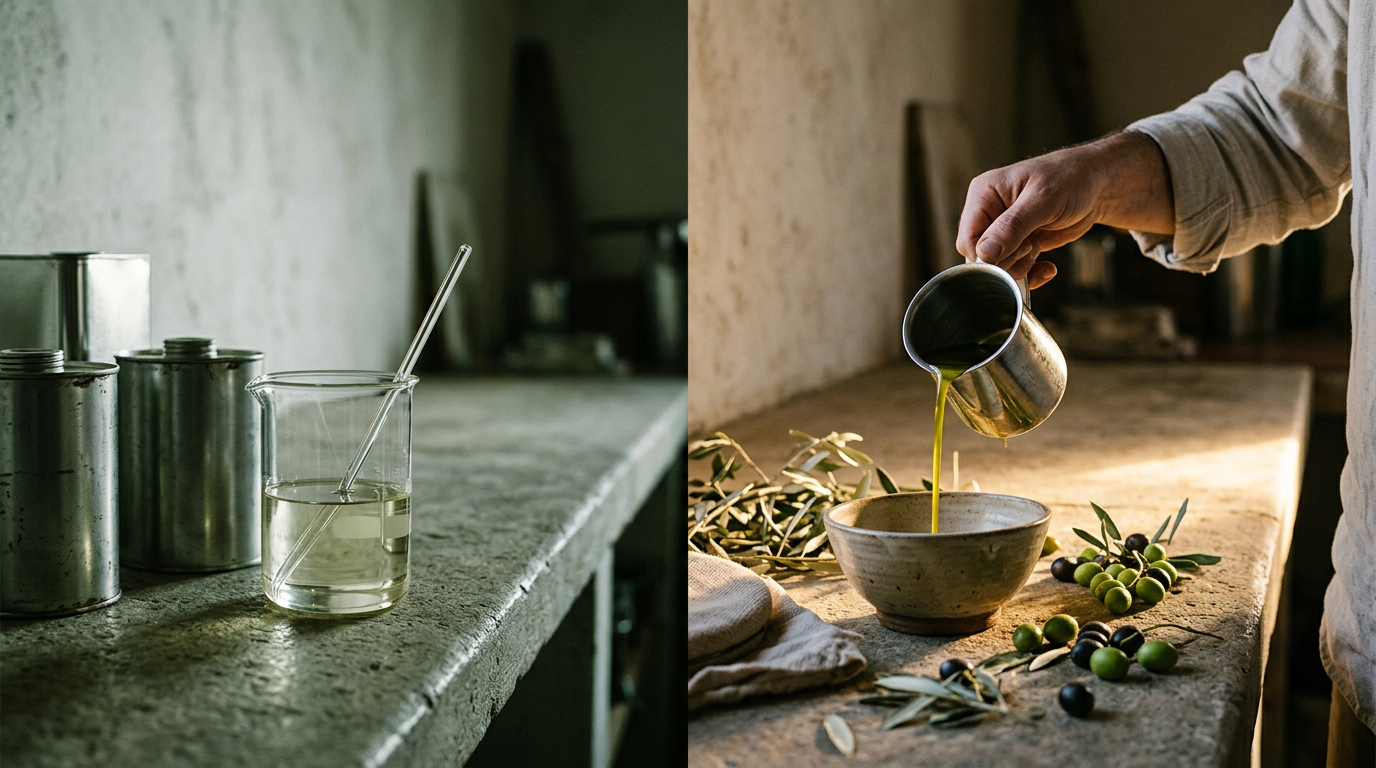
Every olive pressed for oil leaves something behind: a dense, damp paste of crushed pits, skins and spent pulp. In Italian it is called sansa. In English, pomace. And here is the part of the story most shoppers never hear — that leftover paste is pressed into service one more time, chemically, to produce the cheapest grade in the entire olive oil hierarchy: olive pomace oil. It is legal, it is everywhere, and it has almost nothing in common with the oil we make. Here is exactly what it is, so you can decide for yourself whether it belongs in your kitchen.
How pomace oil is actually made
By the time olive paste leaves the mill, mechanical pressing has taken essentially all the oil that pressing can take. What remains in the pomace is a small percentage of residual fat, bound so tightly into the solids that no press on earth can free it. So the industry does not press. It dissolves.
The pomace is dried and treated with a chemical solvent — typically hexane, the same solvent used to extract seed oils — which strips the last oil out of the solids. The solvent is then evaporated off, and what remains is crude pomace oil: dark, harsh, and inedible as it stands. To make it sellable, it goes through full industrial refining — neutralization, bleaching, deodorization at high temperature — the same process we described in our guide to refined olive oil. Refining strips odor and flaws, and with them nearly everything else: the aroma, the pepper, the bitterness, and the great majority of the polyphenols that make real extra virgin worth eating. A small dose of virgin oil is blended back in at the end, mostly to give the finished product a hint of color and flavor.
None of this is a scandal in the legal sense. Olive pomace oil is a recognized category with its own standards, and reputable producers declare it. The problem is not that it exists. The problem is how easily it trades on the reputation of a product it does not resemble.
Where pomace oil hides
On the shelf
By law, the label must say “olive pomace oil” — it cannot be sold as olive oil, and certainly not as extra virgin. But the bottles are designed to blur the distinction: Italian flags, groves at sunset, words like “classico” and “cucina” in large type, with “pomace” in the quietest print the regulations allow. It usually sits on the same shelf as real olive oil at a fraction of the price, and shoppers in a hurry take home the bottle without ever registering the word.
In restaurant kitchens
The biggest market for pomace oil is not homes but food service. It is sold in large tins as a cheap frying and cooking fat, and in much of the world it is what actually sizzles under dishes described on the menu as “cooked in olive oil.” The menu is not exactly lying — pomace oil is, technically, in the olive family. But if you picture green-gold juice from freshly crushed fruit, you are picturing a different product entirely.
What you give up
Real extra virgin olive oil is fresh fruit juice: pressed mechanically, cold, within hours of harvest, and never touched by solvents or refining. That is the entire reason it tastes alive — and the reason it carries the polyphenols and oleocanthal that make it one of the most studied foods in nutrition science. We walk through those standards in detail in what makes quality olive oil.
Pomace oil, by contrast, arrives at your table having been solvent-extracted from spent solids and refined at high heat. Its polyphenol content is negligible. Its flavor is engineered to be absent. It is a neutral industrial fat with an olive-adjacent name — closer, in every way that matters, to the anonymous supermarket blends we examined in why we walked away from supermarket oil than to anything a family mill would sign its name to.
How to make sure you never buy it by accident
Turn the bottle around and read the grade — the front of the label is marketing, the back is law. Look for the words “extra virgin,” a named country of origin, and ideally a harvest date. Be suspicious of any “olive oil” priced like seed oil; solvent extraction is cheap, and real harvests are not. And when a producer tells you exactly which grove the fruit came from, the question answers itself — traceability and pomace do not coexist. That is the standard behind our single-source guarantee: one estate, one press, nothing extracted, nothing refined.
Taste what olive oil is supposed to be. Our extra virgin comes from one Calabrian family estate, pressed within hours of picking — no solvents, no refining, no fine print. Explore the range.
Leave a Reply