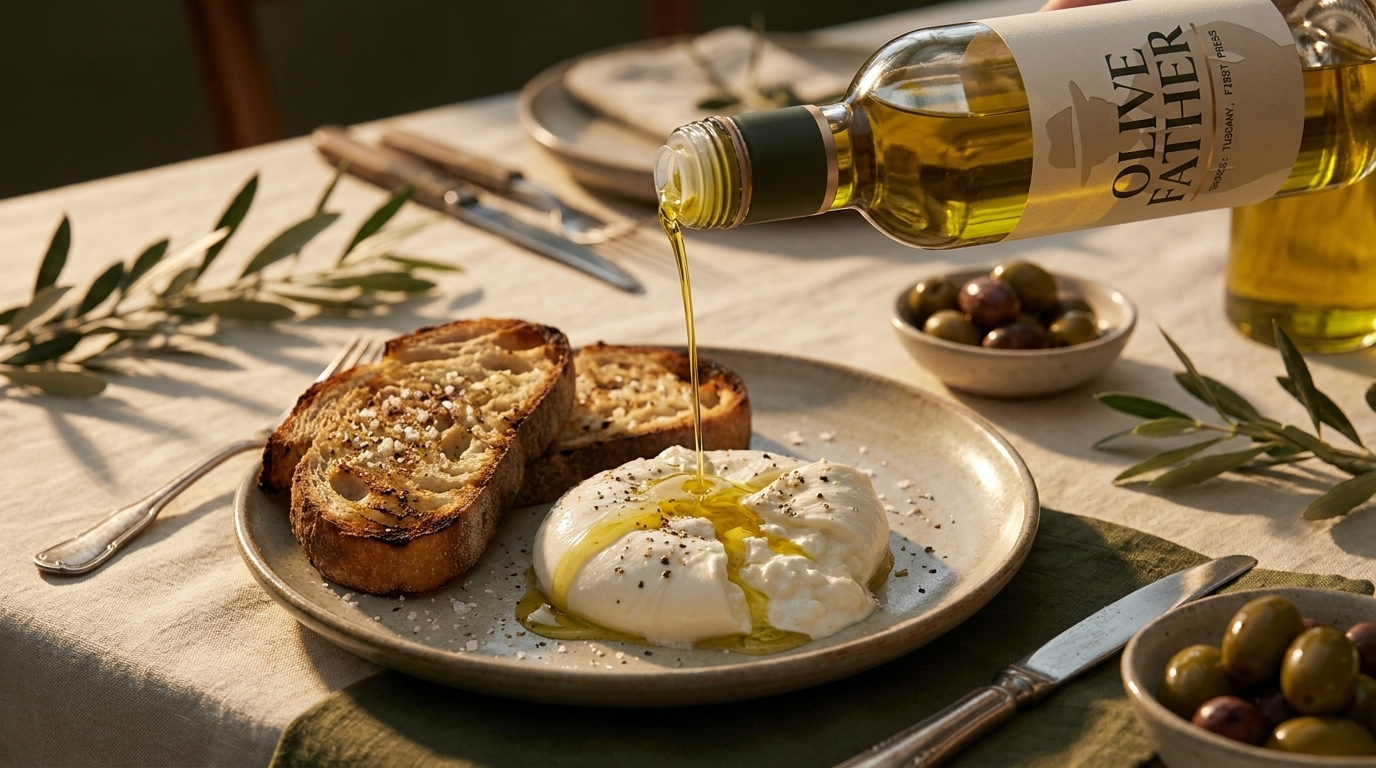
Walk into a serious Italian kitchen and you will usually find two olive oils. One lives beside the stove and goes into the pan. The other lives away from the heat, is guarded a little jealously, and only appears at the very end — poured in a thin golden thread over the finished plate, seconds before it reaches the table. That second bottle is the finishing oil, and once you understand what it is for, you will never plate a meal quite the same way again.
What “finishing oil” actually means
A finishing oil is not a separate grade or a legal category. It is a role: an extra virgin olive oil good enough to be used raw, as the last ingredient a dish receives. Nothing is cooked in it. Nothing is hidden under it. It lands on warm food, blooms in the rising heat, and delivers everything a great oil has to offer — aroma, fruit, bitterness, that peppery catch at the back of the throat — completely intact.
That role is unforgiving. In a sauté, a mediocre oil can hide behind garlic and heat. Poured raw over white beans or a piece of grilled fish, an oil has nowhere to hide at all. Which is exactly why the finishing bottle is where quality matters most.
Why finishing works: the science of the last pour
The most precious things in a truly fresh extra virgin oil are also the most fragile. Its volatile aromatics — the green, grassy, tomato-leaf notes — begin to evaporate the moment the oil gets hot. Its polyphenols, the antioxidant compounds responsible for both the healthy reputation and the pleasant bite of real extra virgin oil, survive cooking better than people think, but they are still gradually spent by prolonged heat.
Pour the oil over food that is warm but no longer cooking, and the equation flips. The residual heat becomes an ally: it lifts the aromatics off the plate and straight to your nose, the way warmth opens up a glass of wine, while the polyphenols arrive at your table untouched. Same bottle, same pour — dramatically more of everything you paid for.
What makes an oil worth finishing with
Freshness above everything
A finishing oil should come from the most recent harvest, with the harvest date printed on the label. Olive oil is a fresh fruit juice, not a wine; its brightness fades month by month. An oil pressed last autumn still tastes alive. An oil of unknown age tastes like regret.
A single, named source
Blends assembled from many countries are engineered to taste like nothing in particular, which is precisely what you do not want in the starring role. An oil from one estate — one grove, one harvest, one press — carries a personality: our Calabrian oil brings green almond, cut grass and a firm peppery finish that stands up on the plate. That is what single-source traceability buys you: not just honesty, but character.
Real intensity
Professional tasters judge oil on three qualities: fruitiness, bitterness, pungency. A finishing oil should have all three in confident measure. If an oil tastes merely “smooth” — a polite word for flat — it will vanish on food. If it makes you cough a little on the first taste, congratulations: that is oleocanthal, and it is exactly what you want. Our tasting notes and pairings page shows you how to judge this like the professionals do.
How to finish like an Italian
There is no technique to learn, only timing. Plate the food, then pour — a thin, deliberate thread, held a little high so the oil ribbons. Where it belongs: over pasta the moment it is tossed; on soups and white beans, where a spiral of green-gold oil transforms humble into luxurious; across grilled fish, steak or vegetables straight off the heat; over burrata or mozzarella with nothing but salt; on charred bread, thick enough to pool. Even vanilla gelato, with good oil and flaky salt, becomes something people talk about. You will find more ideas in our recipes.
One rule above all: the finishing oil never goes back over heat. Cook with a good honest oil; finish with your best one.
One bottle changes every meal
The beauty of a finishing oil is its economics: because it is used in threads and spirals rather than cupfuls, a single bottle elevates dozens of meals. It is the cheapest upgrade a kitchen can make — provided the oil is real. Ours comes from one family estate in Calabria, harvested early, pressed within hours and bottled with its harvest date on the label. Explore the range and give your table the last pour it deserves.
Leave a Reply