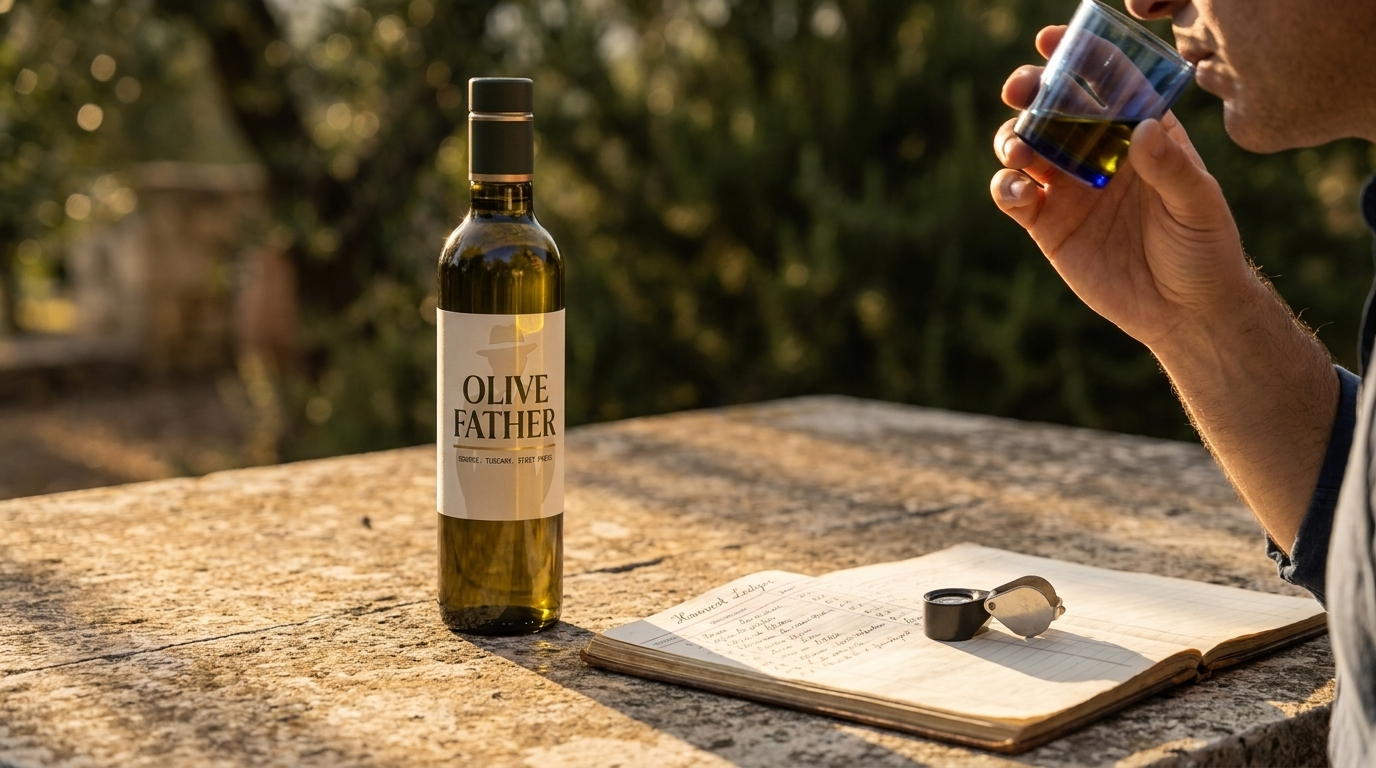
“Extra virgin” is the most valuable phrase in the olive oil world and the most casually abused. It sounds like marketing — a superlative someone invented to sell bottles. It is not. It is a legal grade with hard chemical limits and a mandatory taste test, and most people who buy it every week have never been told what it actually requires. Here is the straight answer.
The real definition, in three parts
1. Juice, not chemistry
Extra virgin oil must be extracted from fresh olives by mechanical means alone — crushing, malaxing, spinning — at temperatures that do not degrade the oil. No solvents, no refining, no blending with processed oil. If chemistry touched it, it is not extra virgin, whatever the bottle says.
2. Free acidity below 0.8%
Free acidity measures how much the oil’s fat molecules have broken down — a direct record of damaged fruit, delays between harvest and milling, or careless handling. The legal ceiling for extra virgin is 0.8 grams per 100 grams. Truly excellent oils, milled within hours of picking, come in far below it — often under 0.3%. We explain the numbers in depth in our guide to the chemistry of olive oil quality.
3. Zero defects on a blind taste panel
This is the part almost nobody knows: extra virgin must pass a blind tasting by a trained panel that finds no defects at all — no rancidity, no mustiness, no winey ferment — and at least some genuine fruitiness. Lab numbers can be met by a mediocre oil; the panel is where tired oils fail.
Why the label alone is not enough
If the definition is strict, the enforcement is not. In a well-known University of California, Davis study, a large share of imported oils labeled “extra virgin” failed the sensory standard on testing. The grade is certified at bottling — but oil is a fresh product, and a technically legal oil that then spends eighteen months in a hot warehouse and under supermarket lights can arrive at your table rancid, with the “extra virgin” label still proudly attached. That gap between the label and the liquid is why we tell people not to buy their oil the way they buy ketchup.
What to check instead of the front label
The harvest date. Not “best by” — the actual harvest. Great producers print it because they are proud of it; industrial bottlers omit it because they cannot pin their blend to a season. Fresh means the most recent harvest, and olives in the northern hemisphere are picked in autumn — a matter of days that decides everything.
A single, named origin. “Product of Italy” can legally mean bottled in Italy from oil grown elsewhere. What you want is a grove, an estate, a family — one place that stands behind the oil. That is the standard we hold ourselves to, and you can read exactly what we believe quality has to prove.
Dark glass or tin, and a peppery finish. Light kills oil, so serious producers never use clear bottles. And when you taste it, real extra virgin should bite gently at the back of your throat — that pepper is the polyphenols talking, and it is the one signature no fake can counterfeit.
Extra virgin, as it was meant to be
Our oil is pressed from a single Calabrian estate within hours of harvest, bottled in dark glass with its harvest stamped on the label, and never blended with anyone else’s fruit. That is not marketing language — it is simply the definition of extra virgin, taken seriously. Explore the Olive Father range and taste what the grade was invented to protect.
Leave a Reply