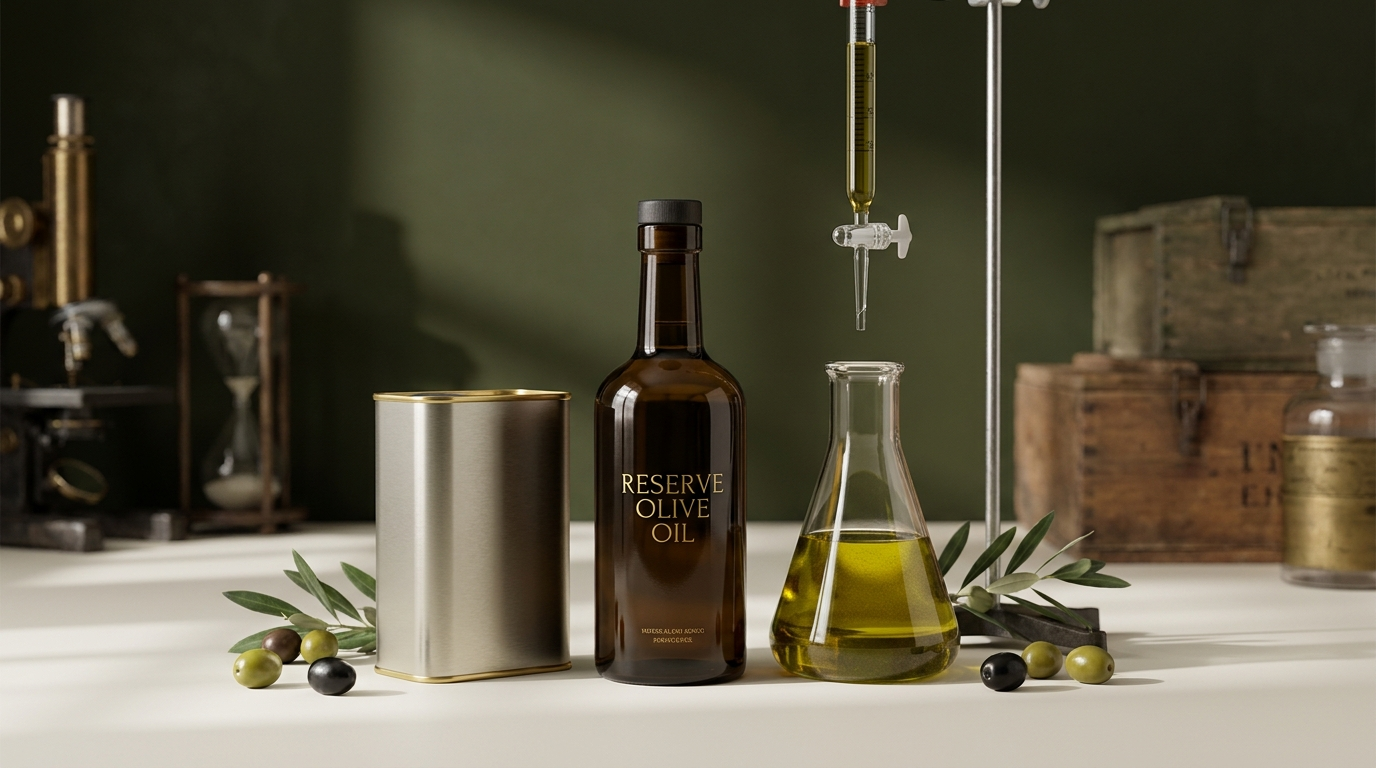
“Fresh” is an easy word to print. “Quality” is easier still. Neither one costs a producer anything, which is why both appear on bottles that deserve neither. What makes olive oil unusual among foods is that it does not have to be taken on trust. Its quality can be pinned to specific, repeatable chemistry — a handful of laboratory figures that a mill either meets or does not, and that no label designer can improve.
This page is our attempt to explain those figures the way we would to a new member of the family: what each number actually measures, what it says about how the fruit was handled, and how the slow chemistry of rancidity works against every bottle from the day it is sealed. If you already know the tasting side, this is the other half of the story — the half that happens in a burette rather than a glass.
Free acidity: the number that defines the grade
Inside a sound olive, the fatty acids are bound up three at a time on a glycerol backbone — triglycerides, the ordinary architecture of any fat. The moment the fruit is bruised, frost-bitten, attacked by the olive fly, left in a heap overnight or milled with dirty equipment, enzymes and microbes begin cutting those bonds and setting individual fatty acids loose in the oil. The proportion of these liberated acids is the free acidity, expressed by convention as grams of oleic acid per 100 grams of oil — in everyday language, a percentage.
Two things follow that most labels quietly rely on you not knowing. First, you cannot taste free acidity. It has nothing to do with sourness or sharpness; an oil at 0.2 percent and an oil at 1.5 percent can taste equally soft. Second, because it is created by damage and delay, it is a record of everything that happened to the fruit between the branch and the separator. A very low figure is not a stylistic choice. It is proof of clean, undamaged olives, picked and milled in a hurry — the discipline described on our page on harvest and cold pressing.
The thresholds are set by the International Olive Council and written into European Union regulation. An oil may be called extra virgin only if its free acidity is no greater than 0.8 percent. Virgin olive oil is permitted up to 2.0 percent. Above that, the oil is lampante — lamp oil — and cannot be sold for eating until it has been refined. Fruit that has been handled the way we handle it lands far below the ceiling, typically well under 0.3 percent. When a bottle boasts of “low acidity” but declines to print the figure, it is worth asking why. Our overview of what quality actually means puts this number beside the others that make up the grade.
Peroxide value: the first fingerprint of oxidation
What it measures
Free acidity tells you about damage before the mill. Peroxide value tells you about damage after it. When the unsaturated fatty acids in oil meet oxygen, the first stable products of the reaction are hydroperoxides, and the peroxide value counts them — in milliequivalents of active oxygen per kilogram of oil. For extra virgin, the legal ceiling is 20 meq O₂/kg. A freshly milled oil from sound fruit will usually sit in single digits.
Peroxides are a beginning, not an end. They are unstable intermediates, and as oxidation proceeds they fracture into the aldehydes, ketones and short-chain acids that the nose eventually reports as rancidity — crayon, old walnut, putty, stale peanut. So a rising peroxide value is an early warning: the oil has started to react with air even though it may still taste acceptable. Read together, a low free acidity and a low peroxide value describe an oil that was made from good fruit and has been kept well since.
The spectrophotometer’s second opinion
There is a subtlety here that the honest producer must own. Peroxides can fall as well as rise: an oil that is badly oxidised and then left long enough may show a deceptively modest peroxide value because its peroxides have already broken down into other things. That is why the grading standard also measures ultraviolet absorbance — the coefficients written as K232 and K270. Primary oxidation products absorb light at 232 nanometres; secondary products, and the traces left by refining, absorb at 270. For extra virgin the limits are K232 no greater than 2.50 and K270 no greater than 0.22. Together these three tests — acidity, peroxides, UV — make it very difficult for a tired or a refined oil to pass itself off as fresh.
How an oil goes rancid
Rancidity in olive oil is almost entirely oxidative: a self-propagating chain reaction in which oxygen attacks the double bonds of unsaturated fatty acids, producing free radicals that go on to attack further molecules. Once it is properly under way it feeds itself. Four things drive it, and each one is within the control of whoever is holding the bottle.
- Light — especially the blue and ultraviolet end of the spectrum — supplies the energy that starts the reaction and destroys the chlorophyll and antioxidants that would otherwise resist it. An oil in clear glass on a lit shelf is being cooked slowly by the shop.
- Heat accelerates every reaction involved. The bottle that lives beside the stove ages faster than the one in the cupboard, and the tanker that sat in a summer port ages fastest of all.
- Oxygen is the reactant itself. Every time a bottle is opened, fresh air replaces the oil you poured, which is why the last third of a bottle should be used briskly.
- Time lets all of the above accumulate. Even a perfectly stored oil is a fresh product with a finite life, not a wine.
The oil is not defenceless. Its polyphenols and vitamin E are sacrificial antioxidants: they intercept free radicals and are consumed in the process, buying the fatty acids time. This is the direct, physical link between the compounds described on our page on high-polyphenol olive oil and how long a bottle stays alive. A phenol-rich oil has a deeper reserve. A phenol-poor one — late-picked, over-ripe, or refined — goes stale first, and takes its health case with it.
Why the bottle and the date matter more than the medal
If light, heat, oxygen and time are the enemies, then packaging is simply the practice of excluding them. Dark glass and lacquered tin are not aesthetic decisions; they are the cheapest and most effective preservation technology available, and a producer who chooses clear glass has chosen the shelf over the oil. A harvest date — printed alongside, or instead of, a distant “best before” — tells you what no shelf-life stamp can: how old the oil truly is. Olive oil is at its best young, and a harvest from the most recent autumn is the single most meaningful freshness signal on any label. It is also only possible for a producer who knows exactly which fruit went into which tank, which is the subject of our page on single source and traceability.
Filtered or unfiltered
Oil straight from the separator carries a faint haze of fruit water and microscopic pulp. Unfiltered, it is cloudy, fuller and briefly magnificent — the olio nuovo that Italians queue for in November. But that suspended water and sediment shelters enzymes and encourages fermentation at the bottom of the bottle, and an unfiltered oil that is not drunk within a few months can turn faster than a filtered one from the same tank. Filtration removes the water and particles and yields a clearer oil that keeps its composure far longer. Neither is inherently superior. One is built for the first weeks after harvest; the other for the year that follows.
The smoke point, in its proper place
A durable piece of kitchen folklore holds that extra virgin olive oil should not be cooked with because of its smoke point. The chemistry does not support it. A fresh, low-acidity extra virgin oil smokes at a temperature comfortably above ordinary sautéing, roasting and shallow frying — and free acidity is part of why: free fatty acids smoke before bound ones do, so a clean oil holds heat better than a damaged one. More to the point, smoke point is a poor predictor of what actually matters, which is oxidative stability — how much harmful degradation a fat undergoes at cooking temperature over time. Olive oil’s high share of monounsaturated oleic acid, its low load of fragile polyunsaturates and its antioxidants make it one of the more stable fats under heat, and controlled cooking studies have repeatedly found it producing fewer oxidation products than seed oils with nominally higher smoke points. The molecular detail is on our page on the science of extra virgin olive oil.
Chemistry is only half the grade
One more thing the standard insists on, and we are glad it does. An oil can pass every laboratory test above and still fail to be extra virgin, because the grade also requires a trained sensory panel to find zero defects and some fruitiness. The lab catches damage and age; the panel catches the flavours of poor fruit and poor storage — fusty, musty, winey, rancid — that the numbers can miss. When the University of California, Davis, tested imported oils from American retail shelves, it was largely the sensory panel, not the chemistry, that most of the failed bottles fell to. We explain how those oils end up on the shelf on our page on why not supermarket olive oil.
Quality you can verify
The virtue of olive oil chemistry is that it turns adjectives into facts. Free acidity below 0.8 percent, peroxides below 20, UV absorbance within limits and a clean panel define extra virgin. Dark packaging, a recent harvest date and sensible storage protect it. And the oil’s own composition makes it more robust in the pan than its reputation suggests. Every lot we bottle is tested against these figures before it is allowed to carry the name, and we would rather show you a certificate than a medal. To see how the standard shapes what we press, explore the range.