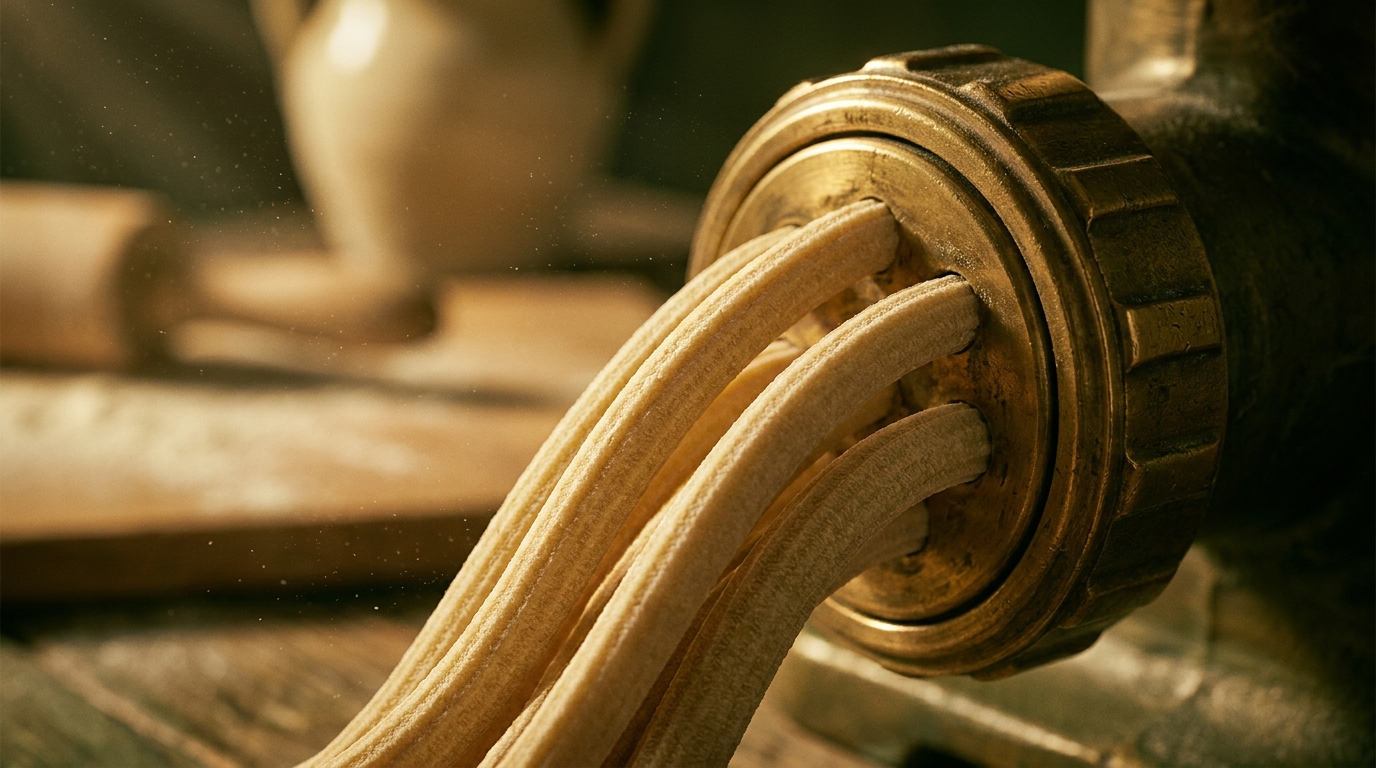
Pick up two boxes of dried pasta — one from an industrial brand, one marked trafilata al bronzo — and run a finger over the surface of each. The first feels like glazed porcelain. The second feels like fine sandpaper. That difference, invisible in a photo and unmistakable in the mouth, is the entire argument for bronze-cut pasta. And it comes down to a single piece of metal.
What a bronze die actually is
All extruded pasta is made the same basic way: durum wheat semolina and water are kneaded into a stiff dough, then forced under pressure through a perforated plate called a die. The shape of the holes decides the shape of the pasta — rigatoni, penne, spaghetti. The material of the die decides its character.
Traditional dies are cast in bronze, the same way they have been made for well over a century. Bronze is a comparatively rough, grippy metal, and as the dough is pushed through it, the surface of the pasta is microscopically torn. The result is a matte, porous skin, pale rather than shiny, covered in tiny ridges and craters.
Most industrial pasta, by contrast, is extruded through dies lined with Teflon. Teflon is slick, fast, and nearly frictionless — dough slides through it cleanly, which means factories can run lines at much higher speeds with less wear. The pasta comes out smooth, glossy, and almost sealed, like it has been varnished.
Why the rough surface wins on the plate
Sauce has something to hold on to
The porous surface of bronze-cut pasta acts like thousands of microscopic hooks. Olive oil, tomato, guanciale fat, pecorino — they cling to the ridges instead of sliding off. With smooth Teflon-cut pasta, the sauce pools at the bottom of the bowl while the noodles stay stubbornly naked. This is not a matter of taste or tradition; it is simple physics of surface area.
Starch that finishes the dish
That torn surface also releases more starch into the cooking water. Italian cooks treat that cloudy water as an ingredient in its own right — a ladleful whisked into the pan emulsifies the sauce, binding oil and liquid into something silky that coats every piece. Bronze-cut pasta produces noticeably starchier water, which is one reason a simple cacio e pepe made with it comes together while the same dish made with slick pasta breaks.
A better bite
Bronze-drawn pasta is usually dried slowly at low temperatures, because the small producers who bother with bronze dies tend to be the same ones who refuse to blast their pasta dry in a few hours. Slow drying preserves the wheat’s flavour and gives the pasta a denser structure that holds a true al dente — firm at the centre, never gummy.
How to spot real bronze-cut pasta
- Look for the words trafilata al bronzo (bronze-drawn) on the package — producers who pay for the process always say so.
- Check the colour. Bronze-cut pasta is pale, matte, almost dusty-looking. A shiny, deep-yellow surface suggests Teflon extrusion and high-heat drying.
- Feel the surface. Through the packet you can often feel the roughness, like fine grit.
- Read the drying time. Slow-dried pasta (24 hours or more) is a strong sign of serious production.
Why we make ours this way
At Olive Father, our pasta is bronze-drawn for the same reason our olive oil comes from a single named grove: the slower way is simply better, and you can taste it. A rough-skinned rigatoni exists to carry great olive oil and honest sauce — it is the natural partner to everything else we make.
If you want to put the theory to work, start with our guide to pasta shapes and the sauces they were built for, then cook something from our recipes — most need five ingredients or fewer, because the pasta and the oil are doing the heavy lifting.
Taste the difference the die makes. Olive Father bronze-drawn pasta and single-source Calabrian olive oil are coming to the United States now — join the early access list and be first at the table.
Leave a Reply