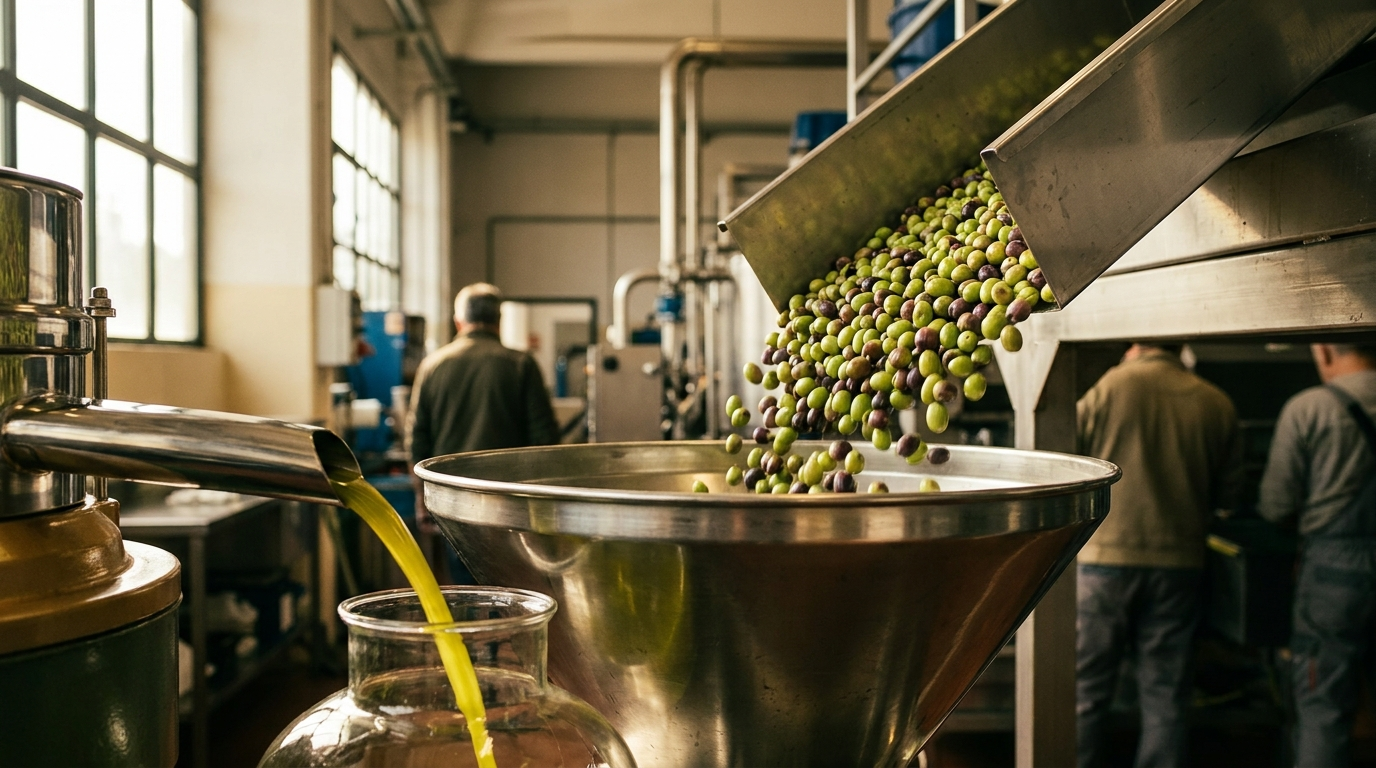
Most people have poured olive oil their whole lives without ever seeing how it comes to exist. The surprise, when you finally watch it happen, is how little stands between the tree and the bottle. Olive oil is not brewed, refined, or formulated. It is a fresh fruit juice, squeezed from a stone fruit and separated from its own water — and every single step is a place where the oil is either protected or quietly ruined. Here is the whole process, from someone whose family has done it for six generations.
First, understand what you are making
An olive is a drupe — a cousin of the cherry and the plum — and its flesh is full of tiny droplets of oil. Making olive oil is simply the craft of freeing those droplets without damaging them. There is no cooking and no chemistry in true extra virgin oil; the entire legal definition requires that the oil be obtained by mechanical means alone. That is also the clock ticking over the whole operation: from the moment an olive leaves the branch, enzymes and oxygen begin degrading it. Speed and care are the recipe.
Step 1: The harvest — the decision that shapes everything
Quality is decided first in the grove. Olives picked early — green, or just turning — give less oil but far more flavor and polyphenols; olives left to blacken give more liters of something flat and fragile. Serious producers accept the smaller yield and pick early, by hand or with gentle rakes and nets, never letting fruit bruise on the ground. The best mills will not accept fruit that has sat overnight. We describe our own timing on our harvest and cold pressing page.
Step 2: To the mill within hours
The interval between picking and milling is the most honest measure of a producer’s seriousness. Hours are good; same-day is the standard that matters. At the mill the fruit is washed, stripped of leaves, and crushed whole — stone and all — into a thick paste. Modern mills use stainless steel crushers rather than the old granite wheels, not for romance but for hygiene and speed.
Malaxation: the slow stir
The paste is then gently churned for thirty to forty-five minutes so the microscopic oil droplets find each other and merge. This is where the phrase “cold extraction” earns its meaning: under European rules the paste must stay below 27°C (about 80°F). Warm the paste and you would get more oil — and lose the aromas and antioxidants that make it worth having. It is the single clearest trade of quantity for quality in the whole process, and it is why the words on the label deserve scrutiny, as we explain in our guide to what cold pressed really means.
Step 3: Separation — juice from water from solids
An olive is mostly water. A horizontal centrifuge called a decanter spins the paste so it splits into three streams: oil, vegetal water, and the solid pomace of skins and pits. A second, vertical centrifuge polishes the oil further. What flows out of that final spout — green, cloudy, alive, often literally still cool from the process — is extra virgin olive oil. It has existed for less than a day, and it will never taste better than it does at that moment.
Step 4: Rest, filter, and bottle in the dark
Fresh oil rests briefly in sealed stainless steel tanks, usually under inert gas so oxygen cannot reach it. Most fine producers then filter it — removing the fruit particles that would eventually turn to sediment and shorten its life — and bottle it in dark glass or tins, because light is one of oil’s three enemies, along with heat and air. From there the countdown continues gently: a well-made oil is at its best within about eighteen months of harvest, which is why a printed harvest date matters more than any medal on the label.
Where great oil is won — and where cheap oil cheats
Notice what this process has no room for: waiting, heating, blending, deodorizing. Industrial “olive oil” exists because each of those shortcuts recovers money at the cost of the fruit — late-picked olives, hot extraction for yield, tanker blends from many countries, refining to strip away defects. The result is technically oil and spiritually nothing. Every step we have described happens on one estate, within hours, for every bottle we make — that is the meaning of our grove to bottle promise and our single-source guarantee.
Once you have seen how olive oil is made, the bottle in your kitchen stops being a commodity and becomes a verdict on how it was treated. Taste one made the slow way — explore our oils, each pressed within hours on a single Calabrian estate.
Leave a Reply