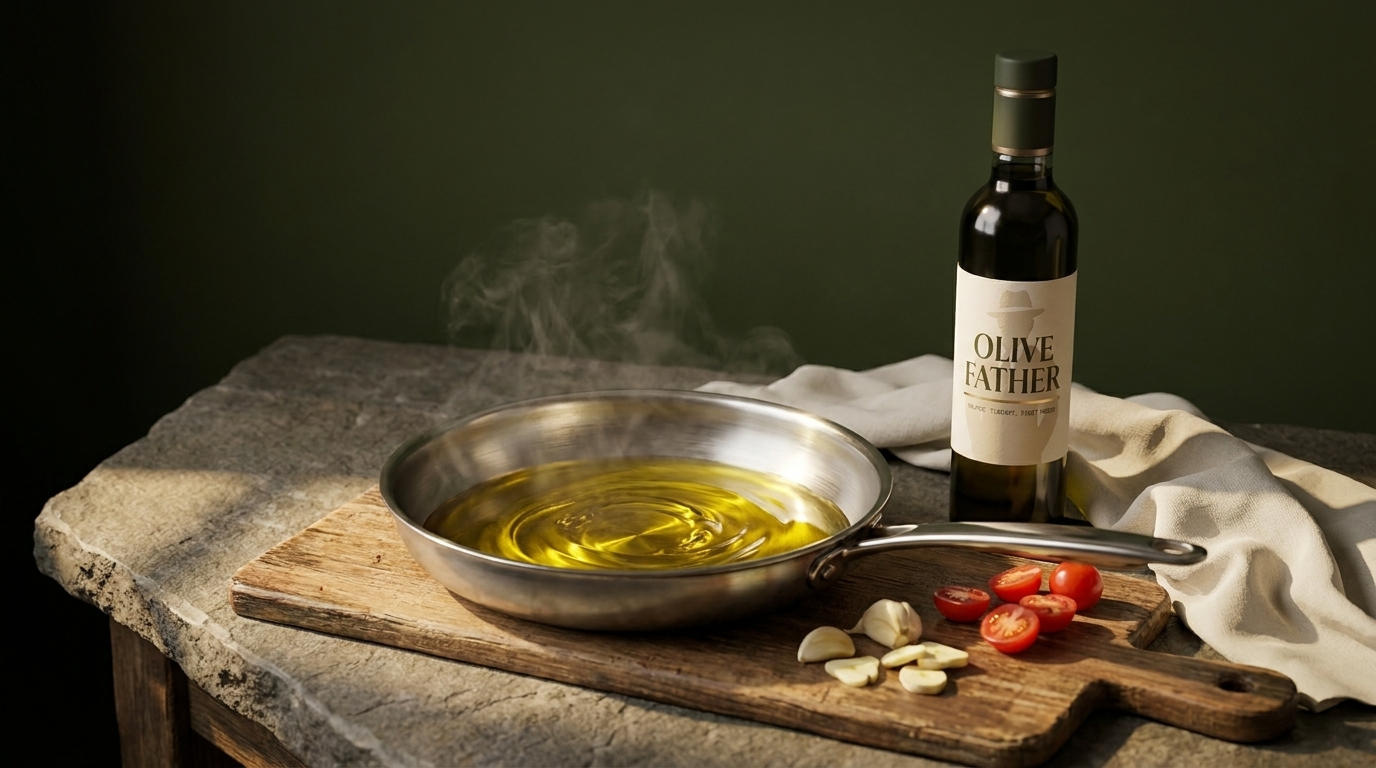
Walk down the oil aisle and you will find bottles labeled “light,” “pure,” “classic,” and “for cooking,” all priced to suggest that the good stuff should stay on the shelf for salads. This is one of the most profitable misunderstandings in the grocery business. The best olive oil for cooking is the same as the best olive oil for everything else: a real, fresh extra virgin. Here is why — and what those other labels are actually selling you.
“Light” and “pure” olive oil: what those words really mean
“Light” does not mean fewer calories — every olive oil has the same 120 per tablespoon. It means light in taste, because the oil has been chemically refined: treated with heat, steam, and deodorization to strip out defects from low-grade oil that could not pass as virgin. The process also strips out nearly everything worth having — the aroma, the color, and most of the antioxidant polyphenols. “Pure” olive oil is the same refined base with a splash of virgin oil added back for color. These are real, legal products; they are simply the least of what the olive can give, sold at a healthy margin. We go deeper on this industrial pipeline on our page about why supermarket oil disappoints.
But doesn’t extra virgin burn? The smoke point myth
The reason people buy refined oil for the pan is the belief that extra virgin cannot take heat. In practice, a quality extra virgin smokes at around 375–410°F (190–210°C) — comfortably above everyday sautéing, roasting, and shallow-frying temperatures. More importantly, research on heated oils has repeatedly found that stability under heat depends less on smoke point than on composition: olive oil’s monounsaturated fat and its antioxidants make it one of the most stable cooking fats there is. Fresh, phenol-rich oil is more durable in the pan, not less, because those antioxidants sacrifice themselves protecting the oil. We took this myth apart line by line in our post on cooking with extra virgin olive oil.
How to choose a cooking oil you can trust
Look for the markers of a real oil
A harvest date on the label. A named estate or mill, not just a country — and certainly not “packed in Italy,” which describes the bottling plant, not the olives. Cold extraction, dark glass or tin, and a single origin rather than a blend of the Mediterranean’s leftovers. These are the same signals of quality we explain on our guide to what quality actually means, and they matter in the pan just as much as on the plate.
Match the oil to the job, not the marketing
For sautéing vegetables, searing fish, roasting, frying eggs, and building a sauce, a robust extra virgin adds flavor at every step — garlic bloomed in real oil tastes like a different ingredient. For finishing, use the freshest, most peppery oil you have, poured raw where its early-harvest, cold-extracted character can speak. The old advice to keep a cheap bottle “for cooking” gets it backwards: heat is exactly when a well-made oil’s stability earns its price, and a refined oil contributes nothing but grease.
One bottle, bought well
The Italian kitchen has never had a drawer full of specialized oils. It has one oil — the family’s oil — used for everything from the morning bread to the evening frying, chosen once and chosen well. That is still the best advice we can give: skip the “light,” skip the “pure,” and cook with an oil whose grove you can name.
Ours comes from a single estate in Calabria, harvested early and milled within hours, with the structure to handle your hottest pan and the flavor to finish the dish. Explore the Olive Father range — in bottles for the table and generous tins for the stove — and give your cooking the oil it deserves.
Leave a Reply