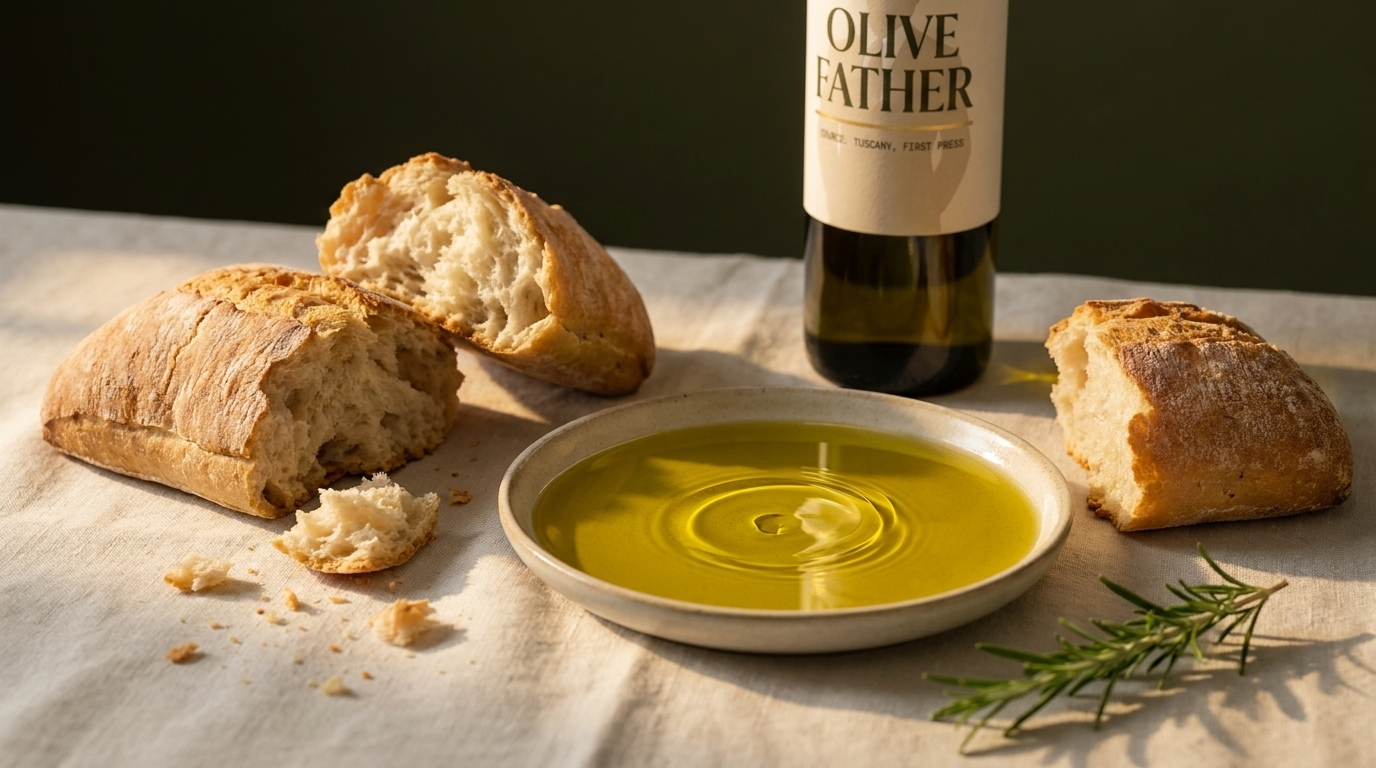
Tear a piece of good bread, pour a pool of green-gold oil onto a plate, add a few flakes of salt, and dip. It is the simplest thing in the kitchen and, not coincidentally, the oldest way in the world to taste an olive oil honestly. There is nothing to hide behind: no heat, no sauce, no distraction. Just bread, oil, and whatever the oil actually is. Here is how Italians treat this ritual — and why it remains the best test of a great extra virgin.
A note on the tradition
The oil-soaked-bread dish you meet in American restaurants — a saucer of oil, often with balsamic swirled in, set out before the meal — is more an Italian-American invention than an everyday habit in Italy itself. What is genuinely ancient and genuinely Italian is fettunta in Tuscany and bruschetta across the country: bread grilled over embers, rubbed with raw garlic, and drenched in the first oil of the new harvest. In Puglia and Calabria, a slice of bread under fresh oil and salt has fed farmhands at harvest time for generations. The spirit is the same everywhere: let the oil be the star, and keep everything around it plain.
Choosing the bread
The bread is a vehicle, not a flavour. You want something honest and sturdy: a rustic country loaf, a ciabatta, or the famously unsalted Tuscan bread that exists almost expressly to carry oil. Avoid anything sweet, buttery, or too soft — a brioche or a milk roll will fight the oil rather than deliver it. A crust with some chew and an open, airy crumb holds a generous slick of oil and lets its aromas rise as you bite.
Choosing the oil is the whole point
Because dipping strips away every disguise, it exposes a mediocre oil instantly. A flat, greasy supermarket oil tastes of not much and coats the mouth unpleasantly. A fresh, well-made extra virgin does the opposite: it smells green — cut grass, artichoke, green almond — turns pleasantly bitter across the tongue, and finishes with a peppery catch at the back of the throat. That bitterness and pepper are not flaws; they are the polyphenols that define a serious oil announcing themselves. If you want to understand exactly what you are tasting and why, our guide to what makes quality olive oil lays it out.
Match the oil to the moment, too. A robust, bitter Tuscan-style oil stands up beautifully to a hearty loaf and a generous hand with the salt; a gentler, riper oil is lovely with a lighter bread when you want fragrance over force.
Salt, herbs, and the balsamic question
A few flakes of flaky sea salt are the one addition almost everyone agrees on — salt lifts the fruit of the oil and sharpens its finish. Beyond that, a purist stops there. If you like, a crack of black pepper, a scatter of chopped rosemary or oregano, or a whisper of chilli are all in keeping. Balsamic vinegar is the point where Italians and Americans politely part ways: it is delicious, but it is a different dish, and its sweetness masks precisely the subtleties — the bitterness, the pepper, the green aromatics — that a fine oil is trying to show you. Our advice: taste the oil clean first. Add balsamic afterward, if you want it, once you have met the oil on its own terms.
How to dip like you mean it
- Pour fresh. Use a shallow pool and refresh it rather than letting oil sit out oxidising all evening.
- Go generous. This is not the moment for a stingy film. A good dip should glisten.
- Salt at the plate. Add the salt to the oil or the bread just before eating, not in advance.
- Smell, then taste. Bring the dipped bread to your nose first. Half the pleasure of great oil is its aroma.
- Serve it fresh from a good bottle. The oil can only be as good as what you opened. Freshness, kept from light and heat, is everything.
Do this once with a truly fresh, single-source oil and the whole ritual makes sense: you taste the grove, the harvest, and the pepper all in one bite. That is the difference we bottle. Explore the Olive Father range and set out a proper plate of bread and oil for yourself.
Leave a Reply