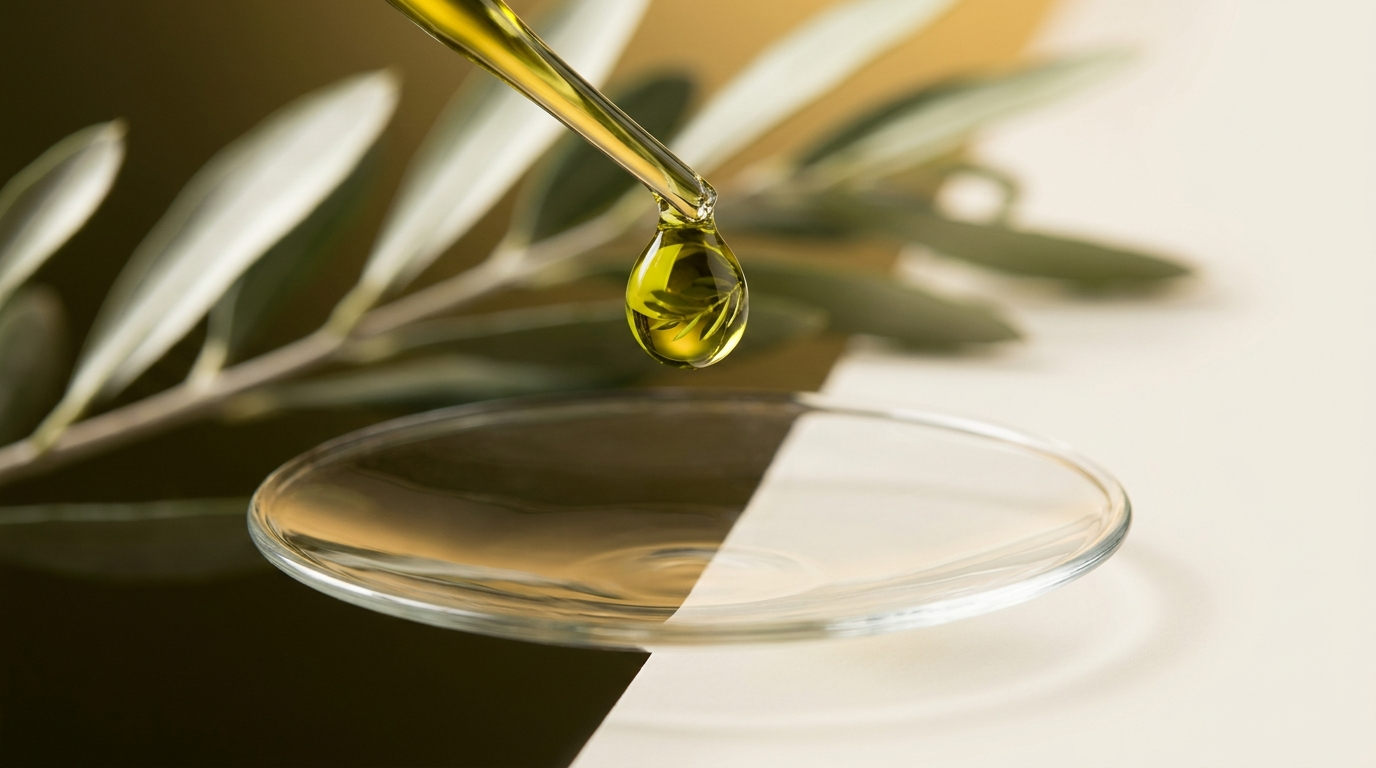
If you have ever tasted a fresh, serious olive oil and felt it catch at the back of your throat — a peppery sting sharp enough to make you cough — you have already met polyphenols. They are the reason great extra virgin olive oil tastes alive, keeps its character on the shelf, and sits at the centre of most of the health research. They are also precisely what a cheap, tired bottle has lost. Here is what polyphenols actually are, why they matter, and how to choose an oil that still carries them.
What polyphenols really are
Polyphenols — sometimes called biophenols — are a family of natural antioxidant compounds the olive tree produces to defend its fruit. When olives are pressed by mechanical means alone, without heat or solvents, those compounds travel from the fruit into the oil. The important members have names worth knowing: hydroxytyrosol and tyrosol, and the secoiridoids derived from oleuropein, the bitter compound abundant in the raw olive itself. Together they make up part of the small but decisive one to two percent of the oil that is not fat, and they carry most of its flavour and biological activity.
A refined seed oil has had this fraction stripped away almost entirely. A genuine extra virgin oil keeps it — which is the whole point of the grade. For the full molecular picture, our guide to the science of olive oil breaks down how these compounds fit alongside oleic acid and vitamin E.
Why they matter: taste, freshness, and health
They protect the oil from itself
Olive oil is a fresh fruit juice, and from the moment it is pressed it begins to oxidise. Polyphenols are antioxidants: they interrupt the chain reactions that would otherwise turn the oil rancid. An oil rich in polyphenols simply lasts longer and holds its flavour better than a phenol-poor one. This is chemistry, not marketing — the same reason a robust oil resists heat more gracefully than a stripped, refined fat.
They are what you taste
Bitterness and pungency in olive oil are not faults; they are polyphenols announcing themselves. Bitterness on the tongue tracks with compounds derived from oleuropein, while the peppery throat-catch comes largely from oleocanthal, a phenolic first identified in 2005 by researchers writing in Nature, who showed it acts on the same COX enzyme pathway as ibuprofen. A trained taster reads bitterness and pepper as a direct, if approximate, sensory measure of how much antioxidant the oil is carrying. A flat, greasy oil with no bite is usually one that had few polyphenols to begin with, or lost them to age and light.
The health claim that is actually approved
It is easy to overstate olive oil’s health effects, so it is worth being precise. The European Food Safety Authority has recognised a specific health claim for olive oil polyphenols: they contribute to the protection of blood lipids from oxidative stress, provided the oil delivers a defined daily amount of hydroxytyrosol and its derivatives. That is a real, regulator-backed claim — and notably, it only applies to oils that still contain meaningful polyphenol levels. A depleted oil cannot make it. Our deep dive on polyphenols looks at the evidence in more detail.
Where polyphenols come from — and where they are lost
Polyphenol content is not fixed by nature; it is won or lost in the grove and the mill. Three things decide it:
- Harvest timing. Olives picked early, while still green or turning, carry far more polyphenols than fully ripe black olives. Early-harvest oils give less oil per tree but a much higher concentration of antioxidants — which is why the most peppery oils are almost always green-harvest.
- Speed and temperature at the mill. Heat and delay drive off polyphenols. Genuine cold extraction keeps the paste below 27°C, and the shorter the gap between harvest and pressing, the more survives.
- Storage. Light, heat, and oxygen quietly burn polyphenols away in the bottle. Dark glass or tin, a cool shelf, and a real harvest date all matter.
This is why single-source oil from a family that controls the whole chain — grove, harvest, mill, bottle — can protect polyphenols that an anonymous global blend routinely loses.
How to choose a high-polyphenol olive oil
You do not need a laboratory. Look for a harvest date rather than only a distant “best by,” a single named origin, an oil sold in dark glass or a tin, and, where possible, a stated polyphenol or acidity figure. Then taste: a high-polyphenol oil is green and fruity on the nose, distinctly bitter across the tongue, and peppery enough to catch your throat. That sting is the signal you are looking for. If an oil is cheap, flat, and utterly smooth, assume its polyphenols are largely gone.
Olive Father is built around exactly these choices: green-harvested fruit, cold pressed within a day, from one six-generation family’s groves in Calabria and Tuscany, dated and protected so the polyphenols reach your kitchen intact. Explore our range and taste the pepper for yourself.
Leave a Reply