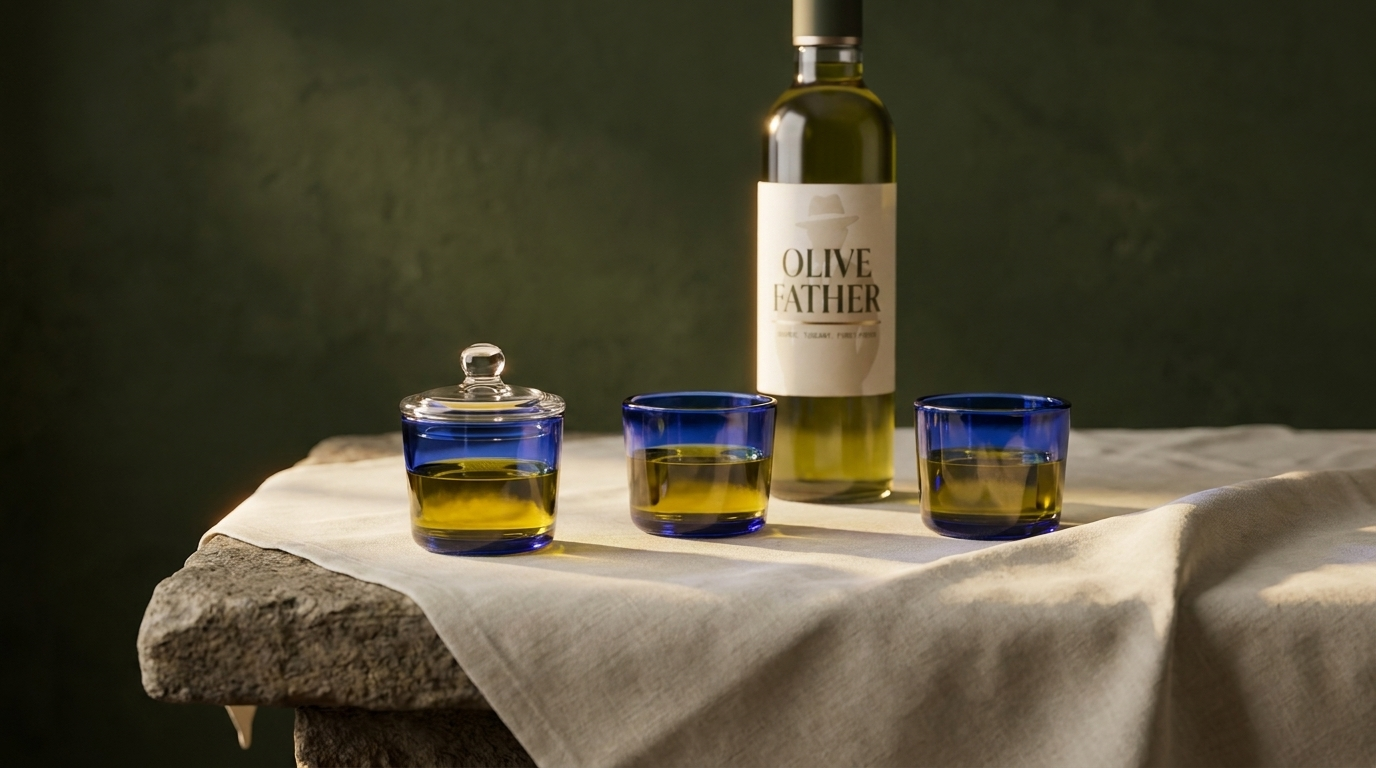
Most people have never tasted olive oil. They have tasted bread with olive oil on it, or salad, or a piece of fish — which is a different thing entirely, the way tasting a sauce is different from tasting the tomato. Oil judged on its own, warmed and inhaled and taken neat, is a startling experience the first time. It has a top note, a middle and a finish. It can be grassy, or tomato-leaf green, or almondy, or faintly of artichoke. It can also be flat, greasy and dead, and once you have learned to notice that, you will never unnotice it again.
The good news is that the professional method is not mysterious. Panels certified to grade oil for the International Olive Council use a procedure simple enough to run in your kitchen in ten minutes. Here it is, exactly as we use it at the mill.
What professionals are actually measuring
A tasting panel does not score an oil on whether it is nice. It scores three positive attributes, and it looks for the absence of defects. That is the whole exercise.
Fruitiness
The aroma and flavour of a sound olive, picked at the right moment. Green fruitiness reads as cut grass, tomato leaf, green almond, artichoke. Ripe fruitiness reads softer and rounder — ripe apple, sweet almond, a little floral. Neither is better; they are different harvest decisions. What matters is that something is there. An oil with no fruitiness at all cannot legally be extra virgin, whatever the label says.
Bitterness
Felt on the sides and back of the tongue, a clean bitterness like radicchio or walnut skin. It is not a flaw. It is the taste of phenolic compounds still present in the oil, and it is one of the reasons real extra virgin resists going rancid.
Pungency
The peppery catch at the very back of the throat that makes first-time tasters cough. It is caused chiefly by oleocanthal, and it is the single most reliable amateur signal of a fresh, phenol-rich oil. We wrote about the science of that sting in our guide to polyphenols and health.
Your equipment (you already own it)
Official panels use a small cobalt-blue glass with a wide belly and a narrow rim, plus a watch glass as a lid. The blue is not decoration: it hides the colour of the oil. Colour tells you almost nothing about quality — it is a function of cultivar and ripeness, not goodness — and a taster who can see green will unconsciously score green higher. If you do not own blue glasses, use a small tumbler and a saucer as a lid, and simply close your eyes.
The method, step by step
- Pour about a tablespoon into the glass — enough to coat the belly when you swirl.
- Warm it. Cup the glass in one palm, cover the top with the other hand, and swirl gently for thirty seconds. Panels warm samples to roughly 28°C because volatile aromatics need heat to leave the oil.
- Uncover and inhale in two or three short sniffs rather than one long one. Note the first thing that arrives, before you start looking for words.
- Take a small sip — less than you think, about half a teaspoon — and hold it at the front of your mouth.
- Do the strippaggio. Part your lips slightly and draw air in over the oil in short sharp sips, as though sucking through your teeth. It sounds ridiculous. It aerosolises the oil and pushes the aromatics up into your nasal cavity from behind, and it is the step that separates tasting from swallowing.
- Swallow, then wait ten seconds. Bitterness arrives first, on the tongue. Pungency comes last, in the throat. Judging too early is the most common beginner error.
- Reset with a slice of green apple or a sip of sparkling water between oils. Bread is a poor palate cleanser; it carries flavour forward.
Learning the defects — the more useful half
Recognising excellence takes years. Recognising failure takes an afternoon, and it will save you far more money. These are the faults a panel is trained to catch, and every one of them is common on American shelves.
- Rancid — the big one. Old crayons, stale walnuts, putty, the inside of a nut jar left open. Caused by oxidation over time, light and heat. If you have only ever bought supermarket oil, this smell may read to you as “what olive oil smells like.”
- Fusty — sour, sweaty, vaguely of compost. Olives left in piles or sacks for days before pressing, fermenting on the way to the mill.
- Musty — damp cellar, wet cardboard, mushrooms. Mould on fruit stored in humidity.
- Winey / vinegary — nail varnish, sharp acetic edge. Fermentation gone further still.
- Metallic or muddy — a dull, sludgy heaviness from prolonged contact with unfiltered sediment or poorly cleaned equipment.
Here is the uncomfortable part. In a widely cited analysis by the UC Davis Olive Center, a majority of imported samples labelled extra virgin failed sensory testing by accredited panels — most often for exactly these defects. The label was legal marketing; the oil was not extra virgin. This is why we treat sensory literacy as consumer protection rather than connoisseurship, and why we set out our own standards plainly on what makes quality olive oil.
A flight worth running tonight
Put three oils side by side: the cheapest “extra virgin” in your supermarket, a mid-priced supermarket brand, and one genuine single-estate oil with a harvest date on the bottle. Taste them blind, in that order, and score each one for fruitiness, bitterness and pungency out of five. Most people discover two things in ten minutes — that the first two oils are nearly indistinguishable from each other, and that they had been calling a defect a flavour for years.
Once your palate is calibrated, tasting stops being a party trick and becomes a purchasing tool. You will start reading harvest dates, asking where the grove is, and noticing when the pepper has faded from a bottle you opened two months ago. Our full guide to tasting notes and pairings takes it further, into which oils belong with which food.
Taste ours the same way
We would rather be judged on a spoon than on a story. Every Olive Father oil is single-source, harvest-dated and pressed within hours of picking, and it is built to survive exactly the scrutiny described above — warmed, inhaled, and taken neat, with nothing to hide behind. See the range, pour a spoonful, and let the third quality — that slow, peppery arrival in the throat — make the argument for us.
Leave a Reply