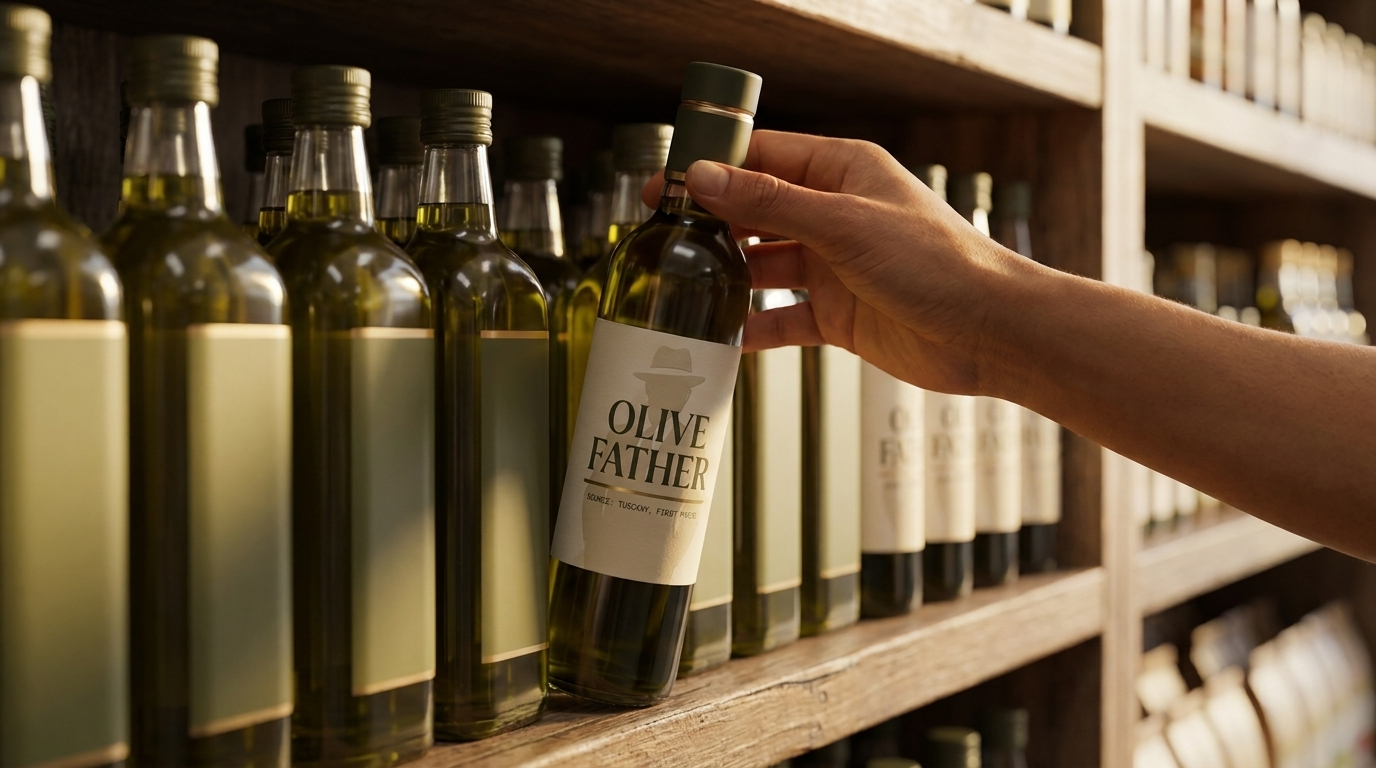
Stand in front of the olive oil shelf and you face forty nearly identical bottles, every one of them promising to be “extra virgin,” “cold pressed,” and “imported from Italy.” The prices run from six dollars to sixty. The labels are gorgeous. And almost none of them tell you the one thing you actually need to know: whether the oil inside is fresh, real, and worth your money. We press olive oil for a living, so let us save you some time. Here is exactly how we would choose a bottle we hadn’t made ourselves.
Start with the harvest date — not the best-by date
Olive oil is a fresh fruit juice, not a wine. It is at its best in the first year after harvest and fades steadily after that. A “best by” date tells you when the bottler thinks the oil becomes unsellable — usually two years after bottling, which itself can happen long after pressing. A harvest date tells you when the olives actually came off the tree. Producers who are proud of their freshness print it; producers who blend old stock from multiple years and countries physically cannot. If there is no harvest date on the bottle, that absence is itself the answer.
Read the back label like a detective
The front of the bottle is marketing. The back, by law, must tell some truth. Look for the small print about origin. “Blend of olive oils of European Union and non-European Union origin” means the bottler is legally telling you they cannot say where the oil came from — it may combine oils from five countries and several harvests. Compare that with a label that names a region, an estate, even a grove. Traceability is the single strongest predictor of quality, because a producer who signs their name to a place has nowhere to hide. It is the entire reason we built our own oil around a single source you can trace to the tree.
The five-point checklist
1. Dark glass or tin, never clear plastic
Light is one of olive oil’s three great enemies, alongside heat and oxygen. Serious producers bottle in dark glass or tin because ultraviolet light degrades the oil day by day on a bright shelf. A clear bottle showing off a pretty green color is a marketing decision made at the oil’s expense.
2. A named place, not just a flag
“Italian olive oil” can legally mean oil bottled in Italy, whatever its origin. What you want is a region (Calabria, Tuscany), a certification (DOP, IGP), or best of all a single named estate. The more specific the place, the more accountable the producer.
3. A harvest date within the last 12–18 months
Fresh oil is where the flavor and the polyphenols live. Anything older is fading, however well it was made.
4. A price that could plausibly pay a farmer
It costs real money to grow, hand-pick, and cold-press olives within hours of harvest. When a liter of “extra virgin” costs less than a latte, someone in the chain has cut a corner — and in a landmark UC Davis study, a large share of imported oils labeled extra virgin failed to meet the standard for the grade. Cheap oil is not a bargain; it is usually a different product wearing the same name.
5. Flavor claims that sound like a living thing
Real extra virgin olive oil tastes of something: grass, artichoke, green almond, tomato leaf — followed by a pleasant bitterness and a peppery catch in the throat. Those last two are quality markers, not flaws. A label (or an oil) that promises only “smooth” and “mild” is usually describing an oil with nothing left to say. Our guide to what actually makes quality olive oil goes deeper on all three markers.
Where you buy matters almost as much as what
The supermarket aisle is optimized for price, not freshness — bottles sit under fluorescent light for months, and the economics of the shelf reward the cheapest possible liquid in the prettiest possible bottle. We have written honestly about why supermarket oil so often disappoints. Specialty grocers, good importers, and producers who sell direct can tell you the harvest date without looking it up. That conversation is worth more than any medal on the label.
Choose once, well
You do not need forty bottles. You need one true one — pressed from a named grove, in the current harvest, by people willing to put their family on the label. That is the standard we hold our own oils to: single-estate Calabrian and Tuscan extra virgin, harvest-dated, traceable to the tree. Once you have tasted oil chosen this way, the wall of anonymous bottles loses its power over you for good.
Leave a Reply