Category: Uncategorized

  • Italian vs Spanish vs Greek Olive Oil: An Honest Comparison

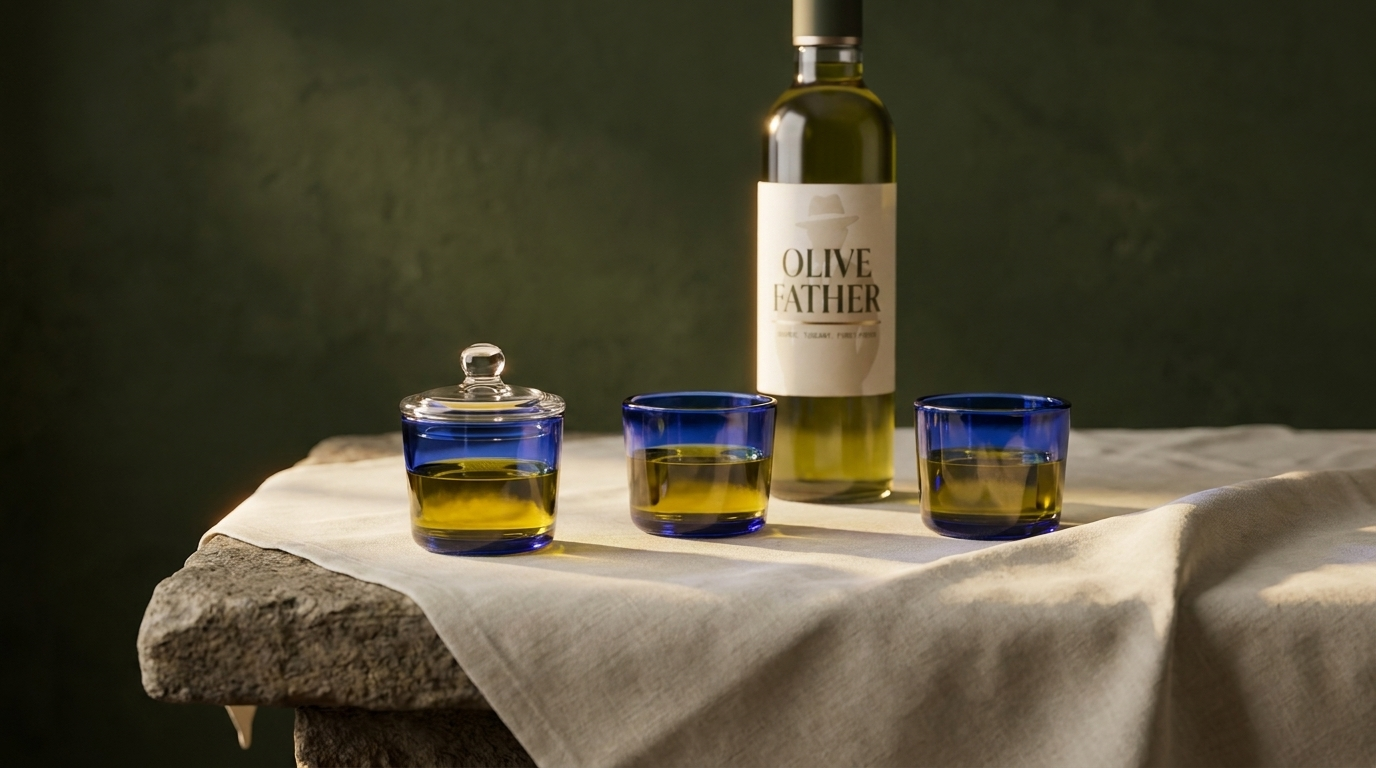
    Three cobalt-blue tasting glasses of olive oil on bone linen, each a different shade of green-gold

    Three countries account for the overwhelming majority of the world’s olive oil, and each of them will tell you, with total sincerity, that theirs is the best. We press in Italy, so our bias is on the table from the first line. What follows is still the fairest account we know how to give — because the honest conclusion is more useful to you than the patriotic one, and because we would rather you bought a superb Greek oil than a lazy Italian one.

    Who actually makes the world’s olive oil

    Spain is the largest producer on earth, and it is not close — in a normal season the country accounts for something on the order of half of global output, with Andalusia alone out-producing every other nation. Italy and Greece trade second and third place depending on how the harvest falls, both of them a long way behind. Tunisia, Turkey, Portugal and Morocco make up most of the rest.

    Those numbers matter less than people assume, because volume and excellence are separate questions. Every one of these countries produces oil at both ends of the scale: transcendent and forgettable, often in the same province.

    Spain: scale, precision, and the tanker problem

    Spanish olive growing is the most industrially advanced in the world, and that is a compliment. The best Spanish mills are technical marvels — fast, cold, obsessively clean — and the country’s signature cultivars are genuinely distinguished. Picual, which dominates Jaén, is exceptionally high in oleic acid and antioxidants, giving an oil that is stable, green, faintly tomato-leaf and built to last. Arbequina is its opposite: soft, almond-sweet, buttery, the gateway oil for people who think they dislike olive oil. Hojiblanca sits between them.

    The complication is what happens after pressing. A very large share of Spanish oil is sold in bulk — moved by tanker, blended with oil from several countries, and bottled somewhere else entirely, frequently under an Italian-sounding name. That is not a Spanish failing. It is a supply-chain reality that makes the country of origin printed in large type on a label close to meaningless, and it is exactly why the tiny print matters more than the flag. We wrote about that small print in what “blend of EU olive oils” really means.

    Greece: the country that keeps its own oil

    Greece is the quiet excellence of the three. An unusually high proportion of Greek production qualifies as extra virgin, groves are typically small and often hand-harvested, and Greek households consume more olive oil per person than any other population in the world. When a country eats most of what it makes, standards tend to hold.

    Koroneiki, the dominant Greek cultivar, is a small, stubborn olive that yields a bright, herbaceous, peppery oil with real backbone — it is planted far beyond Greece now precisely because it performs so well. Crete and the Peloponnese in particular turn out oils that can stand beside anything.

    Greece’s disadvantage is commercial rather than agricultural: a fragmented industry, less export branding, and a great deal of first-rate oil leaving the country in bulk to be bottled under someone else’s name. The oil is often better than the marketing.

    Italy: the case for variety

    Italy’s genuine, defensible advantage is not scale and it is not sunshine. It is diversity. Italy has catalogued more than five hundred olive cultivars — more than any other country — and the peninsula’s geography, from the Alpine foothills to the toe of Calabria, gives each of them somewhere to express itself differently.

    That means Italian oil is not one flavour but a library of them: the artichoke and green almond of Tuscan Frantoio and Moraiolo; the ferocious pepper of Pugliese Coratina; the elegant, almost floral Ottobratica of our own Calabrian hills. A cook who understands this stops buying “olive oil” and starts buying a specific oil for a specific plate. Our guide to Italian olive varieties walks through the great ones.

    Italy also runs the most granular protected-origin system in the business — DOP and IGP designations that tie an oil to a defined territory and a defined method. And Italy carries the largest asterisk of the three: it imports and re-exports enormous volumes of foreign oil, which is why “Imported from Italy” can describe nothing more romantic than a bottling plant outside Bari.

    So which country makes the best olive oil?

    The honest answer is that nationality is one of the weakest quality signals available to you. An early-harvest Cretan Koroneiki bottled in November will out-perform a tired, anonymous Italian blend from an unnamed harvest every single time, and no amount of tricolour on the label changes that.

    What actually predicts quality

    • A printed harvest date. The single most revealing number on any bottle, and the one most producers omit. Here is how to read it.
    • A named single origin. One estate, one region, one harvest — not “EU and non-EU origin.” This is the whole architecture behind our single source and traceability commitment.
    • A named cultivar. Producers who are proud of the olive tell you which olive it was.
    • Dark glass or tin. Light is the fastest way to kill a good oil.
    • A peppery catch in the throat. Sensory proof that the polyphenols are still alive.

    Apply those five tests and the country becomes almost incidental — which is, in the end, the most Italian thing we can tell you. Our own answer to those tests is a Calabrian grove we know tree by tree and a Tuscan estate with an IGP to its name. See the range, or taste the flagship first and judge it against anything on your shelf.
  • Olive Oil Bottles: Why Dark Glass and Tin Beat Clear Glass Every Time

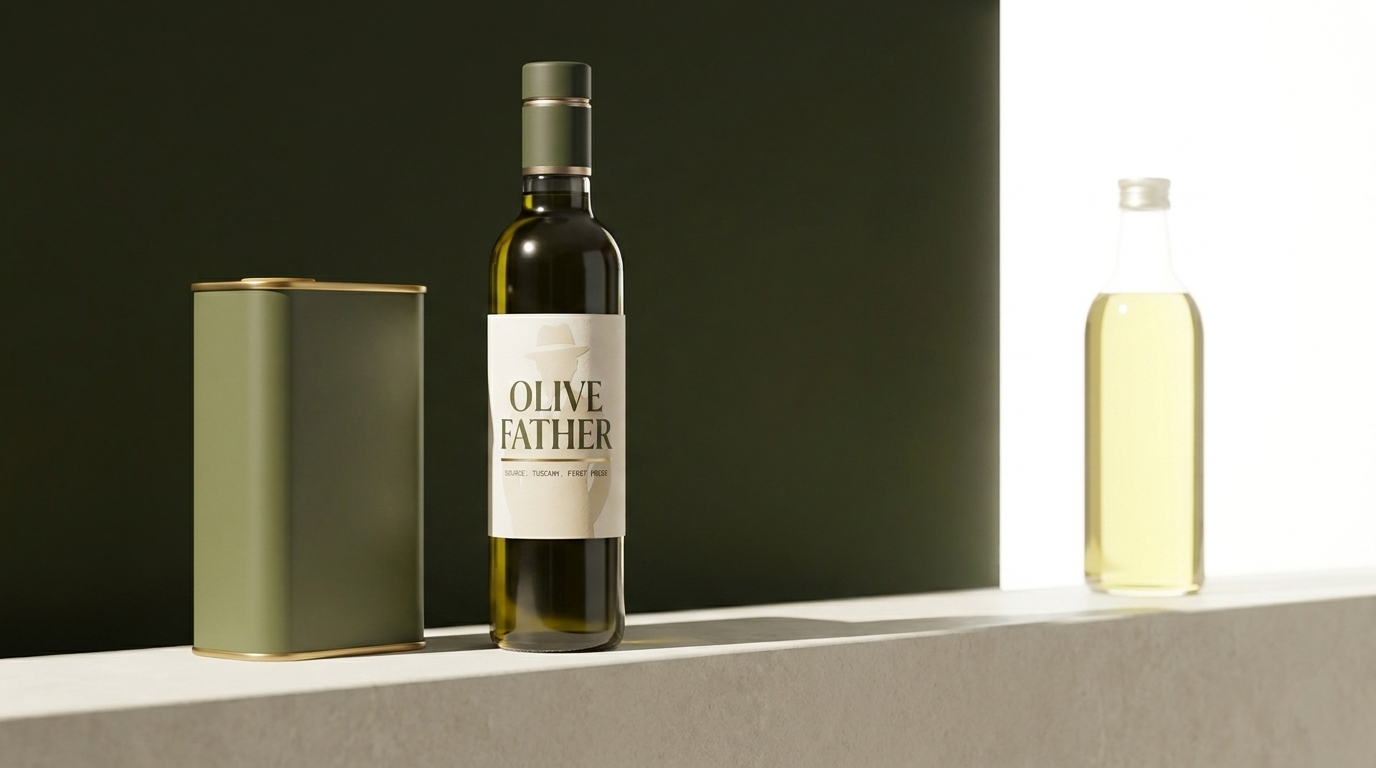
    A dark glass Olive Father bottle and an olive-green tin in shade, beside a clear glass bottle of oil in harsh sunlight
    Same oil, two futures. The container decides which one you get.

    There is a bottle of olive oil sitting in a clear glass decanter on a windowsill in a great many beautiful kitchens right now, and it is dying. Slowly, invisibly, and entirely predictably. Nothing about it looks wrong. That is the problem.

    Olive oil is the only major cooking fat sold in a state where it is still chemically alive, and everything that makes it worth buying — the aromatics, the polyphenols, the pepper at the back of the throat — is fragile. The container is not decoration. It is the last line of defence between a fresh-pressed fruit juice and a bottle of expensive, faintly waxy nothing.

    The three enemies, in order of speed

    1. Light — the fastest killer

    This is the one almost nobody accounts for, and it is by a distance the most aggressive. Olive oil contains chlorophyll and other pigments that behave as photosensitisers: when light strikes them, they help convert ordinary oxygen into a far more reactive form that attacks the oil’s fatty acids directly. The result is photo-oxidation, and it runs at a pace that ordinary oxidation in the dark simply cannot match.

    Which produces a genuinely perverse outcome: the greener and more phenol-rich the oil, the more it has to lose from sitting in clear glass. A supermarket display of clear bottles under bright retail lighting, for weeks, is close to a worst case. The bottle that lets you admire the colour is the bottle destroying it.

    2. Oxygen — the patient one

    Every time you open the bottle, air replaces oil. That headspace is what turns a good oil rancid over months rather than years. It is also why bottle size is a quality decision, not just a price one: a half-empty 3-litre bottle of superb oil in October will be a mediocre oil by February. Buy the volume you will genuinely finish in a couple of months, and decant from a larger format if you cook at volume.

    3. Heat — the accelerant

    Heat does not act alone; it multiplies the other two. Every degree speeds the oxidation reactions along. The convenient spot beside the stove, above the oven, or on a sunny counter is the single most common storage mistake in home kitchens — and it manages to combine all three enemies at once.

    What each container actually does

    • Clear glass — avoid. Zero light protection. Chemically inert and perfectly recyclable, which is why producers like it, but it offers the oil no defence whatsoever. Treat a clear bottle as a warning sign about the producer’s priorities.
    • Dark green or amber glass — good. Blocks a substantial share of the damaging wavelengths while keeping glass’s inertness and its complete lack of flavour transfer. The dark bottle is the traditional serious answer, and still an excellent one.
    • Tin — excellent. A lined metal tin blocks light completely. That is not a partial improvement over dark glass; it is total. Tins are also lighter, unbreakable, cheaper to ship, and stack. In Italy, the people who actually cook every day buy oil in tins, not bottles — the small precious bottle is largely an export idea.
    • Bag-in-box — underrated. Blocks light and, crucially, collapses as you pour, so almost no air enters. Technically among the best formats available. It simply looks like nothing on a table, which is why it has never caught on.
    • Stainless steel fusti — professional standard. How oil is stored at the mill before bottling: sealed, opaque, temperature-stable, often blanketed with inert gas. Overkill for a kitchen, but it tells you what the people who make oil actually believe about storage.
    • Clear plastic — worst. No light protection, and plastic is slightly permeable to oxygen over time. Fine for a week; poor for a pantry.

    How to read a bottle before you buy it

    The container is a reliable tell about the producer’s intentions, because protective packaging costs more and hides the product. A brand that has invested in dark glass or tin has decided freshness matters more than shelf appeal. Combine that read with the two other things worth checking — a stated harvest date rather than only a distant “best by,” and a named single origin rather than a blend of unnamed countries — and you can sort a supermarket shelf in about fifteen seconds. We go deeper into that chemistry on our page about free acidity, rancidity and freshness, and into why the shelf looks the way it does in why not supermarket oil.

    Once it is home

    • Store it in a closed cupboard, away from the stove. Cool, dark, boring.
    • Do not refrigerate. Oil clouds and solidifies in the cold, and while it recovers on warming, the temperature swings do it no favours.
    • Close it properly every time. A pour spout left open all week is a slow leak of aroma.
    • Keep the everyday oil within reach and the finishing oil out of the light — and use the good one faster, not slower. Saving a great oil for a special occasion is how great oil becomes an average one.

    What we bottle in, and why

    We press within hours of picking and then spend the rest of the year defending what that press captured — sealed stainless storage at the mill, dark glass for the table, and lined tin for the kitchens that go through oil properly. It is the least interesting part of what we do and one of the most decisive: an oil is only as fresh as the last container it sat in. You can follow the whole chain on from grove to bottle.

    If the bottle in your cupboard is clear, sitting in daylight, and has no harvest date on it, you now know three separate reasons it tastes the way it does. Meet the range — single-source, harvest-dated, and packed to arrive tasting the way it did at the mill.

  • How to Taste Olive Oil Like a Professional — at Your Own Kitchen Table

    Cobalt-blue olive oil tasting glasses filled with green-gold extra virgin olive oil on bone linen, with an Olive Father bottle behind
    The professional set-up: blue glass, a warm hand, and nothing to look at.

    Most people have never tasted olive oil. They have tasted bread with olive oil on it, or salad, or a piece of fish — which is a different thing entirely, the way tasting a sauce is different from tasting the tomato. Oil judged on its own, warmed and inhaled and taken neat, is a startling experience the first time. It has a top note, a middle and a finish. It can be grassy, or tomato-leaf green, or almondy, or faintly of artichoke. It can also be flat, greasy and dead, and once you have learned to notice that, you will never unnotice it again.

    The good news is that the professional method is not mysterious. Panels certified to grade oil for the International Olive Council use a procedure simple enough to run in your kitchen in ten minutes. Here it is, exactly as we use it at the mill.

    What professionals are actually measuring

    A tasting panel does not score an oil on whether it is nice. It scores three positive attributes, and it looks for the absence of defects. That is the whole exercise.

    Fruitiness

    The aroma and flavour of a sound olive, picked at the right moment. Green fruitiness reads as cut grass, tomato leaf, green almond, artichoke. Ripe fruitiness reads softer and rounder — ripe apple, sweet almond, a little floral. Neither is better; they are different harvest decisions. What matters is that something is there. An oil with no fruitiness at all cannot legally be extra virgin, whatever the label says.

    Bitterness

    Felt on the sides and back of the tongue, a clean bitterness like radicchio or walnut skin. It is not a flaw. It is the taste of phenolic compounds still present in the oil, and it is one of the reasons real extra virgin resists going rancid.

    Pungency

    The peppery catch at the very back of the throat that makes first-time tasters cough. It is caused chiefly by oleocanthal, and it is the single most reliable amateur signal of a fresh, phenol-rich oil. We wrote about the science of that sting in our guide to polyphenols and health.

    Your equipment (you already own it)

    Official panels use a small cobalt-blue glass with a wide belly and a narrow rim, plus a watch glass as a lid. The blue is not decoration: it hides the colour of the oil. Colour tells you almost nothing about quality — it is a function of cultivar and ripeness, not goodness — and a taster who can see green will unconsciously score green higher. If you do not own blue glasses, use a small tumbler and a saucer as a lid, and simply close your eyes.

    The method, step by step

    1. Pour about a tablespoon into the glass — enough to coat the belly when you swirl.
    2. Warm it. Cup the glass in one palm, cover the top with the other hand, and swirl gently for thirty seconds. Panels warm samples to roughly 28°C because volatile aromatics need heat to leave the oil.
    3. Uncover and inhale in two or three short sniffs rather than one long one. Note the first thing that arrives, before you start looking for words.
    4. Take a small sip — less than you think, about half a teaspoon — and hold it at the front of your mouth.
    5. Do the strippaggio. Part your lips slightly and draw air in over the oil in short sharp sips, as though sucking through your teeth. It sounds ridiculous. It aerosolises the oil and pushes the aromatics up into your nasal cavity from behind, and it is the step that separates tasting from swallowing.
    6. Swallow, then wait ten seconds. Bitterness arrives first, on the tongue. Pungency comes last, in the throat. Judging too early is the most common beginner error.
    7. Reset with a slice of green apple or a sip of sparkling water between oils. Bread is a poor palate cleanser; it carries flavour forward.

    Learning the defects — the more useful half

    Recognising excellence takes years. Recognising failure takes an afternoon, and it will save you far more money. These are the faults a panel is trained to catch, and every one of them is common on American shelves.

    • Rancid — the big one. Old crayons, stale walnuts, putty, the inside of a nut jar left open. Caused by oxidation over time, light and heat. If you have only ever bought supermarket oil, this smell may read to you as “what olive oil smells like.”
    • Fusty — sour, sweaty, vaguely of compost. Olives left in piles or sacks for days before pressing, fermenting on the way to the mill.
    • Musty — damp cellar, wet cardboard, mushrooms. Mould on fruit stored in humidity.
    • Winey / vinegary — nail varnish, sharp acetic edge. Fermentation gone further still.
    • Metallic or muddy — a dull, sludgy heaviness from prolonged contact with unfiltered sediment or poorly cleaned equipment.

    Here is the uncomfortable part. In a widely cited analysis by the UC Davis Olive Center, a majority of imported samples labelled extra virgin failed sensory testing by accredited panels — most often for exactly these defects. The label was legal marketing; the oil was not extra virgin. This is why we treat sensory literacy as consumer protection rather than connoisseurship, and why we set out our own standards plainly on what makes quality olive oil.

    A flight worth running tonight

    Put three oils side by side: the cheapest “extra virgin” in your supermarket, a mid-priced supermarket brand, and one genuine single-estate oil with a harvest date on the bottle. Taste them blind, in that order, and score each one for fruitiness, bitterness and pungency out of five. Most people discover two things in ten minutes — that the first two oils are nearly indistinguishable from each other, and that they had been calling a defect a flavour for years.

    Once your palate is calibrated, tasting stops being a party trick and becomes a purchasing tool. You will start reading harvest dates, asking where the grove is, and noticing when the pepper has faded from a bottle you opened two months ago. Our full guide to tasting notes and pairings takes it further, into which oils belong with which food.

    Taste ours the same way

    We would rather be judged on a spoon than on a story. Every Olive Father oil is single-source, harvest-dated and pressed within hours of picking, and it is built to survive exactly the scrutiny described above — warmed, inhaled, and taken neat, with nothing to hide behind. See the range, pour a spoonful, and let the third quality — that slow, peppery arrival in the throat — make the argument for us.

  • Does Olive Oil Go Bad? Shelf Life, Storage, and How to Tell

    A dark green bottle of extra virgin olive oil stored correctly in a cool, dim stone pantry away from light and heat

    Yes — olive oil goes bad. But not the way people expect, and that is precisely why so much of it is quietly ruined in American kitchens. Olive oil does not curdle, mould, or announce itself. It fades. It loses its pepper, then its aroma, then its character, and eventually it turns rancid without ever looking any different in the bottle.

    Which means the person most likely to serve you bad olive oil is you. Here is how long a bottle actually lasts, what destroys it, and how to tell — in about four seconds — whether the one on your counter is still worth pouring.

    How Long Does Olive Oil Last?

    The useful answer is not measured from the day you bought it. It is measured from the day the olives came off the tree.

    An unopened bottle of true extra virgin olive oil, stored well, is at its best for roughly 18 to 24 months after harvest. Once opened, oxygen is in the bottle for good, and you are on a much shorter clock: aim to finish it within two to three months. It will not be dangerous after that. It will simply stop being the thing you paid for.

    This is why the harvest date is the single most honest number on a label and the “best before” date is one of the least. A best-before date is typically set two years from bottling, and oil can sit in a tank for a year before it is bottled. Two bottles can carry the same best-before date and be a full year apart in age. If a producer will not print the harvest, ask yourself why.

    The Four Things That Kill Olive Oil

    Rancidity is oxidation. The fats in the oil react with oxygen and break down into the aldehydes and ketones you can smell. Four conditions accelerate that reaction, and every one of them is under your control.

    • Light. The worst offender and the most ignored. Ultraviolet light drives oxidation hard, which is why serious producers bottle in dark green glass or tin and why a clear bottle in a sunny window is a slow execution.
    • Heat. Every ten degrees roughly doubles the rate of chemical breakdown. The shelf directly above your stove is the worst place in the house, and it is where almost everyone keeps the bottle.
    • Oxygen. Cap it properly, every time. A half-empty bottle is half full of air, so decanting the last of a large tin into a smaller bottle genuinely helps.
    • Time. The one you cannot bargain with. Buy the freshest oil you can find and buy a size you will actually finish.

    How to Store Olive Oil Properly

    The instruction is almost boringly simple: cool, dark, closed. A cupboard or pantry at around 57–70°F (14–21°C), away from the oven, the dishwasher and the window. Cap tightened after each pour. Original dark glass or tin, not a decorative clear cruet left out on the counter.

    Should You Refrigerate It?

    No — and while we are here, the popular “fridge test” for authenticity is a myth. Chilled olive oil clouds and thickens because its waxes and fats begin to crystallise, but the temperature at which that happens varies with cultivar and composition. Real extra virgin may solidify slowly, quickly, or barely at all. A refined or adulterated oil can behave the same way. You cannot tell anything about quality from a cold bottle, and repeatedly chilling and rewarming an oil does it no favours.

    How to Tell If Olive Oil Has Gone Rancid

    Trust your nose. Pour a little into a small glass, cup your hand over it, warm it against your palm for a few seconds, then smell. Fresh oil smells green — cut grass, artichoke, green tomato leaf, sometimes almond or fresh herb. Rancid oil smells of something else entirely, and once you have named it you will never miss it again: wax crayons, putty, stale walnuts, old peanuts, wet cardboard.

    Then taste it. A living oil finishes with a bitter edge and a peppery catch at the back of the throat — that is oleocanthal and the rest of the polyphenol family still doing their work. Rancid oil is flat, greasy and sweetish, with no sting at all. Those antioxidants are the first casualties of age, which is the real cost of an old bottle: you lose the flavour and the health compounds in the same breath. Our tasting guide walks through the full method if you want to train the palate properly.

    Rancid oil will not make you ill in any normal quantity. It will make your food taste of crayons. And if that bottle was already mediocre when you bought it — blended, over-refined, a year older than it looked — you were fighting from behind before you got it home. That is why we are so insistent about what quality actually means.

    Buy Fresh, Store Well, Pour Generously

    The best storage advice anyone can give you is to buy oil young enough that storage barely matters. Every Olive Father bottle is single-source, milled cold within hours of picking, and carries its harvest so you always know exactly how old it is. Keep it in a cupboard, finish it in a season, and use it like Italians do — too fast for it to ever go bad. See the current harvest.

  • Does Olive Oil Go Bad? Shelf Life, Storage, and How to Tell

    A dark green bottle of extra virgin olive oil stored correctly in a cool, dim stone pantry away from light and heat

    Yes — olive oil goes bad. But not the way people expect, and that is precisely why so much of it is quietly ruined in American kitchens. Olive oil does not curdle, mould, or announce itself. It fades. It loses its pepper, then its aroma, then its character, and eventually it turns rancid without ever looking any different in the bottle.

    Which means the person most likely to serve you bad olive oil is you. Here is how long a bottle actually lasts, what destroys it, and how to tell — in about four seconds — whether the one on your counter is still worth pouring.

    How Long Does Olive Oil Last?

    The useful answer is not measured from the day you bought it. It is measured from the day the olives came off the tree.

    An unopened bottle of true extra virgin olive oil, stored well, is at its best for roughly 18 to 24 months after harvest. Once opened, oxygen is in the bottle for good, and you are on a much shorter clock: aim to finish it within two to three months. It will not be dangerous after that. It will simply stop being the thing you paid for.

    This is why the harvest date is the single most honest number on a label and the “best before” date is one of the least. A best-before date is typically set two years from bottling, and oil can sit in a tank for a year before it is bottled. Two bottles can carry the same best-before date and be a full year apart in age. If a producer will not print the harvest, ask yourself why.

    The Four Things That Kill Olive Oil

    Rancidity is oxidation. The fats in the oil react with oxygen and break down into the aldehydes and ketones you can smell. Four conditions accelerate that reaction, and every one of them is under your control.

    • Light. The worst offender and the most ignored. Ultraviolet light drives oxidation hard, which is why serious producers bottle in dark green glass or tin and why a clear bottle in a sunny window is a slow execution.
    • Heat. Every ten degrees roughly doubles the rate of chemical breakdown. The shelf directly above your stove is the worst place in the house, and it is where almost everyone keeps the bottle.
    • Oxygen. Cap it properly, every time. A half-empty bottle is half full of air, so decanting the last of a large tin into a smaller bottle genuinely helps.
    • Time. The one you cannot bargain with. Buy the freshest oil you can find and buy a size you will actually finish.

    How to Store Olive Oil Properly

    The instruction is almost boringly simple: cool, dark, closed. A cupboard or pantry at around 57–70°F (14–21°C), away from the oven, the dishwasher and the window. Cap tightened after each pour. Original dark glass or tin, not a decorative clear cruet left out on the counter.

    Should You Refrigerate It?

    No — and while we are here, the popular “fridge test” for authenticity is a myth. Chilled olive oil clouds and thickens because its waxes and fats begin to crystallise, but the temperature at which that happens varies with cultivar and composition. Real extra virgin may solidify slowly, quickly, or barely at all. A refined or adulterated oil can behave the same way. You cannot tell anything about quality from a cold bottle, and repeatedly chilling and rewarming an oil does it no favours.

    How to Tell If Olive Oil Has Gone Rancid

    Trust your nose. Pour a little into a small glass, cup your hand over it, warm it against your palm for a few seconds, then smell. Fresh oil smells green — cut grass, artichoke, green tomato leaf, sometimes almond or fresh herb. Rancid oil smells of something else entirely, and once you have named it you will never miss it again: wax crayons, putty, stale walnuts, old peanuts, wet cardboard.

    Then taste it. A living oil finishes with a bitter edge and a peppery catch at the back of the throat — that is oleocanthal and the rest of the polyphenol family still doing their work. Rancid oil is flat, greasy and sweetish, with no sting at all. Those antioxidants are the first casualties of age, which is the real cost of an old bottle: you lose the flavour and the health compounds in the same breath. Our tasting guide walks through the full method if you want to train the palate properly.

    Rancid oil will not make you ill in any normal quantity. It will make your food taste of crayons. And if that bottle was already mediocre when you bought it — blended, over-refined, a year older than it looked — you were fighting from behind before you got it home. That is why we are so insistent about what quality actually means.

    Buy Fresh, Store Well, Pour Generously

    The best storage advice anyone can give you is to buy oil young enough that storage barely matters. Every Olive Father bottle is single-source, milled cold within hours of picking, and carries its harvest so you always know exactly how old it is. Keep it in a cupboard, finish it in a season, and use it like Italians do — too fast for it to ever go bad. See the current harvest.

  • Olive Oil Smoke Point: Why You Can Absolutely Cook With Extra Virgin

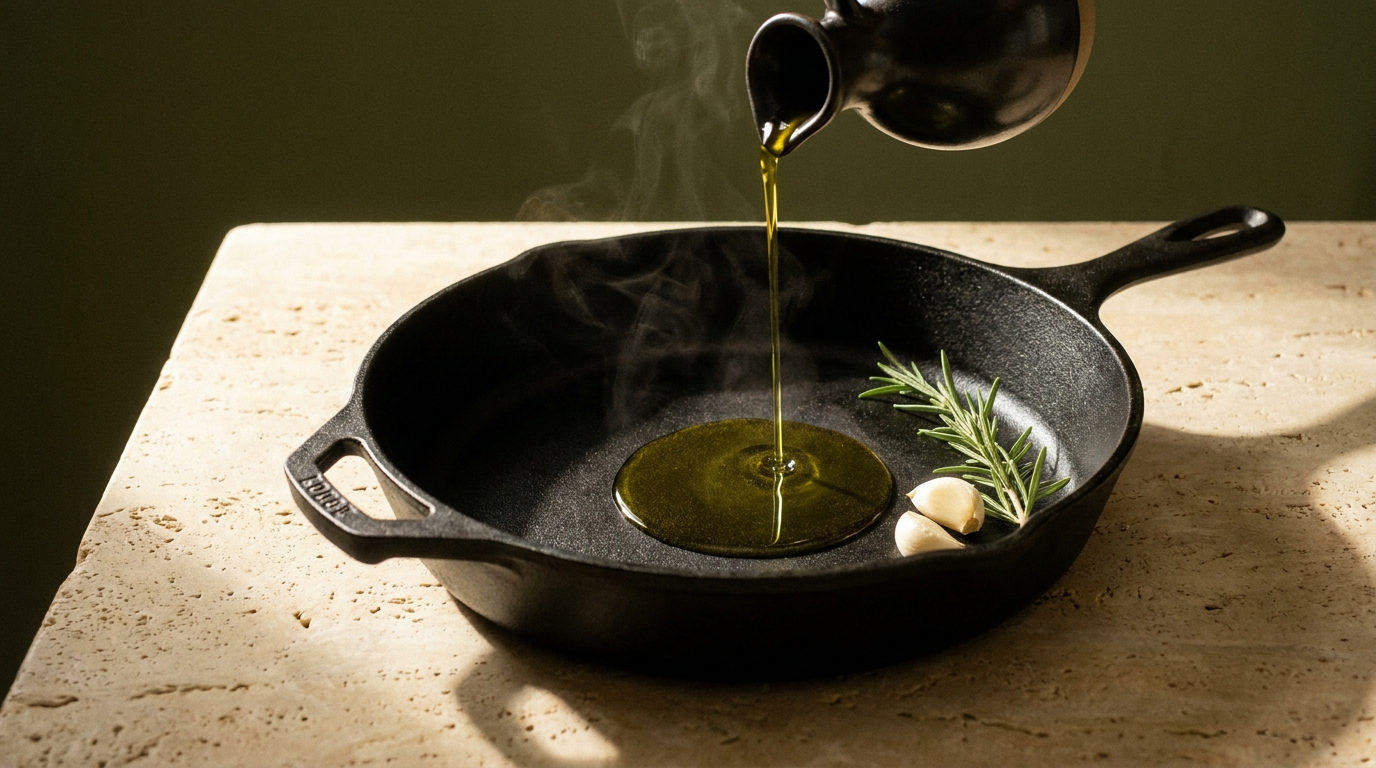
    Extra virgin olive oil poured into a hot cast-iron skillet with rosemary and garlic, showing that olive oil is safe to cook with

    Somewhere in the last twenty years, a rumour hardened into common knowledge: extra virgin olive oil is too delicate to cook with. Save it for salads. Use something neutral for the pan. Every Italian kitchen we have ever stood in would find this baffling — and so, it turns out, does the chemistry.

    The confusion comes down to a single number that has been asked to do far more work than it can bear: the smoke point. Here is what it actually measures, why it is a poor guide to how an oil behaves in your pan, and how to cook with the good bottle without wasting a drop of what makes it good.

    What the Smoke Point Actually Is

    The smoke point is the temperature at which an oil, heated in still air, first gives off a continuous wisp of blue smoke. That is the entire definition. It is a visual threshold, not a safety line and not a nutritional one.

    For genuine extra virgin olive oil, that threshold generally falls somewhere around 375°F to 410°F (190–210°C), with fresher, lower-acidity oils sitting at the higher end of the range. The reason is worth understanding, because it flatters good oil: what smokes first is not the fat itself but the small stuff suspended in it — free fatty acids, water, fruit solids. An oil with very low free acidity has less of that material to burn off, so it holds its composure longer.

    This is one of the quiet advantages of oil pressed within hours of picking. The harvest and cold-pressing decisions that give an oil its low acidity also give it a higher, steadier smoke point. Freshness is not just a flavour argument. It is a performance one.

    How Hot Does Your Pan Really Get?

    Now put that range next to the way people actually cook. Sauteing onions and garlic happens between roughly 250°F and 320°F. A hard sear in a heavy pan lands around 350°F to 400°F. Even deep frying is conventionally done at 350°F to 375°F. Roasting at 425°F sounds alarming until you remember that the oven air is at 425°F, not the oil in the tray, which is cooled continuously by the moisture coming out of the food.

    In other words: almost everything you do on a domestic stove sits at or below the smoke point of a good extra virgin. The oil is not the fragile party in this arrangement.

    The Number That Matters More: Oxidative Stability

    Here is the part the smoke-point chart never tells you. Smoking is a cosmetic event. What you actually care about when you heat a fat is oxidation — the formation of polar compounds and breakdown products as the oil is stressed. Those two things are not the same, and they do not rank oils in the same order.

    Extra virgin olive oil is unusually well armoured against oxidation for two reasons. It is dominated by oleic acid, a monounsaturated fat with only one double bond to attack — far more stable under heat than the polyunsaturated fats that make up most seed oils. And it arrives carrying its own antioxidants: the polyphenols and vitamin E that refining strips out of every other bottle on the shelf. A 2018 laboratory study out of Australia heated a range of common cooking oils and found that extra virgin olive oil generated lower levels of polar compounds and oxidation byproducts than several oils with substantially higher smoke points.

    Why “Light” Olive Oil Is Not the Answer

    You will be told that refined or “light” olive oil is the sensible choice for high heat, because its smoke point is higher — often quoted around 465°F. That is true, and it is true for an unflattering reason. Refining removes the free fatty acids, the aromatics, the pigments and the polyphenols. Nothing is left to smoke because nothing is left at all. You have bought a higher number by deleting everything the oil had to offer, including the antioxidants that were protecting it. We explain the full grade ladder on our what makes quality olive oil page, and why the cheapest bottles in the supermarket aisle are so often the most refined.

    How We Cook With It

    None of this means every drop should go in the pan. It means the decision is about flavour, not fear.

    • Cook freely with good oil. Soffritto, roasting vegetables, searing fish, confit garlic — extra virgin is the right fat, and it seasons the dish as it goes.
    • Warm the pan, then the oil, then the food. Do not preheat oil alone in an empty pan for minutes on end. There is nothing to absorb the heat.
    • If it smokes, it is too hot for the food anyway. Pull the pan off, let it settle, start again. This is a cooking correction, not a catastrophe.
    • Keep the best bottle for the last thirty seconds. Heat does soften aroma and pepper. A raw finishing pour restores everything the pan mellowed.

    The honest summary is this: a real extra virgin will not fail you at any temperature you are likely to reach at home, and it will hold up better than the neutral oil you were told to reach for instead. What actually decides the outcome is not the smoke point printed on a chart — it is whether the oil in your hand is genuinely fresh, genuinely extra virgin, and genuinely traceable to a grove.

    Cook With Oil Worth Cooking With

    Olive Father is single-source extra virgin from one family grove in Calabria and one estate in Tuscany — harvested early, milled cold, and bottled with the harvest on the label so you know exactly how fresh it is. Low acidity, high polyphenols, nothing blended in. Explore the range and put a bottle next to the stove where it belongs.

  • Olive Oil Calories & Nutrition Facts: What’s Really in a Tablespoon

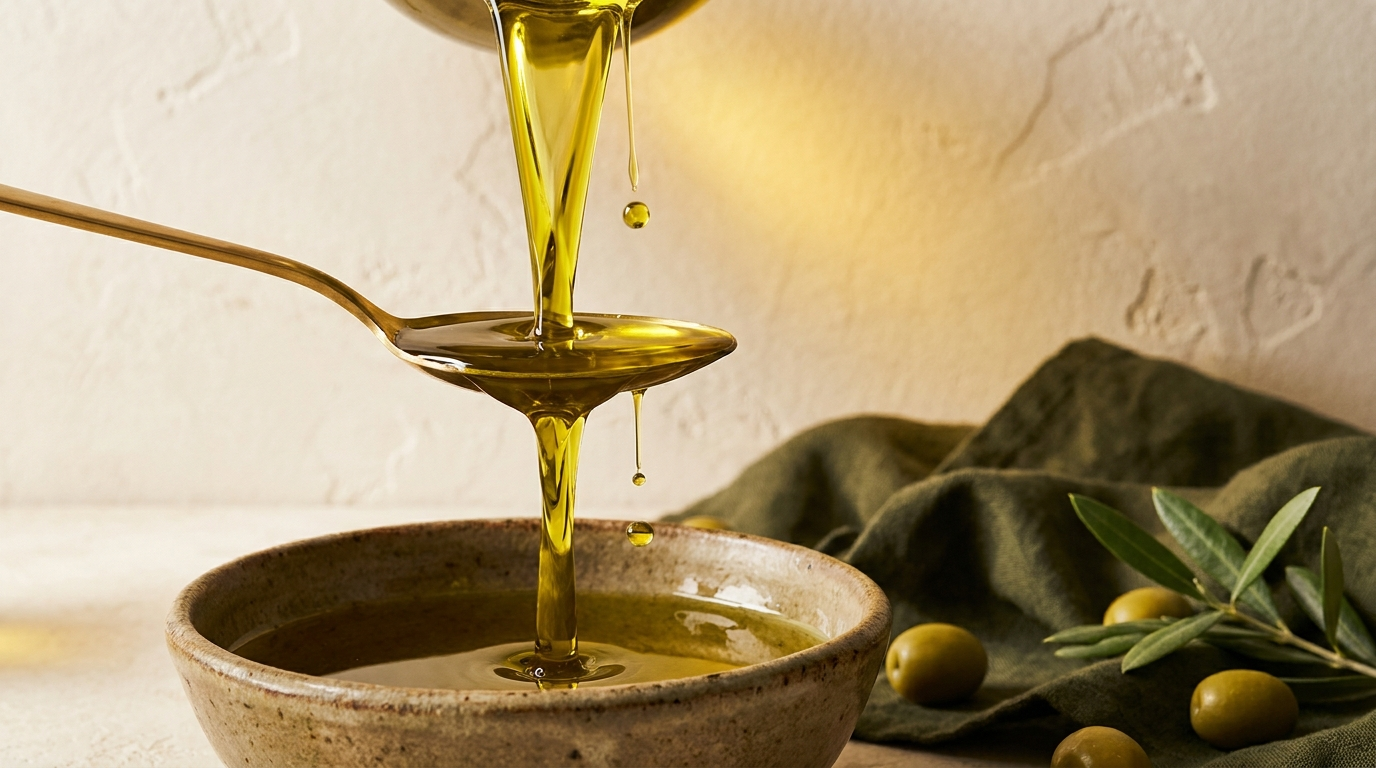
    Golden ribbon of extra virgin olive oil pouring into a brass tablespoon over a ceramic bowl

    Type “olive oil calories” into a search bar and you will get a number — and almost nothing worth knowing. Yes, olive oil is calorie-dense. It is pure fat; that is what an oil is. But the nutrition label, with its tidy grid of grams and percentages, manages to hide the single most important fact about olive oil: two bottles with identical labels can be completely different foods. Here are the honest numbers first, and then the part the label leaves out.

    The numbers: one tablespoon of olive oil

    Per USDA data, one tablespoon (about 13.5 g) of olive oil contains roughly:

    • 119 calories — all from fat
    • 13.5 g total fat: about 9.9 g monounsaturated (mostly oleic acid), 1.4 g polyunsaturated, 1.9 g saturated
    • Vitamin E: about 1.9 mg (roughly 13% of the daily value)
    • Vitamin K: about 8 µg (7% of the daily value)
    • Zero carbohydrates, sugar, protein, fiber, sodium, and cholesterol

    A teaspoon runs about 40 calories; a generous quarter-cup for a dressing, around 480. These figures are essentially identical for every olive oil ever bottled — extra virgin or refined, six dollars or sixty. Calorie-wise, oil is oil.

    Why the label can’t tell good oil from bad

    Here is the strange thing: the nutrition panel describes about 98% of the oil — the fatty acids — and stays silent about the 1–2% that decides everything else. That minor fraction is where extra virgin olive oil keeps its polyphenols: hydroxytyrosol, oleuropein derivatives, and oleocanthal, the peppery compound that catches your throat. These antioxidants are the basis of the EU-recognized health claim for olive oil and much of the research on the Mediterranean diet — and they never appear on a standard label. A refined “light” oil and a fierce, freshly pressed extra virgin show the same 119 calories, while one is chemically alive and the other has been stripped bare. Our guide to polyphenols and health covers what those molecules actually do.

    “Light” olive oil is not lighter in calories

    One label myth deserves a direct answer: “light” olive oil has exactly the same calories as extra virgin. The word refers to flavor and color — the result of refining — not to calories. You pay the full 119 per tablespoon and receive the least interesting version of the oil.

    Calorie-dense, yet at the heart of healthy eating

    It seems like a paradox: the most calorie-dense food in the kitchen anchors the world’s most studied healthy eating pattern. The Mediterranean diet, with olive oil as its principal fat, is consistently associated with better cardiovascular outcomes in large trials — not despite the oil but, the evidence suggests, partly because of it. The resolution is simple: olive oil in real diets replaces other fats rather than adding to them, and quality extra virgin brings its minor compounds along. What the science does and does not support is laid out honestly on our page about olive oil and health — olive oil is a food, not a medicine, and it does not need to be more than that.

    Spend your calories on oil that earns them

    If every tablespoon costs 119 calories regardless of quality, the practical conclusion writes itself: make each one count. An oil with a harvest date, a named grove, and the bitterness and pepper of real phenolic content gives you flavor and function for the same caloric price as a dead refined blend. That is what quality actually means in olive oil — and it is measurable, not marketing.

    Ours comes from a single family estate in Calabria, pressed within hours of harvest and traceable to the tree. Same 119 calories as every other bottle on the shelf — and nothing else in common. Explore the range.

  • Canola Oil vs Olive Oil: The Honest Difference, From People Who Press Olives

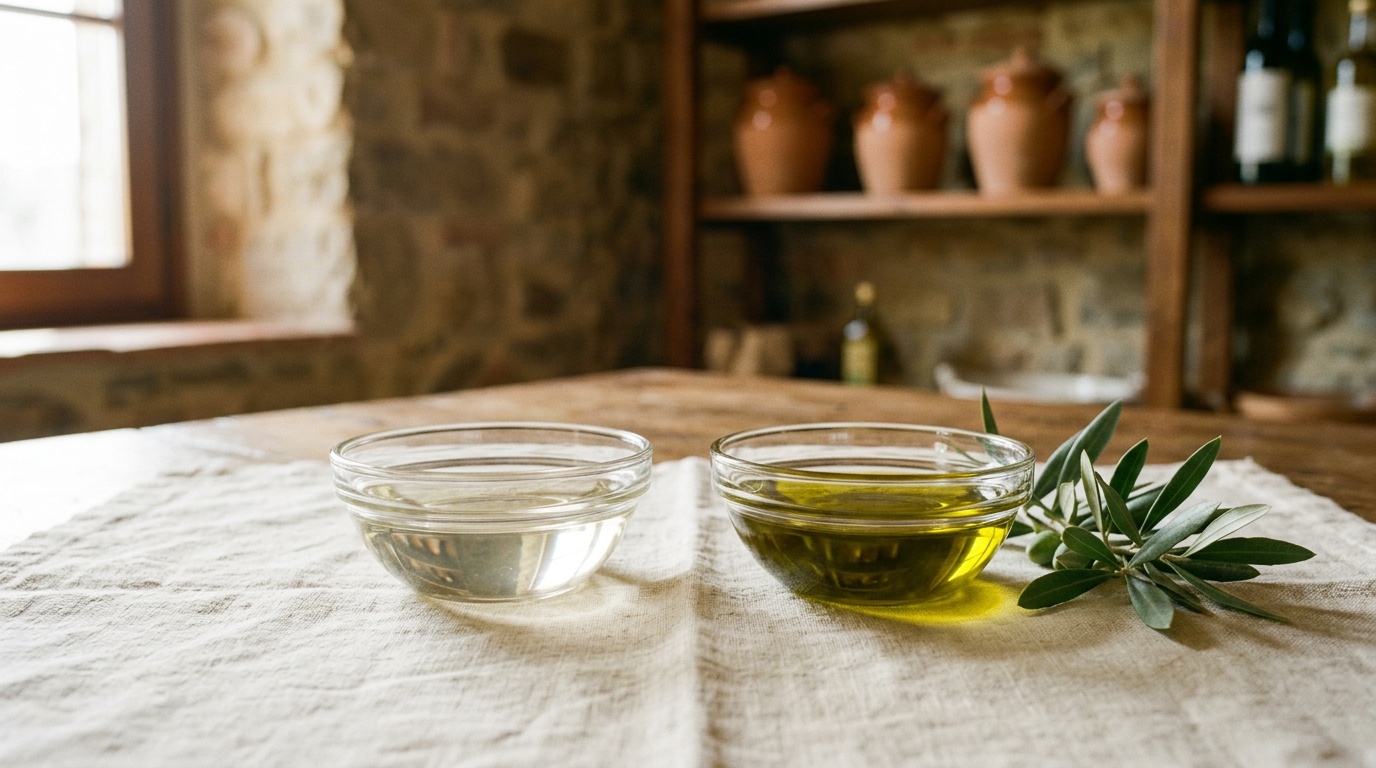
    Side-by-side bowls of pale refined canola oil and green-gold extra virgin olive oil on a bone linen surface

    Canola oil and olive oil sit a shelf apart in every American supermarket, and the internet argues about them endlessly — usually with more heat than light. As a family that presses olives for a living, we have an obvious horse in this race. So let us be careful, and fair. Canola is not poison, whatever certain corners of the internet insist. But the two oils are made in profoundly different ways, and that difference — not the fat chart — is the real story.

    What canola oil actually is

    Canola is a cultivar of rapeseed, bred in Canada in the 1970s to be low in erucic acid and bitter glucosinolates. The seeds are crushed, and in nearly all commercial production the remaining oil is extracted with a solvent (typically hexane), then refined, bleached, and deodorized into a pale, neutral, shelf-stable fat. That process is safe and efficient — and it is also the point. Refining strips out nearly everything that is not pure fat: pigments, aromas, antioxidants, character. What survives is a blank canvas. A small amount of expeller-pressed and cold-pressed canola exists and deserves to be judged separately, but it is a sliver of the market.

    What extra virgin olive oil actually is

    Extra virgin olive oil is the opposite kind of object: a fresh fruit juice. Olives are picked, crushed, and the oil is separated by mechanical means alone — no solvents, no refining, no deodorizing. Everything in the fruit that survives pressing arrives in the bottle: the polyphenols that give real oil its bitterness and peppery bite, vitamin E, the pigments, the aroma of the grove. That is why quality standards for extra virgin are so strict, and why the difference between a great oil and a cheap one is so easy to taste.

    The fat profile: closer than you think

    Here is where honesty matters. On a macronutrient chart, canola looks respectable: roughly 60–65% monounsaturated fat (olive oil runs about 55–83%, with good oils near the top), low saturated fat, and — a genuine point in its favor — around 9–11% alpha-linolenic acid, a plant omega-3 that olive oil has little of. If fatty acids were the whole story, this would be a near-draw.

    They are not the whole story. The fatty-acid chart describes about 98% of both oils and ignores the 1–2% where olive oil does its most interesting work: the phenolic compounds. Hydroxytyrosol, oleuropein derivatives, oleocanthal — the antioxidants behind the EFSA-recognized health claim for olive oil polyphenols and the subject of most of the modern research on the Mediterranean diet. Refined canola contains essentially none of this minor fraction, because refining removes it. Our deep dive on polyphenols and health explains what those molecules do and why cheap oil has lost them too.

    In the pan and on the plate

    Heat

    The old claim that you cannot cook with extra virgin olive oil does not survive contact with the evidence. A good extra virgin smokes around 190–210°C — above normal sautéing temperatures — and its monounsaturated fats plus antioxidants make it remarkably stable under heat. Refined canola’s smoke point is somewhat higher, which matters for industrial deep-frying and almost never in a home kitchen.

    Flavor

    This is not a contest. Canola is engineered to taste of nothing, and it succeeds. Olive oil is grass and artichoke and black pepper; it finishes a plate of pasta, wakes up a tomato, turns bread into a course. One is a lubricant. The other is an ingredient.

    So which should you buy?

    If you need a truly neutral fat for a specific job — a delicate cake, a huge batch of fried chicken — canola does that job cheaply and well. For everything else, our honest answer is the one you would expect from us, but for reasons you can verify: a real extra virgin olive oil brings flavor and a minor-compound chemistry that no refined oil can offer. The catch is the word real — much of what sits on supermarket shelves labeled extra virgin does not deserve the name.

    If you want to taste what the comparison is actually about, start with an oil that can prove where it comes from. Ours is pressed on a single family estate in Calabria, harvest-dated and traceable to the grove — explore the range, and taste the 2% that refining throws away.

  • Olive Oil Salad Dressing: The Only Recipe You Need — and Why the Oil Is the Recipe

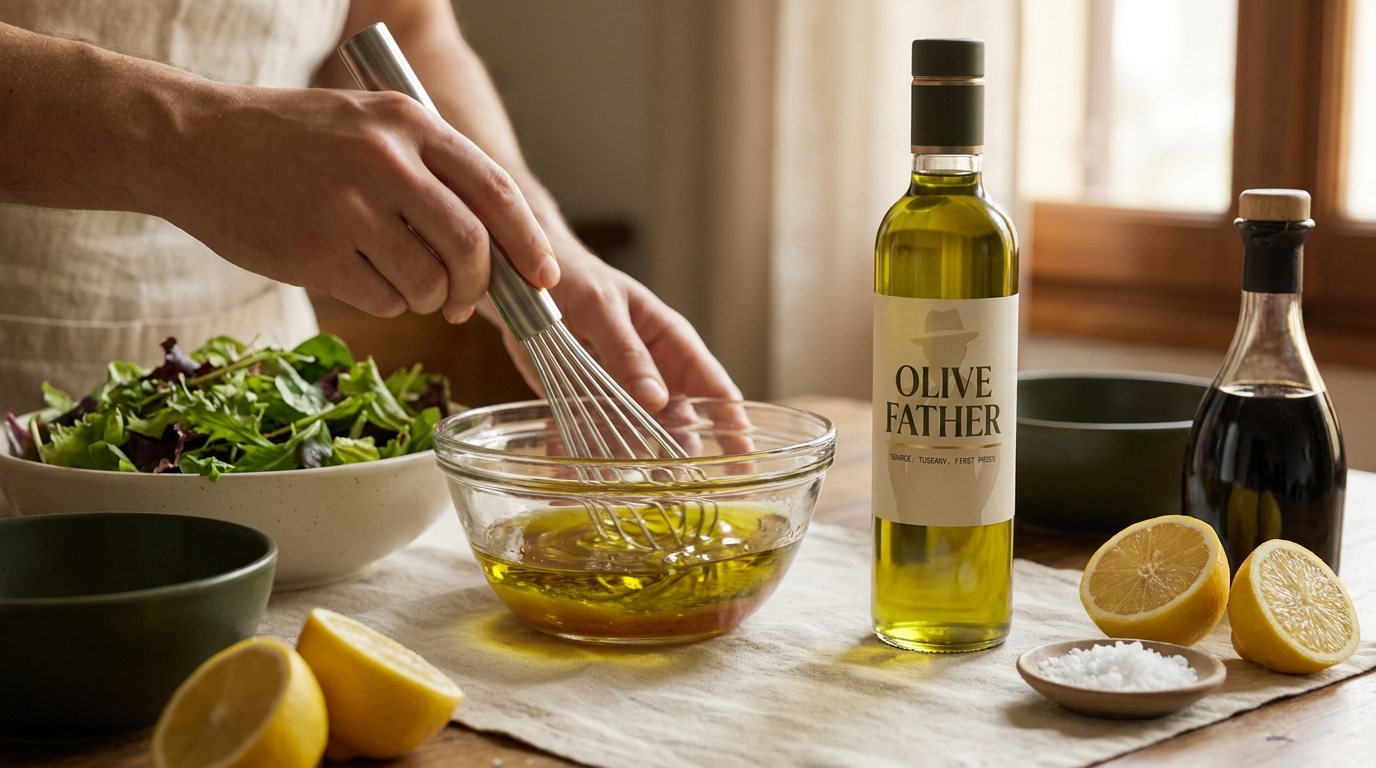
    Whisking an olive oil vinaigrette in a rustic Italian kitchen beside a bowl of fresh salad and a bottle of Olive Father extra virgin olive oil

    Walk down the dressing aisle of any American supermarket and you will find fifty bottles of something that never needed to be invented. Emulsifiers, gums, sugar, “vegetable oil blend,” and a shelf life measured in years — all to replace a preparation that takes ninety seconds and three ingredients. A real olive oil salad dressing is one of the oldest recipes in the world, and it is barely a recipe at all. It is a ratio, a pinch of salt, and one decision that determines everything: which oil you pour.

    The master ratio: three to one

    Every classic vinaigrette begins with the same proportion: three parts extra virgin olive oil to one part acid, plus salt. The acid can be red wine vinegar, white wine vinegar, or fresh lemon juice. That is the entire foundation. From there:

    • In a jar: add three tablespoons of olive oil, one of vinegar, a generous pinch of flaky salt, screw the lid on, and shake hard for ten seconds. The agitation breaks the oil into droplets and produces a briefly stable emulsion — cloudy, thick, and ready to pour.
    • In a bowl: whisk the vinegar and salt first so the salt dissolves, then stream in the oil while whisking. Half a teaspoon of Dijon mustard, if you like it, acts as a natural emulsifier and holds the dressing together longer.

    Taste it on a leaf, not a spoon — a leaf carries far less dressing, which is how it will actually be eaten. Adjust with a few drops of vinegar if it tastes flat, a little more oil if it bites too hard.

    The Italian way: dress the salad, not the jar

    It is worth knowing that in Italy, the vinaigrette itself is almost a foreign concept. An Italian salad is dressed in the bowl, at the table, in a strict order the old rule captures neatly: be a sage with the salt, a miser with the vinegar, and a spendthrift with the oil. Salt first, so it dissolves against the wet leaves; a restrained thread of vinegar; then olive oil, poured generously, and a final toss with your hands or two forks until every leaf shines. No jar, no whisk, no leftovers.

    Both methods work. The jar gives you an emulsified, American-style vinaigrette; the Italian method gives you a brighter salad where you taste leaf, salt, and oil in sequence. What they share is the arithmetic: the dressing is roughly three-quarters olive oil. Which brings us to the part most recipes skip.

    The oil is the recipe

    A salad dressing is a raw preparation. Nothing is cooked, nothing is masked, and the oil is never diluted below seventy-five percent of the total. Whatever character your olive oil has — fresh-cut grass, green almond, that peppery catch at the back of the throat — arrives on the leaf intact. And whatever faults it has arrive intact too. A tired, refined, or blended supermarket oil produces exactly the dressing you would expect: greasy, flat, and vaguely stale. This is the quiet reason so many people think they dislike vinaigrette. They have only ever tasted it made with oil that was never worth eating raw.

    The bitterness and pepper of a genuine extra virgin oil are not flaws to be softened — they are the polyphenols, the same compounds behind most of the oil’s health research, and in a dressing they do real culinary work. Bitterness balances sweet vegetables and fruit; pungency cuts through rich cheeses and cured meats; the acid ties it together. A robust oil against sweet tomatoes and burrata is not a recipe so much as a chord.

    Choosing an oil worth pouring

    For a dressing, apply the same tests we would apply at our own mill: a stated harvest date within the last year or so, a named place and producer rather than a “blend of EU oils,” dark glass, and — when you taste it — the bitterness and pepper of an oil that is still alive. A single-source oil tells you exactly whose standards you are eating. This is precisely what our own estate oils are pressed for: olives from one family’s groves in Calabria, milled cold within hours, bottled unblended, made to be poured raw.

    Three dressings to know by heart

    • Classic red wine vinaigrette: 3 tbsp olive oil, 1 tbsp red wine vinegar, pinch of salt, optional ½ tsp Dijon. For every leafy salad and most grain bowls.
    • Lemon and oil: 3 tbsp olive oil, juice of half a lemon, salt. The Mediterranean default for fish, avocado, fennel, and bitter greens.
    • Warm pan dressing: whisk a spoonful of pan juices from roasted vegetables or chicken with oil and vinegar for a dressing that seasons the whole plate.

    Ninety seconds, three ingredients, one decision

    You do not need the dressing aisle. You need a ratio you can remember, salt you can pinch, and an olive oil good enough to carry three-quarters of every bite. Choose the oil the way you would choose the main ingredient — because in this dish, it is. Explore our single-estate extra virgin olive oils, pressed from one harvest and dated so you know exactly how alive they are, and taste what a salad has been trying to tell you all along.

  • The Truth About Truffle Oil: Why Most of It Has Never Met a Truffle

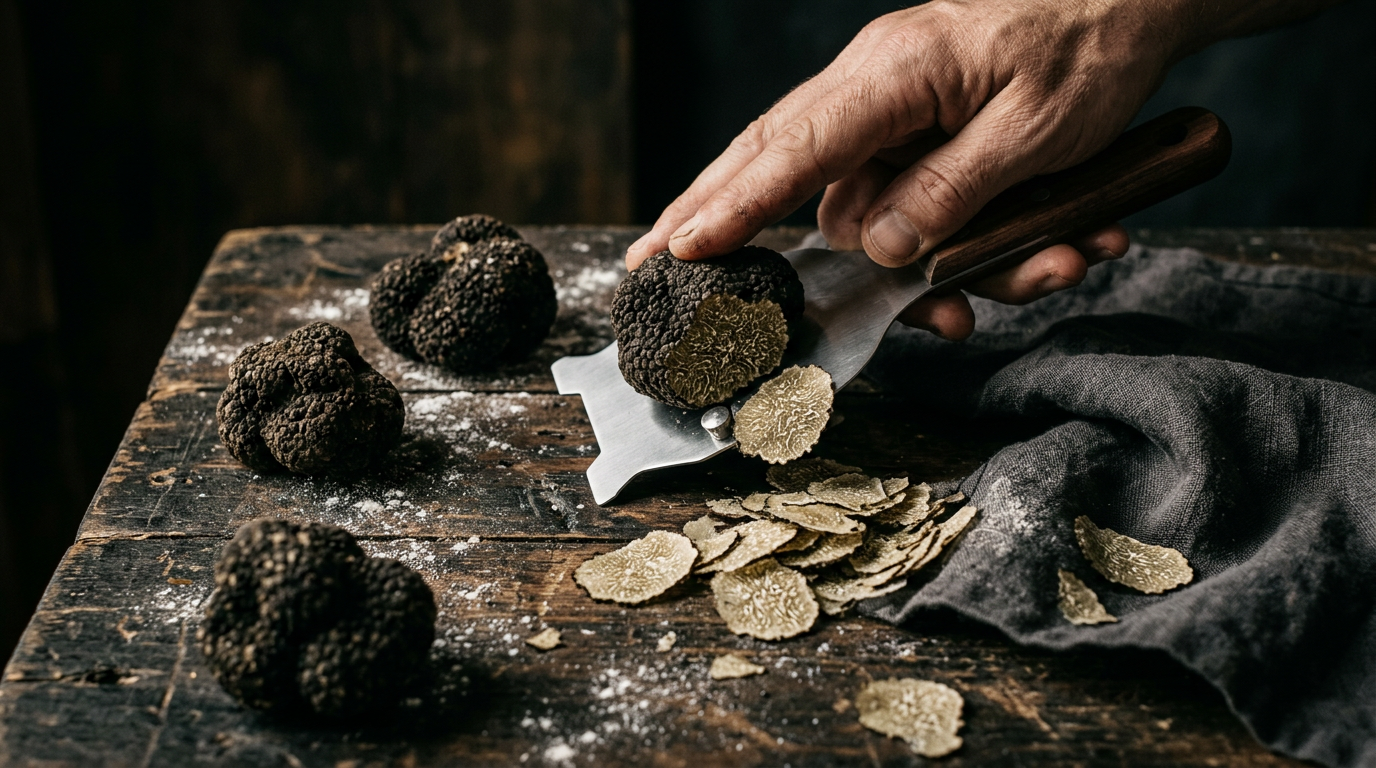
    Fresh black truffles and shaved truffle slices on a dark wooden table in dramatic light

    Truffle oil may be the most successful illusion in the modern pantry. It sits on the shelf at a luxurious price, wearing a photograph of a black truffle, promising the most coveted aroma in gastronomy for twenty dollars. And in the great majority of bottles, no truffle was ever involved. As people who make our living pressing real olives into real oil, we have a professional interest in what happens when an ingredient’s name and its contents part ways. Here is the honest story.

    What is actually in most truffle oil

    The dominant aroma of white truffle can be imitated by a single synthetic molecule — 2,4-dithiapentane — produced in a laboratory for a fraction of the cost of the fungus itself. Most commercial truffle oils are exactly that: a neutral base oil (often refined olive oil, sunflower or grapeseed) dosed with the synthetic aroma compound, sometimes with a fleck of dehydrated truffle added so the label can mention the real thing. The ingredient list gives it away: “truffle aroma,” “truffle flavor,” or simply “aroma” means the perfume came from a flask, not a forest. This is legal, and it is everywhere — including in some very expensive restaurants.

    Why chefs turned against it

    Real truffle is subtle, earthy, layered — and fades within days of being dug up. The synthetic compound is loud, persistent, and one-dimensional, which is precisely why many serious chefs have banned truffle oil from their kitchens. Once you have smelled fresh truffle next to the artificial version, the difference is unmistakable: one is a place and a season; the other is a single note played at full volume. The parallel with olive oil is exact. A refined, deodorized oil dressed up with additives can imitate the idea of the real thing, but it cannot imitate the experience — something we explore in what makes quality olive oil.

    How to read a truffle oil label

    The three questions that expose the bottle

    First: does the ingredient list say truffle, or “truffle aroma”? Only actual pieces of tuber — named, ideally by species — mean truffle was present. Second: what is the base oil? A producer proud of the base names it; “vegetable oil” or unspecified “olive oil” usually means the cheapest refined liquid available. Third: is there a harvest or production date? Both truffles and olive oil are fresh products; an undated bottle of either is a bottle with something to skip. These are the same habits of label-reading we teach in our guide to choosing olive oil — the aisle changes, the detective work doesn’t.

    The honest alternative: let a great oil be the luxury

    Here is the quiet irony. The role people want truffle oil to play — a finishing flourish that makes a plate of pasta or eggs feel expensive — is a role a genuinely great extra virgin olive oil already performs, honestly. A fresh, high-polyphenol oil from a single estate brings aroma that no laboratory produced: cut grass, artichoke, green tomato, black pepper. Drizzled over the same risotto or scrambled eggs, it does what the synthetic bottle only gestures at — it adds a place and a harvest to the plate. Our tasting notes and pairings show how far one true bottle can carry a kitchen.

    If you love real truffle, buy real truffle in season and shave it yourself — it is worth every cent. And if what you want is that everyday feeling of luxury from a bottle, choose an oil made by people who put the grove, the harvest date and their name on the label. That is the entire philosophy behind our single-estate oils: no shortcuts, no aromas from a flask — just the fruit, pressed fresh, telling the truth.