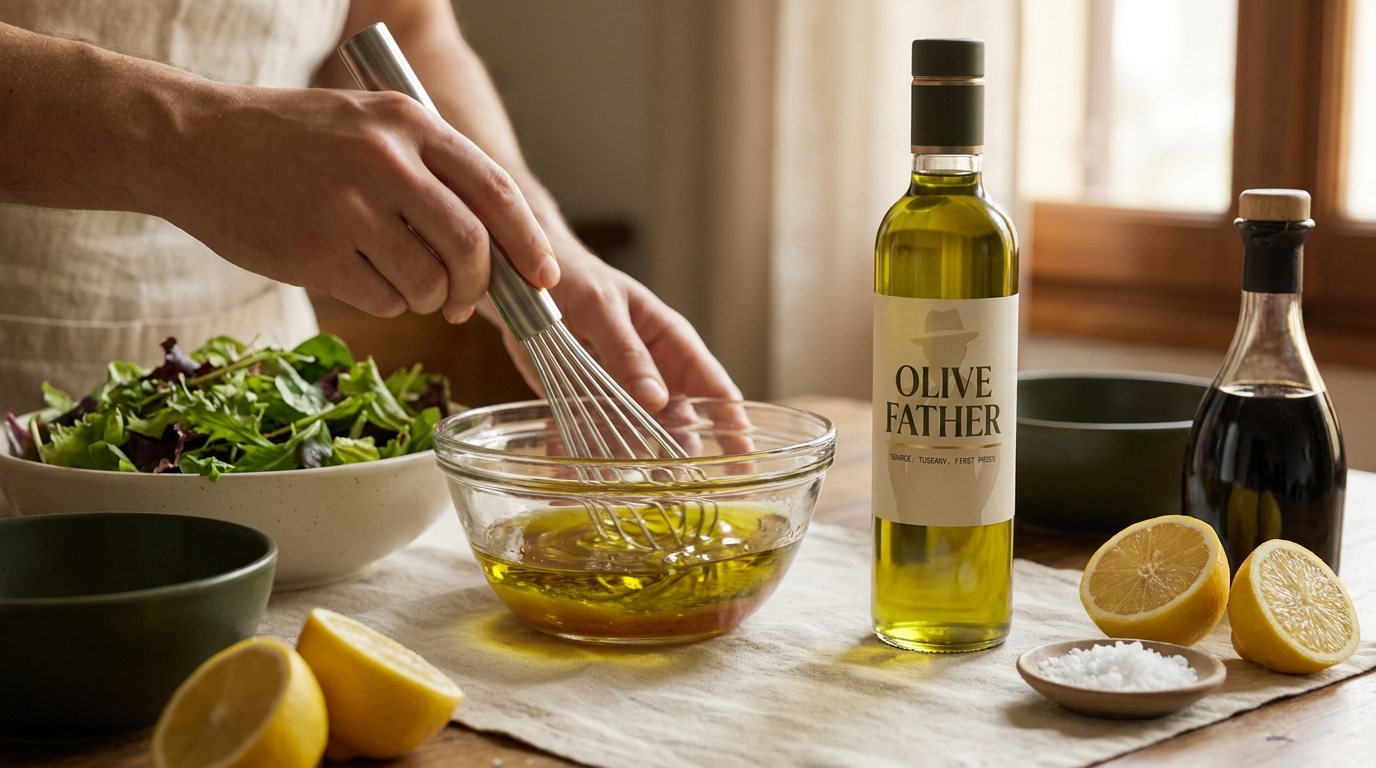
Mayonnaise is one of the great kitchen magic tricks: a single egg yolk persuading a cup of oil to become something thick, pale and spoonable. It is also, by weight, about eighty percent oil — which makes it one of the most revealing things you can do with a bottle. Made with a fresh extra virgin olive oil it tastes green, rich and faintly peppery, and turns a plate of boiled potatoes or a piece of poached fish into a meal. Made with a tired one, it tastes exactly like a tired one, only more so.
Here is how we make it at home in Calabria, the two mistakes that make people swear off olive oil mayonnaise forever, and a short, unsentimental look at what is actually inside the supermarket jar with the olive branch on the label.
What mayonnaise actually is
An emulsion: millions of tiny oil droplets suspended in a small amount of water, held apart by the lecithin in egg yolk. The yolk is the emulsifier, the acid — lemon juice or vinegar — supplies the water phase and the brightness, and the oil supplies almost everything else: body, richness and flavor. One yolk can comfortably hold 150 to 200 milliliters of oil. Push far past that and the emulsion runs out of yolk and breaks.
Because there is so much oil and nothing is cooked, the oil’s character arrives on the spoon intact — bitterness, pepper, grass and all. That is the whole promise of olive oil mayonnaise, and it is also the trap.
The recipe, by hand
Makes about a cup. Everything should be at room temperature — a cold yolk and cold oil are the most common reason a mayonnaise refuses to come together.
- 1 large egg yolk, as fresh as you can find (or from a pasteurized egg)
- 1 teaspoon fresh lemon juice, plus more to finish
- A generous pinch of fine sea salt
- 175 ml (about ¾ cup) extra virgin olive oil — see the note on choosing it below
- Optional: ½ teaspoon Dijon mustard, which helps the emulsion hold but is not Italian
Set a bowl on a damp cloth so it does not skate around. Whisk the yolk with the salt and lemon juice for thirty seconds until it lightens slightly. Now add the oil drop by drop — truly drop by drop for the first two tablespoons — whisking without pause. This is the stage where the emulsion is born, and hurrying it is the second most common reason for failure. Once the mixture visibly thickens and turns glossy, you can move to a thin, steady stream, still whisking. When all the oil is in, it should stand in soft peaks. Taste, and adjust with lemon and salt. It will taste of the oil; that is correct.
Keep it refrigerated and use it within two days. It contains raw egg, so it is not for the very young, the elderly, the pregnant or the immunocompromised unless you have used pasteurized eggs.
If it breaks
Do not throw it away. Put a fresh yolk, or a teaspoon of warm water, in a clean bowl and whisk the broken mixture into it a spoonful at a time. It will come back.
Why olive oil mayonnaise turns bitter — and how to stop it
This is the complaint we hear most, and the reason many people conclude that olive oil is “wrong” for mayonnaise. It is not wrong; it is being handled wrong.
Extra virgin olive oil carries polyphenols — the compounds responsible for its bitterness and peppery finish, and for most of the health research around the oil. In a dressing they are a virtue. In an emulsion, two things can push them from pleasant to harsh:
- The blender. A food processor or immersion blender shears the oil into far smaller droplets than a whisk does and exposes vastly more of its surface to the water phase. The result is a mayonnaise that tastes noticeably more bitter than the oil that went into it. Whisk by hand and the same oil is rounder and gentler. If you must use a machine, use a mild oil, and keep the running time short.
- The wrong oil for the job. A fierce, early-harvest, high-polyphenol oil — glorious on grilled bread — makes an aggressive mayonnaise. Reach instead for a medium-fruity oil, or a slightly later-harvest one, and let it carry the dish rather than dominate it. Our tasting notes explain how to tell the two apart in the glass.
Some cooks split the difference and use half extra virgin, half a neutral oil. It works, and we will not pretend otherwise. But once the ratio slides much past that, you no longer have olive oil mayonnaise; you have plain mayonnaise with a memory of olives.
Aioli is not garlic mayonnaise
Worth saying, because American menus have blurred the two. True aioli — allioli in Catalonia, aioli in Provence — is an emulsion of garlic and olive oil only, pounded in a mortar with salt until the crushed garlic itself holds the oil. No egg. It is fiercely garlicky, pale gold, and difficult to make in any quantity, which is why most restaurant “aioli” is simply mayonnaise with garlic stirred in. That version is perfectly good. It just is not aioli, and it is worth knowing the difference when you order it.
What is really in the jar labeled “with olive oil”
Read the first ingredient
Walk down the condiment aisle and you will find several mayonnaises whose labels lean heavily on the words “olive oil,” often with a sprig of olives on the front. Turn the jar around. Ingredients are listed by weight, and in many of these products the first oil named is a refined seed oil — soybean or canola — with olive oil appearing further down the list, sometimes well behind water and vinegar. The phrase “made with olive oil” is true in the way that a room is “made with” a single brick.
Even where the olive oil is genuine, it is almost never extra virgin, for the simple reason that refined and blended oils are cheaper and blander and keep for a year on a shelf. Which means the thing you were paying extra for — the flavor and the polyphenols of a real extra virgin — is exactly the thing that was left out. We go through the same sleight of hand on the oil shelf on our page on why supermarket olive oil usually disappoints.
Choosing the oil
The rules are the ones we apply at our own mill. A stated harvest date within the last year. A named place and producer rather than a “blend of EU oils.” Dark glass or tin. And when you taste it on its own, a clean fruitiness with some bitterness and pepper — an oil that is still alive, but a medium rather than a monster. Our Classic extra virgin was pressed for exactly this kind of everyday work: round, fresh and honest, single-source from one Calabrian grove, and gentle enough to whisk into a mayonnaise that tastes of olives rather than argues with them.
Five minutes, one yolk, one decision
You do not need the jar. You need a bowl, a whisk, a fresh egg and an oil worth being four-fifths of the result. Choose it the way you would choose the main ingredient, because in this recipe it is. Explore our single-estate extra virgin olive oils — one harvest, dated, nothing blended — and make the mayonnaise the supermarket only promised.
Leave a Reply