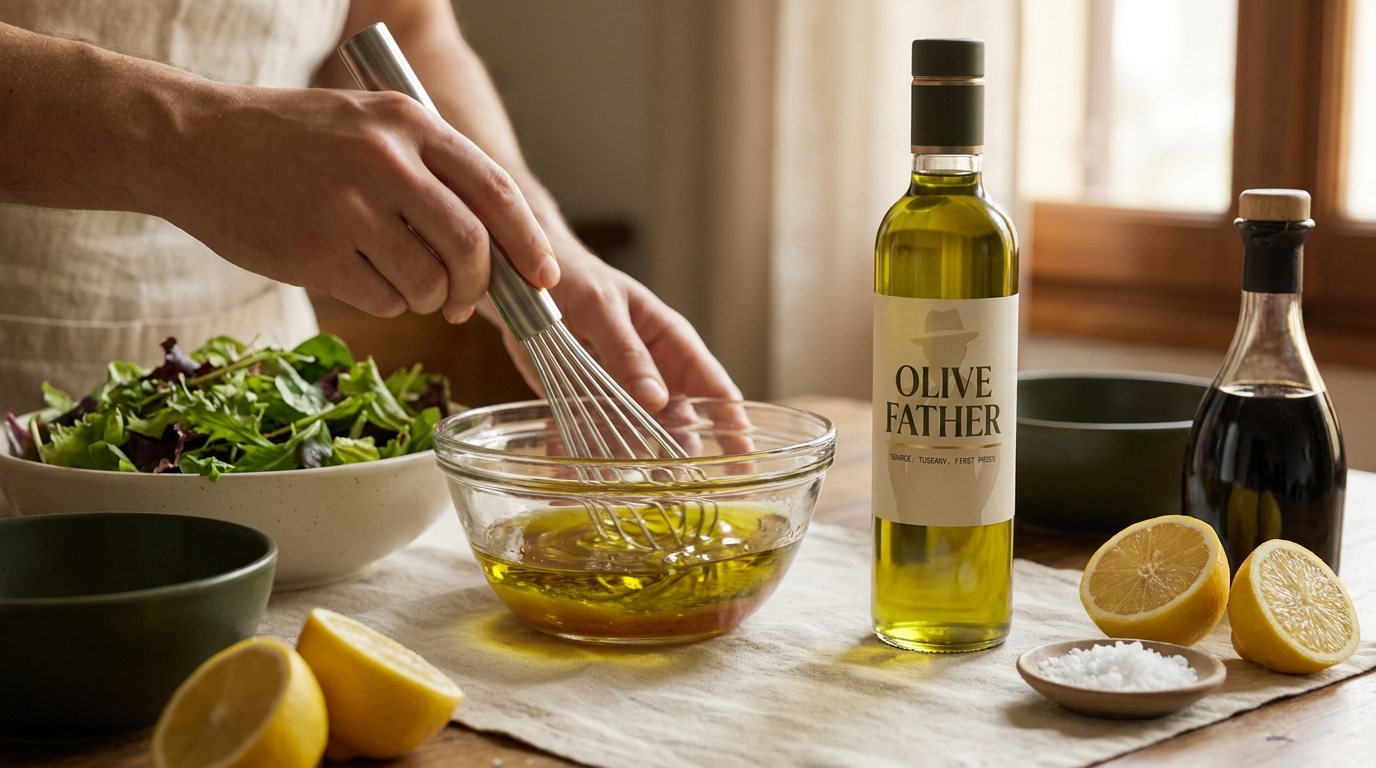
Walk down the dressing aisle of any American supermarket and you will find fifty bottles of something that never needed to be invented. Emulsifiers, gums, sugar, “vegetable oil blend,” and a shelf life measured in years — all to replace a preparation that takes ninety seconds and three ingredients. A real olive oil salad dressing is one of the oldest recipes in the world, and it is barely a recipe at all. It is a ratio, a pinch of salt, and one decision that determines everything: which oil you pour.
The master ratio: three to one
Every classic vinaigrette begins with the same proportion: three parts extra virgin olive oil to one part acid, plus salt. The acid can be red wine vinegar, white wine vinegar, or fresh lemon juice. That is the entire foundation. From there:
- In a jar: add three tablespoons of olive oil, one of vinegar, a generous pinch of flaky salt, screw the lid on, and shake hard for ten seconds. The agitation breaks the oil into droplets and produces a briefly stable emulsion — cloudy, thick, and ready to pour.
- In a bowl: whisk the vinegar and salt first so the salt dissolves, then stream in the oil while whisking. Half a teaspoon of Dijon mustard, if you like it, acts as a natural emulsifier and holds the dressing together longer.
Taste it on a leaf, not a spoon — a leaf carries far less dressing, which is how it will actually be eaten. Adjust with a few drops of vinegar if it tastes flat, a little more oil if it bites too hard.
The Italian way: dress the salad, not the jar
It is worth knowing that in Italy, the vinaigrette itself is almost a foreign concept. An Italian salad is dressed in the bowl, at the table, in a strict order the old rule captures neatly: be a sage with the salt, a miser with the vinegar, and a spendthrift with the oil. Salt first, so it dissolves against the wet leaves; a restrained thread of vinegar; then olive oil, poured generously, and a final toss with your hands or two forks until every leaf shines. No jar, no whisk, no leftovers.
Both methods work. The jar gives you an emulsified, American-style vinaigrette; the Italian method gives you a brighter salad where you taste leaf, salt, and oil in sequence. What they share is the arithmetic: the dressing is roughly three-quarters olive oil. Which brings us to the part most recipes skip.
The oil is the recipe
A salad dressing is a raw preparation. Nothing is cooked, nothing is masked, and the oil is never diluted below seventy-five percent of the total. Whatever character your olive oil has — fresh-cut grass, green almond, that peppery catch at the back of the throat — arrives on the leaf intact. And whatever faults it has arrive intact too. A tired, refined, or blended supermarket oil produces exactly the dressing you would expect: greasy, flat, and vaguely stale. This is the quiet reason so many people think they dislike vinaigrette. They have only ever tasted it made with oil that was never worth eating raw.
The bitterness and pepper of a genuine extra virgin oil are not flaws to be softened — they are the polyphenols, the same compounds behind most of the oil’s health research, and in a dressing they do real culinary work. Bitterness balances sweet vegetables and fruit; pungency cuts through rich cheeses and cured meats; the acid ties it together. A robust oil against sweet tomatoes and burrata is not a recipe so much as a chord.
Choosing an oil worth pouring
For a dressing, apply the same tests we would apply at our own mill: a stated harvest date within the last year or so, a named place and producer rather than a “blend of EU oils,” dark glass, and — when you taste it — the bitterness and pepper of an oil that is still alive. A single-source oil tells you exactly whose standards you are eating. This is precisely what our own estate oils are pressed for: olives from one family’s groves in Calabria, milled cold within hours, bottled unblended, made to be poured raw.
Three dressings to know by heart
- Classic red wine vinaigrette: 3 tbsp olive oil, 1 tbsp red wine vinegar, pinch of salt, optional ½ tsp Dijon. For every leafy salad and most grain bowls.
- Lemon and oil: 3 tbsp olive oil, juice of half a lemon, salt. The Mediterranean default for fish, avocado, fennel, and bitter greens.
- Warm pan dressing: whisk a spoonful of pan juices from roasted vegetables or chicken with oil and vinegar for a dressing that seasons the whole plate.
Ninety seconds, three ingredients, one decision
You do not need the dressing aisle. You need a ratio you can remember, salt you can pinch, and an olive oil good enough to carry three-quarters of every bite. Choose the oil the way you would choose the main ingredient — because in this dish, it is. Explore our single-estate extra virgin olive oils, pressed from one harvest and dated so you know exactly how alive they are, and taste what a salad has been trying to tell you all along.
Leave a Reply