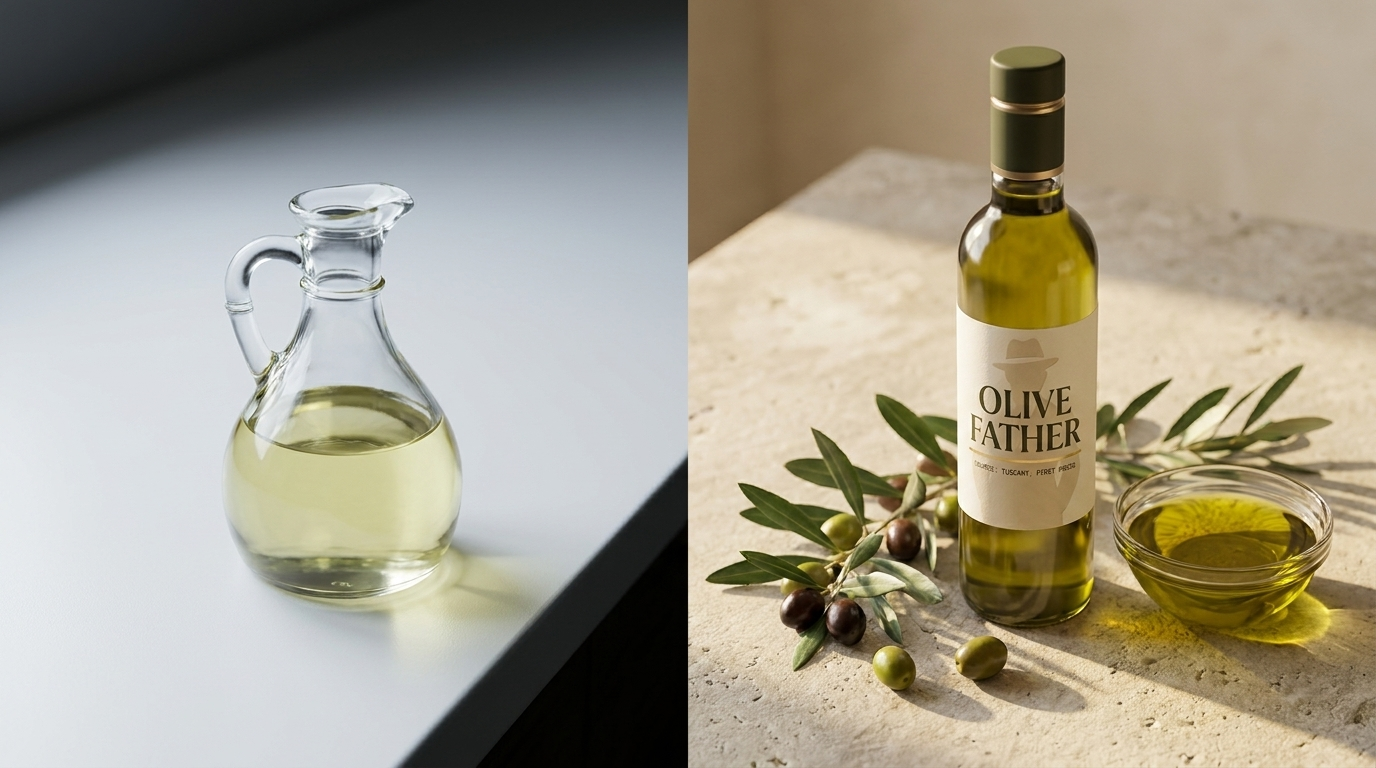
Stand them side by side and they look like cousins: two bottles of golden cooking fat. But olive oil and vegetable oil are not two versions of the same thing. One is a juice, pressed from a fresh fruit and bottled with its character intact. The other is an industrial product, extracted and refined until almost nothing of the original seed remains. Understanding that difference changes how you shop, how you cook, and how your food tastes.
How each one is actually made
Extra virgin olive oil: pressed, not processed
Real extra virgin olive oil is made the way it has been made for millennia, with better machinery: olives are picked, crushed, and the oil is separated mechanically at low temperature — no heat treatment, no chemistry. What lands in the bottle is essentially fresh fruit juice. That is why a genuine oil tastes of something: grass, artichoke, green tomato, a peppery catch at the back of the throat. We walk through every step of our own process in From Grove to Bottle.
Vegetable oil: extracted and refined
“Vegetable oil” is usually soybean, canola, sunflower, corn, or a blend. The seeds hold their oil tightly, so industry gets it out with heat and, in most large-scale production, a solvent — typically hexane. The crude oil that results is not pleasant to eat, so it is then refined, bleached, and deodorized: degummed, treated to strip color, and steamed at high temperature until it is pale, neutral, and stable. That process is precisely the point. The goal is an oil with no flavor, no aroma, and no personality — a blank cooking medium.
What refining takes away
Neutrality has a cost. The refining that makes vegetable oil bland also strips out most of the minor compounds that make a fat interesting — the aromatics, the pigments, and the natural antioxidants. Extra virgin olive oil, because it is never refined, keeps its polyphenols: the bitter, peppery compounds that protect the oil in the bottle and are central to why olive oil holds the place it does in Mediterranean eating. A refined oil is calories with a neutral face. A great extra virgin is an ingredient.
There is also a category difference worth naming: olive oil is a fruit oil, not a seed oil. It comes from the flesh of a fresh fruit and can be consumed exactly as it leaves the press. We covered that distinction in depth in Is Olive Oil a Seed Oil?
In the pan: heat, flavor, and the smoke point myth
The standard argument for vegetable oil is heat tolerance. It is weaker than it sounds. A fresh, low-acidity extra virgin olive oil has a smoke point comfortably above the temperatures of everyday sautéing and roasting, and its natural antioxidants help it resist breakdown while it is hot. Meanwhile, everything you cook in it picks up flavor instead of nothing. For deep frying at very high temperatures in large volumes, a neutral oil is a defensible economic choice — but for the daily pan, the “you can’t cook with olive oil” rule belongs to marketing, not chemistry.
Why the price gap is honest
Vegetable oil is cheap because it is engineered to be cheap: commodity seeds, solvent extraction, continuous refining, global scale. Real extra virgin olive oil is expensive for the opposite reason — it is agriculture, not industry. Trees must be tended all year for one harvest, picked at the right moment, and milled within hours. When an “olive oil” is priced like a vegetable oil, the label deserves your suspicion, a problem we explore in Why Not Supermarket Oil.
How to choose, honestly
If you want one everyday fat that improves nearly everything it touches, choose a real extra virgin olive oil: look for a harvest date, a named origin, and the measurable standards we describe in What Makes Quality Olive Oil. Keep a neutral oil around for the rare jobs that truly need one, and let the olive oil do the daily work — the eggs, the vegetables, the pasta, the finishing pour.
Taste the difference a single grove makes. Olive Father is a single-source Italian extra virgin olive oil — grown, pressed, and bottled by one family in Calabria, traceable to the tree. Explore the range and put a fruit juice, not a factory product, on your table.
Leave a Reply